Pages

Showing posts with label eucharistic adoration. Show all posts

Friday, August 7, 2015

When younger priests won't kneel

I am suffering from arthritis and I know the pain.

But you have just got to push through with that effort to show how much you love this Person.  And so you bend it, even though it cracks, even though it is painful.

You just have to do it.

Why?

Because it is the right thing to do.

Because it is the proper thing to do.

Because I want to show this as an example to the younger generations.

Because it is how I show my love for Him.

Make this viral!


You see younger ones who would not serve the Mass if it were not a celebrity cleric celebrating.

Or if the wedding is not Marian Rivera and Dingdong Dantes.

Or the baptism, confirmation and first communion does not involve Liza Soberano.

And you see younger ones who don't even kneel.

You know who you are.

In fact they teach it seminaries, convents and schools of liturgy.

Proof of it is that you see it on TV every week.  And everyday in parishes.

Nakakahiya.

Annibale Bugnini, the master architect of the New Mass, took out almost all of the genuflections of the Mass even though it was not mandated by the Council Fathers or Sacrosanctum Concilium.

When he was assigned to Iran as pro-nuncio, it was then that the ruthless Ayatollah Khomeini took power and so a theocracy ruled the country.  The Ayatollah summoned the members of the diplomatic corps into his presence and made them kneel down to him as a pledge of obedience.  Among those in the presence of the Ayatollah was Bugnini. He knelt.

When news of this event reached Rome, members of the Curia, in traditional Italian fashion, joked that Bugnini in Iran was doing all the genuflections he had removed from the Mass.

So the next time you are in the presence of Christ, in the church, during Mass, during the exposition and Benediction of the Blessed Sacrament, inside a Eucharistic Adoration chapel.............KNEEL!


NOT THAT ONE!!! (those who are into the Christopher Reeves Superman would know this.)

These ones!


Do it before the opportunity is FORCED upon you.


Wednesday, December 10, 2014

Innovations and Traditions: Christ the King Eucharistic Procession redux!

So if you do not have any degree in Theology and Liturgy, you don't have any right to speak up.

Like if you do not have any law degree, you cannot talk about your rights under the law.

Right.

Makes you wonder why some individuals would rather defend their procession of an image of Christ the King instead of a procession with the Blessed Sacrament.

(You have this inkling that they are the ones behind this, eh?  Or your typical anti-TPC readers.  Maybe Nuknuk got touche here.  HA HA)

Let's turn the tables.

Show me an example that processing with an image of Christ the King is done as part of Church Tradition?

Put it this way.

You don't do the Sinulog with the Blessed Sacrament.

I would be against it.

It was always done with the Sto. Niño image so do it like how our forefathers did it.

So?

Why have a Christ the King procession without the Blessed Sacrament?

An image cannot replace Christ Himself.

And since they ask for Church LAW:

104. Eucharistic processions should be arranged in accordance with local customs in regard to the decoration of the streets and the order followed by the participants. In the course of the procession there may be stations where the eucharistic blessing is given, if there is such a custom and some pastoral advantage recommends it. Songs and prayers should be planned with the purpose of expressing the faith of the participants and the centering of their attention on the Lord alone.
(Eucharistiae Sacramentum)

Next challenge!

Show me a photograph to prove that Christ the King processions with an image instead of the Blessed Sacrament is THE tradition and NOT an innovation.


Digital Photograph - Eucharistic Procession, Feast of Christ the King, Convent of the Little Sisters of the Poor, Northcote, 1959

This photo is from this source.

Thursday, June 19, 2014

How important is the Mass to you?

Sabi ni Padre Pio, mas makaka-survive daw ang mundo ng walang araw kaysa walang Misa.

Ikaw, gano kahalaga sa iyo ang Misa? Handa ka ba mamatay para makadalo lang sa isang Misa? Handa ka ba makulong, o mabugbog?

O kaya handa ka ba magising ng maaga para dumating bago ang Misa? O kaya naman handa ka bang magbihis ng pormal at maayos para sa pagdalo sa Misa?


This blog has been criticized and ridiculed because it advocates proper and correct Liturgy.

To the readers of this blog, it's not about me or you or us, or him, or them. It's about what our Lord deserves in the Mass.

Thursday, October 10, 2013

BRAZEN THEFT OF THE BLESSED SACRAMENT!!!


Nah. His name is not Robby Okol.

Here is the transcript of the video

***

It was a brazen, and blasphemous crime. A Catholic community in northern New Mexico is beside itself after a man burst into the adoration chapel at Sacred Heart of Jesus Catholic Church, and stole something very precious to them.

The priest at Sacred Heart told News 13 this is the highest form of desecration he's seen. He made a plea to the burglar Tuesday afternoon before police arrested the suspect.

It's meant for prayer, a place of peace, open 24/7. So, when a man walked into the adoration chapel at the Sacred Heart Catholic Church in Española on Monday afternoon, the two people in there praying couldn't believe what he did.

"There is something so precious to us as Catholics that he has taken, and that is the Eucharist," explained Father Vitus Ezeiruaku, of the Sacred Heart Catholic Church.

The suspect police later identified as Isaac Morfin, made a b-line for the monstrance, which holds the Eucharist, then ran out the door, dropping part of it in the parking lot.

"We believe that Jesus is holy and entire in humanity and divinity, present in the holy Eucharist," explained Father Ezeiruaku. "So it means everything to us."

Detective  Solomon Romero of the Española Police Department said, ""We do believe that this individual may have been inside the chapel the day before, maybe looking at it or coming up with some sort of plan."

One worshiper followed the suspect around the corner, but the suspect got away.

Parishioners have had a hard time dealing with the crime.

"It is not just the Catholic Church alone, but this entire community, not just the parish alone, but the entire community, who see this as a place of refuge," explained Father Ezeiruaku.

"It's a small community, it's predominantly Catholic, it's extremely upsetting," added Detective Romero.

On Tuesday afternoon, police conducted a search warrant, and arrested 39-year-old Morfin for burglary and larceny.

"What he did is more than what he thinks, because he has touched the center of our belief, the center of our worship," said Ezeiruaku.

Before the arrest, the priest made a plea to the burglar.

"If he can find it in his heart to consider this community in pain and bring back what he has taken, I believe God's mercy follows him, and he will know the peace of God that he gives to those who say, Lord I am sorry."

Española police told News 13 late Tuesday afternoon the stolen monstrance and the Eucharist were recovered at Morfin's home. The monstrance suffered minor damage.
   
It's still unclear what the motive was for stealing it. Online court records show Morfin has a criminal record dating back more than a decade. The church had mass at 4 p.m. and a mass of atonement at 5:30 Tuesday. [That is done after a desecration had been done.  Before the liturgical revolt, public penance and atonement was REALLLY an act of penance and atonement for the entire parish.  But now.  Well....kumbaya!]

The Eucharist will be put back and the adoration chapel is still open.

***

See the wisdom why there were communion rails before?


And even though Vatican II did not mandate the destruction or removal of altar rails, they were removed for no apparent reason at all!  All in the name of modernity and the alleged spirit of Vatican II!

Again...contributing to the loss of the sense of the sacred.

I hope the church does something drastic to prevent this theft, life putting the monstrance behind iron grates or glass doors, etc.  This has been done here in some adoration chapels in the Philippines.

If this guy is a Catholic, then he must make to face a church tribunal for his crime.

But......will the OTHER guy who took home the Eucharist be disciplined by the Church?

Still waiting.

Wednesday, October 9, 2013

The Blessed Sacrament: if we only knew the great treasure we have


A new book by my favorite bishop on the Eucharist emphasizes the need to be aware of the great mystery and treasure we have right in front of us, in the tabernacle.  If we only knew, then we would behave properly.


***

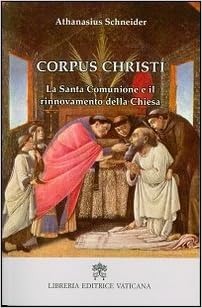
Vatican City, Oct 8, 2013 / 04:39 am (CNA/EWTN News).- Bishop Athanasius Schneider has recently published his second book on Eucharistic devotion in the hopes that it will foster greater reverence for the sacrament amongst the faithful of his diocese.

It is necessary to give a good catechism on what the Eucharist is because we have to be aware of it. Jesus said to the Samaritan woman 'if you knew the gift of God,'” the bishop said in a Sept. 27 interview with CNA.  [I believe this to be so.  I can see why people have lost the awe and reverence to the Eucharist because of our pastors dismal failure to catechize the laity after the "new Pentecost" promised by the Council. Not!]

Bishop Schneider, whose most recent book “Corpus Christi - Holy Communion and the Renewal of the Church” was published earlier this year, is the auxiliary bishop of Kazakhstan in Central Asia – a country whose religious population is roughly seventy percent Muslim, and thirty percent Christian.

During the interview, the bishop expressed the great need to be more reverent in the way that the Eucharist is treated, explaining that the aim of both of his books is to increase respect of the Sacrament, especially amongst the faithful in his diocese.
Bishop Schneider distributing Holy Communion...the BEST WAY! (Photo courtesy of Orbis Catholicus Secundus)
If people only knew the greatness of the Eucharist. We have to stress its greatness in  homilies and in catechism,” he said.  [if priests only knew the great work they do...]

When I recognize all the richness and deepness and divinity of the Eucharist of the Lamb of God, before whom the angels prostrate themselves in heaven – as we read in the Apocalypse – then I also have this spontaneous, natural desire to prostrate myself when I receive Him. [FTW!!!!  But with that we instead do this...click here.]

The bishop voiced his perspective that the Eucharist ought to be received in the mouth only, explaining that the tradition of receiving the Host in one’s hand “never existed in the Church,” and was “was invented by Calvinists in the seventeenth century,” but was not present in the first centuries.  [Communion in the hand is an invention as a statement of disbelief and therefore of disrespect!]

There was communion received in the hand but in a totally different manner and I explain this in my second book (Corpus Christi).

Referencing the lack of true devotion present in the attitudes of many in the presence of the Blessed Sacrament, Bishop Schneider urged that “only when we try to cure this wound of the Eucharist, only then we will have a real and stable renewal of the Church. A springtime.


***

The "super-dogma" Sacrosanctum Concilium called the Eucharist the "summit and source of christian life".

If that is so, then why we still have liturgical nonsense happening every Sunday and every Fiesta?

Why we still have the circus every Sunday live on TV?

I think we should all watch this.


Take note.

At the 13:56 mark, the great bishop called them "infidels".

So much for ecumenical mushy kumbaya politically correct language, no?

Ha!

And so since we are aware of the Sense of the Sacred, we have this at our Sunday Mass, regularly.

Hit it Fr. Mario!


Check out the batallion of EMHCs.


And the regular Sunday Tambourine Dancers.

Classy!

WE HAVE LOST RESPECT FOR THE HOLY OF HOLIES!

Thursday, June 6, 2013

From St. Peter's in Rome to St. Petersburg in Russia! This is why atheism is going gaga!


Europe is slowly fighting back to trace it's Christian roots!

Now, next is to intensify Eucharistic adoration, rid all types of liturgical abuse, promote the TLM and reverent celebration of the OF Mass, and dump all sexual abusers!!!


Tuesday, June 4, 2013

Corpus Christi around the world

Aside from this powerful image...


I have found this wonderful photo slide of the different traditions by different cultures around the world!


NOW THAT IS HOW INCULTURATION IS DONE!!!

Not how Fr. Chupungco or Fr. Diwa or their minions teach it!

By playing with the Mass!

Monday, June 3, 2013

This is how they "honor" the Blessed Sacrament!


From a Facebook reader and GULP member...

Thank you!

Keep snapping those photos...ED

***

Can you see "where they have taken the Lord"?

There at the right side of the altar when you can perfectly see that the beautiful retablo can house the tabernacle and even the image of the Holy Spirit.

There is still space!

Look at what is at the left side of the altar?

A niche in the retablo where the open Bible is "enthroned".

Wow!

They have just equaled the presence of Christ in the written word with His Presence in the Holy Eucharist!

It's like saying...

You're blog post, or your FB wall status, or your text message, or your email....is just as equal as to your ACTUAL PRESENCE.

That is faith in the Blessed Sacrament dear folks!

Sad to see this.  And your usual suspects?

Priests who purport to be interpreting the documents of Vatican II.

Priests who purport to give the Lord the better treatment he deserves before Vatican II, the tabernacle is "buried" in that altar of a "hodge podge" you cannot see where the tabernacle is and you cannot give Him the honor he deserves.

Like in this altar!


Yeah.  They don't like this kind of a sanctuary.

They prefer this kind.  Ugh!


Liturgists like Fr. Geny Diwa are your usual suspects for such treatment to the Blessed Sacrament.

Yes, Fr. Diwa!

We accuse you of failing in your duties!

Tell me...

How can placing the tabernacle with the Blessed Lord inside be a sign of Eucharistic adoration and devotion?

The Bible is the same as the Blessed Sacrament?  Really?

So much for the "source and summit of Christian life", eh?

Monday, November 26, 2012

A scene during the Christ the King Eucharistic Procession


The Blessed Sacrament passed by in front of her small store.

This woman knows what she is doing......."and it cannot be taken away from her."

Blessed are the pure of heart, for theirs is the Kingdom of God!

Do the proper things at the proper time, properly!

When the time comes when you call upon the Lord, He will recognize you for what you actually did.

This woman has sought and found the Kingdom of God.

This is true riches!

Thursday, June 14, 2012

The best way to celebrate Corpus Christi

I am not saying it is the only way.  I am saying that it is probably the best way to show your love of Christ and giving him public honor.

It is always done in Rome.


And also here, albeit quite rarely, in the Philippines.


Thank the Lord for this!

Photo credits from Sense of the Sacred of Rev. Fr. Jojo Zerrudo of the Diocese of Cubao.


Sung TLM.  Yup.  That little kid is serving because as haters of the TLM say, the kid does not understand Latin and does not understand what is going on. Try talking to that kid and you'll be surprised.

So, who is the one who does not understand, eh?

As the saying in Tagalog goes:

"Kung gusto hahanapan ng paraan.  Kung ayaw, hahanapan ng dahilan."


Street procession of the Blessed Sacrament.  Yeah, Fr. Zerrudo is just following liturgical laws.  Why would your parish priest not do this?

Hmmm...let me answer that.

LAZY!

The procession of the Blessed Sacrament outside of the church or chapel happens only twice a year:  Corpus Christi and Christ the King.

Only two.  And your friendly neighborhood TV Mass priest would not dare have it.

Guess airtime is too short for him, eh?  But not the SOBRE!

Ha!


The procession goes back to the church patio where the Benediction was done.


This is how you promote religious fervor among the faithful!

If you don't hold processions, how do you expect people to develop that love and devotion to the Mass and the Eucharist?  By your jokes in your homily?  By singing and dancing at Mass?  By asking them to clap at the end of a lousy, empty homily?


This is the right way to do it!

And this one is the way to sure failure!


KSPs............

I bet that this Willie Revillame priest did not have a Corpus Christi procession.

Monday, June 11, 2012

The Saints about the Most Holy Sacrament


"If we but paused for a moment to consider attentively what takes place in this Sacrament, I am sure that the thought of Christ's love for us would transform the coldness of our hearts into a fire of love and gratitude."

- St. Angela of Foligno


"Christ held Himself in His hands when He gave His Body to His disciples saying: 'This is My Body.' No one partakes of this Flesh before he has adored it."

- St. Augustine


"Recognize in this bread what hung on the cross, and in this chalice what flowed from His side... whatever was in many and varied ways announced beforehand in the sacrifices of the Old Testament pertains to this one sacrifice which is revealed in the New Testament."

- from the writings of St. Augustine, Sermon 3, 2; circa A.D. 410 {original translation}


"O Lord, we cannot go to the pool of Siloe to which you sent the blind man. But we have the chalice of Your Precious Blood, filled with life and light. The purer we are, the more we receive."

- St. Ephraem


"When the bee has gathered the dew of heaven and the earth's sweetest nectar from the flowers, it turns it into honey, then hastens to its hive. In the same way, the priest, having taken from the altar the Son of God (who is as the dew from heaven, and true son of Mary, flower of our humanity), gives him to you as delicious food."

- St. Francis de Sales


"When you have received Him, stir up your heart to do Him homage; speak to Him about your spiritual life, gazing upon Him in your soul where He is present for your happiness; welcome Him as warmly as possible, and behave outwardly in such a way that your actions may give proof to all of His Presence."

- St. Francis de Sales


"What wonderful majesty! What stupendous condescension! O sublime humility! That the Lord of the whole universe, God and the Son of God, should humble Himself like this under the form of a little bread, for our salvation"

"...In this world I cannot see the Most High Son of God with my own eyes, except for His Most Holy Body and Blood."

- St. Francis of Assisi

****

and you just receive Him by hand?

Goodness me.

Tuesday, September 13, 2011

Words of Wisdom: Pope Benedict XVI on Eucharistic Spirituality

The 2,000-year history of the Church is studded with men and women saints whose life is an eloquent sign of how in fact from communion with the Lord, from the Eucharist a new and intense assumption of responsibility is born at all levels of community life; born hence is a positive social development, which has the person at the center, especially the poor, the sick and the straitened.
To be nourished by Christ is the way not to remain foreign and indifferent to the fortunes of our brothers, but to enter into the very logic of love and of gift of the sacrifice of the Cross; he who is able to kneel before the Eucharist, who receives the Lord's body cannot fail to be attentive, in the ordinary course of the days, to situations unworthy of man, and is able to bend down personally to attend to need, is able to break his bread with the hungry, share water with the thirsty, clothe the naked, visit the sick and imprisoned (cf. Matthew 25:34-36).
He will be able to see in every person the Lord who did not hesitate to give the whole of himself for us and for our salvation. Hence, a Eucharistic spirituality is a real antidote to individualism and egoism that often characterize daily life, and leads to the rediscovery of gratuitousness, the centrality of relationships, beginning with the family, with a particular care for binding the wounds of the broken.
A Eucharistic spirituality is the soul of an ecclesial community that overcomes divisions and oppositions and appreciates the diversity of charisms and ministries putting them at the service of the unity of the Church, of her vitality and of her mission.
A Eucharistic spirituality is a way to restore dignity to man's days and, hence, to his work, in the quest for reconciliation with the times of celebration and the family and in the commitment to surmount the uncertainty of precariousness and the problem of unemployment.
A Eucharistic spirituality will also help us to approach the different forms of human fragility conscious that they do not obfuscate the value of the person, but require closeness, acceptance and help. Drawn from the Bread of life will be the vigor of a renewed educational capacity, attentive to witnessing the fundamental values of life, of learning, of the spiritual and cultural patrimony; its vitality will make us inhabit the city of men with the willingness to spend ourselves on the horizon of the common good for the building of a more equitable and fraternal society.

From the Pope's Homily at the close of the Eucharistic Congress

Friday, June 24, 2011

The Dogma of the Real Presence


"I believe, I believe, I believe and profess to the last breath that this is the body and the blood of our Lord God and Saviour Jesus Christ, which he took from our Lady, the holy and immaculate Virgin Mary, the Mother of God."  
- Ethiopic liturgy


"We believe the Lord Jesus Christ to be present, not typically, nor figuratively, nor by superabundant grace, as in the other Mysteries, … but truly and really, so that after the consecration of the bread and of the wine, the bread is transmuted, transubstantiated, converted and transformed into the true Body Itself of the Lord, Which was born in Bethlehem of the ever-Virgin Mary, was baptised in the Jordan, suffered, was buried, rose again, was received up, sitteth at the right hand of the God and Father, and is to come again in the clouds of Heaven; and the wine is converted and transubstantiated into the true Blood Itself of the Lord, Which, as He hung upon the Cross, was poured out for the life of the world."
- Eastern Orthodox Church Synod of Jerusalem


"Hail, true body, born of Mary Virgin, and which truly suffered and was immolated on the cross for mankind!"
 -  Catholic Hymn  "Ave verum"

"by the consecration of the bread and of the wine, a conversion is made of the whole substance of the bread into the substance of the body of Christ our Lord, and of the whole substance of the wine into the substance of His blood; which conversion is, by the holy Catholic Church, suitably and properly called Transubstantiation"
- The Council of Trent's declaration to combat the heresy of Lutheranism


We believe that the Mass, celebrated by the priest representing the person of Christ by virtue of the power received through the Sacrament of Orders, and offered by him in the name of Christ and the members of His Mystical Body, is the sacrifice of Calvary rendered sacramentally present on our altars. We believe that as the bread and wine consecrated by the Lord at the Last Supper were changed into His body and His blood which were to be offered for us on the cross, likewise the bread and wine consecrated by the priest are changed into the body and blood of Christ enthroned gloriously in heaven, and we believe that the mysterious presence of the Lord, under what continues to appear to our senses as before, is a true, real and substantial presence.35

Christ cannot be thus present in this sacrament except by the change into His body of the reality itself of the bread and the change into His blood of the reality itself of the wine, leaving unchanged only the properties of the bread and wine which our senses perceive. This mysterious change is very appropriately called by the Church transubstantiation. Every theological explanation which seeks some understanding of this mystery must, in order to be in accord with Catholic faith, maintain that in the reality itself, independently of our mind, the bread and wine have ceased to exist after the Consecration, so that it is the adorable body and blood of the Lord Jesus that from then on are really before us under the sacramental species of bread and wine,36 as the Lord willed it, in order to give Himself to us as food and to associate us with the unity of His Mystical Body.37
The unique and indivisible existence of the Lord glorious in heaven is not multiplied, but is rendered present by the sacrament in the many places on earth where Mass is celebrated. And this existence remains present, after the sacrifice, in the Blessed Sacrament which is, in the tabernacle, the living heart of each of our churches. And it is our very sweet duty to honor and adore in the blessed Host which our eyes see, the Incarnate Word whom they cannot see, and who, without leaving heaven, is made present before us.
 - The Credo of the People of God, Pope Paul VI


PANGE LINGUA GLORIOSI
by St. Thomas Aquinas


Latin text An English translation

Pange, lingua, gloriosi
Corporis mysterium,
Sanguinisque pretiosi,
quem in mundi pretium
fructus ventris generosi
Rex effudit Gentium.
Nobis datus, nobis natus
ex intacta Virgine,
et in mundo conversatus,
sparso verbi semine,
sui moras incolatus
miro clausit ordine.
In supremae nocte coenae
recumbens cum fratribus
observata lege plene
cibis in legalibus,
cibum turbae duodenae
se dat suis manibus.
Verbum caro, panem verum
verbo carnem efficit:
fitque sanguis Christi merum,
et si sensus deficit,
ad firmandum cor sincerum
sola fides sufficit.
Tantum ergo Sacramentum
veneremur cernui:
et antiquum documentum
novo cedat ritui:
praestet fides supplementum
sensuum defectui.
Genitori, Genitoque
laus et jubilatio,
salus, honor, virtus quoque
sit et benedictio:
Procedenti ab utroque
compar sit laudatio.
Amen. Alleluia.

Sing, my tongue, the Savior's glory,
of His flesh the mystery sing;
of the Blood, all price exceeding,
shed by our immortal King,
destined, for the world's redemption,
from a noble womb to spring.
Of a pure and spotless Virgin
born for us on earth below,
He, as Man, with man conversing,
stayed, the seeds of truth to sow;
then He closed in solemn order
wondrously His life of woe.
On the night of that Last Supper,
seated with His chosen band,
He the Pascal victim eating,
first fulfills the Law's command;
then as Food to His Apostles
gives Himself with His own hand.
Word-made-Flesh, the bread of nature
by His word to Flesh He turns;
wine into His Blood He changes;
what though sense no change discerns?
Only be the heart in earnest,
faith her lesson quickly learns.
Down in adoration falling,
This great Sacrament we hail,
Over ancient forms of worship
Newer rites of grace prevail;
Faith will tell us Christ is present,
When our human senses fail.
To the everlasting Father,
And the Son who made us free
And the Spirit, God proceeding
From them Each eternally,
Be salvation, honor, blessing,
Might and endless majesty.
Amen. Alleluia.

The Associated Press needs a Catholic writer.

This is not a GULP joke.

This is for real.

The caption, I mean.

Emphasis mine.

***
Pope Benedict XVI, behind the Corpus Christ's relic, leads the Corpus Christi procession on an open vehicle from St. John in Lateran Basilica to St. Mary Major Basilica, in Rome, Thursday, June 23, 2006. The event is dedicated to the mystery of the Eucharist and concludes the cycle of feasts following Easter. Pope Benedict celebrated the evening Mass at St. John in Lateran Basilica then traveled a short distance in a procession to St. Mary Major Basilica.

***
or maybe a time keeper?  :)

***
UPDATE!!! AP Corrects itself!
CAPTION CORRECTION, CORRECTS YEAR IN CAPTION - Pope Benedict XVI, behind the Corpus Christ's relic, leads the Corpus Christi procession on an open vehicle from St. John in Lateran Basilica to St. Mary Major Basilica, in Rome, Thursday, June 23, 2011. The event is dedicated to the mystery of the Eucharist and concludes the cycle of feasts following Easter. Pope Benedict celebrated the evening Mass at St. John in Lateran Basilica then traveled a short distance in a procession to St. Mary Major Basilica.
***

But the report still says that the Eucharist is Christ's relic.

While liberals and dissenters might say "Yes, it is a relic of Christ because the true Christ lives in our hearts.  He is resurrected in our hearts."  Catholics who know their Catechism KNOW FOR A FACT that the Eucharist IS CHRIST HIMSELF... BODY, BLOOD, SOUL AND DIVINITY.

And not just a relic, a symbol, a representation...

That His Presence in the Eucharist begins at the words of consecration "Hoc est enim corpus meum..." and persists even after the celebration of the Mass, and as long as the appearance of bread remain.

And not like what we hear in theology schools nowadays that ;"We are Eucharist.  The presence of Christ remains in the Eucharist as long as we remain as a community."

Huh?!?!

Now you wonder why Catholics are pro-contraception and pro-divorce?!

They all begin down there!

Monday, April 4, 2011

Pope: The whole of our salvation rests on prayer

VATICAN CITY, MARCH 30, 2011 (Zenit.org).- Benedict XVI is reminding the faithful of the need for prayer, citing the teaching of an 18th century doctor of the Church who particularly encouraged visits to the Blessed Sacrament.The Pope dedicated his reflection at today's general audience to St. Alphonsus Liguori (1696-1787).

The saint was gifted with an exceptional intellect -- completing studies in canon and civil law by age 16 -- but also "a way of acting marked by gentle and meek goodness, which was born from his intense relationship with God, who is infinite Goodness."  [wow!  kids nowadays would have a closer relationship with their gadgets rather than Him!]

The Holy Father recalled how Alphonsus "insisted a lot on the need for prayer" as a condition for doing God's will and achieving holiness.

He cited the priest, who wrote, "God does not deny to anyone the grace of prayer, with which one obtains the help to overcome every concupiscence and every temptation. And I say, and repeat and will always repeat, for my entire life, that the whole of our salvation rests on prayer." [Remember the Gospel passage about the persistent widow and the judge in Luke?  That is how we sound and look like when we pray the Rosary and as Cardinal Sin once said "Storm Heaven with our prayers."  Persistence pays folks.  You do not get what you want just by saying that you paid your tithes and you belong to the One True Church from the Far East!  Oh...]

"Outstanding among the forms of prayer fervently recommended by St. Alphonsus is the visit to the Most Blessed Sacrament or, as we would say today, adoration -- brief or prolonged, personal or in community -- of the Eucharist," the Pope added. "'Certainly,' wrote Alphonsus, 'among all the devotions this one of adoration of the sacramental Jesus is the first after the sacraments, the dearest to God and the most useful to us. O, what a beautiful delight to be before an altar with faith and to present to him our needs, as a friend does to another friend with whom one has full confidence!'"

Benedict XVI recounted how Alphonsus had a very successful ministry among the poor of Naples, some of whom "often were dedicated to vices and carried out criminal activity."

He explained, "With patience he taught them to pray, encouraging them to improve their way of living. Alphonsus obtained great results: In the poorest quarters of the city, there were increasing groups of persons who gathered in the evening in private homes and shops, to pray and meditate on the Word of God, under the guidance of some catechists formed by Alphonsus and other priests, who regularly visited these groups of faithful. [...] [These meetings] were a real and proper source of moral education, of social healing, of reciprocal help among the poor: thefts, duels and prostitution virtually disappeared." [This is the right way to do prayer meetings!  With priests around who taught the Word of God.  Not the kind we see in BECs, BCCs, GKKs, Kapitbahayan...and all that jazz...where any Tom, Dick and Jane stands up and 'shares' his reflection on the Readings and sounds like he is doing a theological treatise.  Dangerous, folks!  That is how some Catholics I knew, drew away from the Faith and became Evangelicals.]

The Pontiff proposed that such meetings could be "a model of missionary action in which we can be inspired today as well, for a 'new evangelization,' particularly among the poorest." [I know some missionaries whose form of "evangelization" is to go on house visits and talk about...the latest episode of their favorite telenovela aka soap opera or have a toast with the boys.  Yup.  Evangelization does not involve the Gospel.  It is "just being with the poor".  Just being.  No Gospel.  Yup.  No joke.]

The Bishop of Rome concluded by emphasizing how Alphonsus taught that holiness is meant for everyone: "The religious as religious, the lay person as lay person, the priest as priest, the married as married, the merchant as merchant, the soldier as soldier, and so on."  [Like how St. Francis de Sales and St. Josemaria Escriva taught it!]

The Pope affirmed his gratitude to God, who "raises saints and doctors in different times and places who, speaking the same language, invite us to grow in faith and to live with love and joy our being Christians in the simple actions of every day, to walk on the path of holiness, on the path to God and to true joy."

***

One liturgist, who teaches liturgy at MST, told me once that the need to have the tabernacle put to the side, and any place else, like a separate chapel, other than the center of the sanctuary or on the Main Altar, is for the people not to be confused and the priest not to be turning his back of the Lord Who is in the Tabernacle.

Wha?!

And...he continued, (yup, he was not yet done.) to foster more devotion to the Eucharist so that the focus of the people during Mass is the sacred action being done on the Altar and that the people would not focus their attention on the Tabernacle.

Wha?!

Quite frankly, judging by how this priest/liturgist lives his life...and how I do not even see him visit the Adoration Chapel or spend more time in the private chapel in the Rectory....uhm...

NEXT TOPIC PLEEEAAASSSEEE!

***

Here are some beautiful quotes about the Eucharist from Blessed Teresa of Calcutta:

“It was not until 1973, when we began our daily Holy Hour that our community started to grow and blossom... In our congregation, we used to have adoration once a week for one hour, and then in 1973, we decided to have adoration one hour every day.  We have much work to do.  Our homes for the sick and dying destitute are full everywhere.  And from the time we started having adoration every day, our love for Jesus became more intimate, our love for each other more understanding, our love for the poor more compassionate, and we have double the number of vocations.  God has blessed us with many wonderful vocations. The time we spend in having our daily audience with God is the most precious part of the whole day.”

“When you look at the crucifix, you understand how much Jesus loved you. When you look at the Sacred Host you understand how much Jesus loves you now. This is why you should ask your parish priest to have Perpetual Adoration in your parish. I beg the Blessed Mother to touch the hearts of all parish priests that they may have Perpetual Eucharistic Adoration in their parishes, and that it may spread throughout the entire world.

“The time you spend with Jesus in the Blessed Sacrament is the best time you will spend on earth. Each moment that you spend with Jesus will deepen your union with Him and make your soul everlastingly more glorious and beautiful in Heaven, and will help bring about everlasting peace on earth."

Now those are nice thoughts to end the post.

Thursday, November 18, 2010

Eucharistic Springtime

VATICAN CITY, NOV. 17, 2010 (Zenit.org).- Benedict XVI says there is a "Eucharistic springtime" in the Church, manifested in the numerous people who pause before the tabernacle to enjoy a "conversation of love" with Jesus. [Huzzah!!!  Even if the tabernacle is being put in an odd position in the church and not in the most prominent and most honorable place for the Lord, people are publicly expressing their love, devotion and faith to the Lord who is present in the Holy Sacrament.]

The Pope mentioned this springtime when he dedicated today's general audience to a woman saint of the 13th century who was instrumental in promoting the feast of Corpus Christi.

He spoke of St. Juliana of Cornillon (1191 or 1192-1258), noting that she had "a profound sense of the presence of Christ, which she experienced by living in a particularly intense way the sacrament of the Eucharist and pausing often to meditate on the words of Jesus: 'And lo, I am with you always, to the close of the age' (Matthew 28:20).

This saint had visions in her Eucharistic adoration, which led her to promote a feast "in which believers would be able to adore the Eucharist to increase their faith, advance in the practice of virtue and make reparation for offenses to the Most Holy Sacrament," the Holy Father explained.

He added that through trials, Juliana persevered in her devotion to the Eucharist, up to her death: "In the cell where she lay the Most Blessed Sacrament was exposed and, according to the words of her biographer, Juliana died contemplating with a last outburst of love the Eucharistic Jesus, whom she had always loved, honored and adored."


Benedict XVI went on to reflect about Eucharistic devotion in the Church, affirming "with joy" that there is a "Eucharistic springtime" and noting the consolation that "not a few groups of young people have rediscovered the beauty of praying in adoration before the Most Blessed Sacrament."

In this regard, he recalled Eucharistic adoration in Hyde Park during his September visit to London.

"I pray so that this Eucharistic 'springtime' will spread increasingly in every parish, in particular in Belgium, the homeland of St. Juliana," the Pope said. [The pope's words have very deep meaning in them as Belgium produced a lot of dissenters and heretics in the University of Lou...]

And he encouraged the faithful to find the Eucharistic Christ not only at Sunday Mass. "[L]et us try as well to frequently go to visit the Lord present in the Tabernacle," he urged. "Gazing in adoration at the consecrated Host, we discover the gift of the love of God, we discover the passion and the cross of Jesus, and also his Resurrection. Precisely through our gazing in adoration, the Lord draws us to himself, into his mystery, to transform us as he transforms the bread and wine."

***

On this note, I implore...

PUT BACK THE TABERNACLE IN THE CENTER OF THE SANCTUARY!

ERECT MORE ADORATION CHAPELS!

STOP COMMUNION IN THE HAND!

Tuesday, November 9, 2010

Bow!

What the !@&*!@%&^?!

The Iglesia ni Cristo bows to no one except the Manalos!

While we Catholics bow to worship...


Christ, His Humanity and Divinity, in the appearance of a Host.

"truly, really, and substantially, the body and blood together with the soul and divinity of our Lord Jesus Christ, and consequently the whole Christ"...and His presence persists!

Him, we worship and none others.

The INC might say that we bow to images and worship Mary.

That's WHAT THEY SAY but what WE ACTUALLY DO is to bow as a sign of respect BUT NOT TO WORSHIP.

We worship no other gods but the LORD.

Bowing is either a sign of respect or worship.  Would you say that Obama worshiped the Emperor and Empress of Japan in this photo?


The INC NEVER BOWS.  Not in their worship...never ever!

Except!  When their ministers are ordained by none other than Manalo and his offsprings.

Ain't that so biblical?

***

PS:  Nice photo of a Faithful Commander of the KofC in white chapeau!

Saturday, June 5, 2010

Christ is 'the true and effective priest,' declares Pope at Corpus Christi Mass

From the Catholic News Agency

***

Christ “transformed extreme violence and extreme injustice into a supreme deed of love and justice,” [BEAUTIFUL!!!] said the Holy Father at Mass in the Basilica of St. John Lateran on Thursday evening. During the homily, he spoke of the relationship between the Eucharist and Christ’s priesthood.


The atmosphere of the celebration, already dampened because of the rain, was further sobered by the news of the murder of Bishop Luigi Padovese, the President of the Turkish Bishops Conference and Apostolic Delegate to the country, earlier in the afternoon.

The Holy Father spoke of transformation of Christ, through the suffering of his life, death and resurrection, into the “supreme priest.” The Passion was for Jesus “a sort of priestly consecration,” he explained.

He gave Himself up in atonement and the Father, by exalting Him above every creature, made Him the universal mediator of salvation,” [so Blessed Virgin Mary bashers out there take note of this!  Catholics call Mary as Lediatrix because she participates in the salvific work of Christ by Her Fiat to God through the Archangel Gabriel, not taking it away from Him.] the Pope continued. Referring to the Eucharist and the consecration to take place during the celebration of the Mass, the Holy Father pointed out that, “in it Jesus anticipated His sacrifice, not a ritual one but a personal sacrifice.

"This love," he explained, "is none other than the Holy Spirit … that consecrates the bread and wine and changes their substance into the Body and blood of the Lord, making present in the Sacrament the same Sacrifice that is brought about in a vicious way on the Cross.  It can be seen that Christ is "the true and effective priest," said Benedict XVI, because in spite of the betrayal in "his darkest hour," he was full of the Spirit, the height and fullness of God's love.

It is this divine strength … that transformed the extreme violence and the extreme injustice into a supreme deed of love and justice. This is the work of the priesthood of Christ, which the Church has inherited and extends through history, in the dual form of the common priesthood of the baptised and the ordained priesthood of ministers, so as to transform the world with the love of God.” [THE WORK OF THE PRIEST!!! First and foremost as I have been blogging a loooong time ago.  Not just social justice, environmental protection, etc.  If bishops and priests fight for these things without being rooted in the call of their ordination, then they might as well leave the clerical state and go full time ala Al Gore with whatever they wanted to pursue!]

He added that “all of us, priests and faithful, are nourished in the same Eucharist, we all prostrate ourselves to adore It, because in It is present our Master and Lord, is present the true Body of Jesus, Victim and Priest, salvation of the world.” [Fr. Richard McBrien, "the anti-Eucharistic Adoration man who still thinks he is Catholic", must be biting his nails in anger once again!]

Rain kept the Mass for the Solemnity of Corpus Domini from being held in the square outside the basilica and also prevented the Eucharistic procession to the nearby Basilica of St. Mary Major afterwards for the first time since John Paul II started the event in the 1980s.

***

Papa Benny is reminding us that the Mass is the same Sacrifice of Calvary and calls us again to Go Back to the Basics!

Wednesday, January 20, 2010

Eucharistic Adoration: Exposed or in the Tabernacle


I found this very interesting article in Zenit about Eucharistic Adoration of which I am devoted. I am posting this in its entirety so you can read it and be inspired.


***

ROME, JAN. 19, 2010 (Zenit.org).- Answered by Legionary of Christ Father Edward McNamara, professor of liturgy at the Regina Apostolorum university.

Q: We have a very unusual problem in my parish regarding the exposition of the Blessed Sacrament. Our pastor is very devoted to the Holy Sacrament and dedicated to the adoration of the same. He spends long hours in the chapel and encourages all the parishioners to do the same. However, he believes that the exposition of the Blessed Sacrament is unimportant and unnecessary. Christ is present in the tabernacle, and having the door of the tabernacle open or closed does not make any difference. His logic seems to be: that the parishioners should be taught to pray and adore the Blessed Sacrament all the time and that the practice of exposition in the monstrance is irrelevant and counterproductive to any real devotion. Your thoughts, please. -- J.L., Cumberland County, New Jersey

A: The pastor's devotion to the Eucharist is commendable, and our reader is surely thankful for this. The pastor also has a valid point in stressing adoration of Our Lord in the tabernacle, since reverence toward the tabernacle has often been neglected in recent times. It is necessary to do all that is possible to recover the spirit of silent prayer and adoration in many of our churches.

Adoration of Our Lord in the tabernacle is and remains the normal and most common mode of adoration. There is, however, a small number of Catholics who emphasize exposition of the Blessed Sacrament so much as to give the impression that they consider this to be the only authentic adoration.

That said, I think the pastor should go deeper into Church doctrine so as to discover that it is not a question of aut--aut but of et--et. Almost all magisterial documents recommend both practices. In some cases, they allude to exposition and Benediction as bringing to the fore certain doctrinal aspects that are less apparent in adoration in the tabernacle.

Thus, Pope Pius XII in his 1947 encyclical "Mediator Dei" speaks of how adoration has contributed to doctrinal progress with a deeper understanding of Christ's presence outside of Mass. He points out that the different forms of Eucharistic adoration "have brought a wonderful increase in faith and supernatural life to the Church militant upon earth."

Regarding Benediction, he says: "Of great benefit is that custom which makes the priest raise aloft the Bread of Angels before congregations with heads bowed down in adoration, and forming with It the sign of the cross." This "implores the heavenly Father to deign to look upon His Son who for love of us was nailed to the cross, and for His sake and through Him willed [...] to shower down heavenly favors upon those whom the Immaculate blood of the Lamb has redeemed."

The 1967 instruction on the Eucharistic Mystery underlines the importance of both forms of practice:

"58. Devotion, both private and public, toward the sacrament of the altar even outside Mass that conforms to the norms laid down by lawful authority and in the present Instruction is strongly advocated by the Church, since the eucharistic sacrifice is the source and summit of the whole Christian life …

"60. Exposition of the blessed sacrament, either in a ciborium or a monstrance, draws the faithful to an awareness of the sublime presence of Christ and invites them to inner communion with him. Therefore, it is a strong encouragement toward the worship owed to Christ in spirit and in truth."

It is possible to quote many other magisterial sources, such as Pope Paul VI's encyclical "Mysterium Fidei," and the Catechism of the Catholic Church, No. 1378.

I believe the following texts from the two most recent Holy Fathers is sufficient to illustrate the point.

Pope John Paul II in his final encyclical "Ecclesia de Eucharistia" admirably summed up the doctrinal essentials:

"25. The worship of the Eucharist outside of the Mass is of inestimable value for the life of the Church. This worship is strictly linked to the celebration of the Eucharistic Sacrifice. The presence of Christ under the sacred species reserved after Mass -- a presence which lasts as long as the species of bread and of wine remain -- derives from the celebration of the sacrifice and is directed towards communion, both sacramental and spiritual. It is the responsibility of Pastors to encourage, also by their personal witness, the practice of Eucharistic adoration, and exposition of the Blessed Sacrament in particular, as well as prayer of adoration before Christ present under the Eucharistic species.

"It is pleasant to spend time with him, to lie close to his breast like the Beloved Disciple (cf. Jn 13:25) and to feel the infinite love present in his heart. If in our time Christians must be distinguished above all by the 'art of prayer,' how can we not feel a renewed need to spend time in spiritual converse, in silent adoration, in heartfelt love before Christ present in the Most Holy Sacrament? How often, dear brother and sisters, have I experienced this, and drawn from it strength, consolation and support!

"This practice, repeatedly praised and recommended by the Magisterium, is supported by the example of many saints. Particularly outstanding in this regard was Saint Alphonsus Liguori, who wrote: 'Of all devotions, that of adoring Jesus in the Blessed Sacrament is the greatest after the sacraments, the one dearest to God and the one most helpful to us.' The Eucharist is a priceless treasure: by not only celebrating it but also by praying before it outside of Mass we are enabled to make contact with the very wellspring of grace. A Christian community desirous of contemplating the face of Christ in the spirit which I proposed in the Apostolic Letters Novo Millennio Ineunte and Rosarium Virginis Mariae cannot fail also to develop this aspect of Eucharistic worship, which prolongs and increases the fruits of our communion in the body and blood of the Lord.

"In the course of the day the faithful should not omit visiting the Blessed Sacrament, which in accordance with liturgical law must be reserved in churches with great reverence in a prominent place. Such visits are a sign of gratitude, an expression of love and an acknowledgment of the Lord's presence."

Finally, our present Pope touches on this theme in the postsynodal exhortation "Sacramentum Caritatis," Nos. 67-68:

"The practice of eucharistic adoration

"67. With the Synod Assembly, therefore, I heartily recommend to the Church's pastors and to the People of God the practice of eucharistic adoration, both individually and in community. Great benefit would ensue from a suitable catechesis explaining the importance of this act of worship, which enables the faithful to experience the liturgical celebration more fully and more fruitfully. Wherever possible, it would be appropriate, especially in densely populated areas, to set aside specific churches or oratories for perpetual adoration. I also recommend that, in their catechetical training, and especially in their preparation for First Holy Communion, children be taught the meaning and the beauty of spending time with Jesus, and helped to cultivate a sense of awe before his presence in the Eucharist ….

"Forms of eucharistic devotion

"68. The personal relationship which the individual believer establishes with Jesus present in the Eucharist constantly points beyond itself to the whole communion of the Church and nourishes a fuller sense of membership in the Body of Christ. For this reason, besides encouraging individual believers to make time for personal prayer before the Sacrament of the Altar, I feel obliged to urge parishes and other church groups to set aside times for collective adoration. Naturally, already existing forms of Eucharistic piety retain their full value. I am thinking, for example, of processions with the Blessed Sacrament, especially the traditional procession on the Solemnity of Corpus Christi, the Forty Hours devotion, local, national and international Eucharistic Congresses, and other similar initiatives. If suitably updated and adapted to local circumstances, these forms of devotion are still worthy of being practiced today."

From this, it seems clear that the Church desires the practice of both adoration in the tabernacle and exposition and Benediction of the Blessed Sacrament. If well-prepared, exposition should lead to more-frequent visits to the tabernacle and to a deeper living of the mystery of the Eucharistic sacrifice.

Saturday, June 13, 2009

Words of Wisdom: Pope Benedict XVI

"Becoming the Eucharist: let this be our constant desire and commitment! So that the offer of the Body and Blood of the Lord we make upon the altar may be accompanied by the sacrifice of our own lives. Every day we draw from the Body and Blood of the Lord the free and pure love that makes us worthy ministers of Christ and witnesses to His joy. What the faithful expect from a priest is the example of authentic devotion to the Eucharist. They like to see him spend long periods of silence and adoration before Jesus, as did the saintly 'Cure of Ars' whom we will especially recall during the imminent Year for Priests".

"Aware that, because of sin, we are inadequate, yet needing to nourish ourselves from the love the Lord offers us in the Eucharistic Sacrament, this evening we renew our faith in the real presence of Christ in the Eucharist. Such faith must not be taken for granted!

"Today there is a risk of insidious secularisation, even inside the Church", "This could translate into a formal but empty Eucharistic worship, in celebrations lacking that involvement of the heart which finds expression in veneration and respect for the liturgy.

"There is always a strong temptation to reduce prayer to superficial and hurried moments, allowing ourselves to be overcome by earthly activities and concerns."

"With the Eucharist", the Pope explained, "heaven comes down to earth, God's tomorrow descends into the present moment and time is, as it were, embraced by divine eternity".