New Haven, Conn., Jan 21, 2010 (CNA).- Just one day before the March for Life in Washington D.C. and the anniversary of Roe v. Wade, a new survey shows that the number of Americans who say they are pro-life is continuing to grow. Members of the Millennial generation say abortion is “morally wrong” at a rate of 58 percent.
The survey, which was conducted between December 2009 and January 2010, was co-sponsored by the Knights of Columbus and the Marists. It asked, among other things, if abortion was “morally wrong.”
Fifty-six percent of Americans said they thought that abortion was indeed “morally wrong.”
The survey shows that Americans are becoming more pro-life, but more importantly, it showed that the upcoming generations are more pro-life than those nearing retirement. [Expect Obama Catholics (aka pro-death) will release a new survey coutering this one!]
The “Millennials,” as the generation of 18-29 year-olds is called, responded that abortion is morally wrong at a rate of 58 percent. Sixty percent of those belonging to “Generation X,” or people between 30 and 44, also fell in the pro-life camp.
“Americans of all ages – and younger people in even greater numbers than their parents – see abortion as something morally wrong,” said Supreme Knight Carl Anderson.
“America has turned a corner and is embracing life – and in doing so is embracing a future they – and all of us – can be proud of,” Anderson commented.
“Baby Boomers,” or people between the ages of 45 and 64, are less likely to call abortion morally reprehensible, with 51% saying abortion is wrong.
Those over age 65 said abortion is immoral at a rate of 60 percent.
“Advances in technology, show clearly – and ever more clearly – that an unborn child is completely a human being,” Anderson pointed out. “The majority of Americans now understand that abortion has consequences, and that those consequences are not good.”

The blog of a group of Filipino Catholics and their frank commentary on anything that affects their lives as a citizen of the Philippines and as a Roman Catholics.
Saturday, January 23, 2010


Second collection in Manila for Haiti
From CBCPNews
MANILA, January 21, 2010—The Archdiocese of Manila has recently announced that the second collection on all masses this Sunday, January 24, 2010, will be allotted for the earthquake victims in Haiti. [Huzzah!]
“We request that a second collection be made in all Masses in parishes, shrines, and communities in the Archdiocese of Manila on Sunday, January 24, 2010,” read a circular issued by the chancellor of the archdiocese Fr. Rufino Sescon.
“We are deeply saddened by the recent earthquake that struck Haiti. Its city was laid wrecked and its people are in dire need of all possible humanitarian assistance,” said Sescon.
The circular also urged the public to continue praying those who died and those who are suffering due to the calamity that befell on Haiti’s capital, Port-au-Prince.
Last week, the President of the Catholic Bishops’ Conference of the Philippines recommended that all the dioceses in the country allocate Sunday second collection for the earthquake victims of Haiti. (Kate Laceda)
***
The Archdiocese of Manila is one that deserves a TPC "HUZZAH!"
Now...
Where's the Iglesia ni Cristo when you need them? Huh?
Friday, January 22, 2010
Jesus of Nazareth 2

Courtesy of CNA
Vatican City, Jan 20, 2010 / 09:12 pm (CNA).- After meeting with Pope Benedict XVI in a private audience, American Rabbi Jacob Neusner, prolific writer, professor and expert in Judaism, told L'Osservatore Romano newspaper about his history with the Pope. He also mentioned that the Holy Father confided to him that the second volume of Jesus of Nazareth is complete.
The two met privately on Monday at the Vatican for 20 minutes, which the Rabbi Neusner called a "great gift" and said was "time enough for a nice meeting between two professors." During this encounter, the Pope chose to reveal to him that the second volume on Jesus is ready for the press.
The American rabbi was in Rome to take part in Catholic-Jewish dialogues following the Pope's visit to the Synagogue of Rome. He's no stranger to the environment, having dedicated his life to the scholarly study of Judaism, including how it interacts with Christianity and Islam.
Rabbi Neusner has written various treatises addressing inter-religious subjects. In fact, so impressive was his 1993 treatise "A Rabbi talks with Jesus" that then-Cardinal Ratzinger wrote that it was "the most important novelty in the last decade for Jewish-Christian dialogue," a review which the Rabbi published on the inside cover of the book.
The next contact between the two came in 2007 when Pope Benedict XVI dedicated several pages in his first volume on Jesus of Nazareth to the Rabbi's treatise, which concerns Christ's teaching of the beatitudes on the mount.
Wednesday, January 20, 2010
GULP Alert: Liturgical abuse or plain liturgically dumb?
Every Sunday, I work at our parish as a marshall during Mass. As a Knight of Columbus, we are tasked with collection and guarding against those who might not receive Communion properly (i.e.: not dressed properly, those who might go away with the Host without consuming It.)
Last Sunday, I was assigned to be the Communion Marshall near the celebrating priest (not out parish priest). He used a huge host for consecration, one that is as huge as a serving plate.
During the Agnus Dei, the priest broke the Host. I noticed that he consumed only a portion of the Host.
When he went down for Holy Communion, I noticed that he gave the parts of the Host to the communicants. Most of those who communicated did so by hand. As a marshall, I watched closely if the communicant, especially those who receive by hand, consumed It.
Here's where the sad part begins.
AS one of the communicants places the Host in his mouth, a small Piece broke off from the Host. Remember, this came from the big Host. The Piece fell to the floor and the altar server, who was holding a communion paten, failed to catch the Fragment and even notice It fall to the marble floor of the church.
I immediately picked up the Piece and placed it on the communion paten. The priest continued with the communion as if nothing had happened!
After I communicated, since I am the marshall, the priest did not even bother to take the communion paten from the altar server, even though he saw me put the Fragment onto the communion paten. I pulled the altar server aside and told him to remind the priest to consume the Fragment.
The priest does not purify the vessels himself. He lets the EMHC do it. I did not see what he did to the communion paten nor to the Piece.
I could not talk to the priest. We know each other too personally. A fraternal correction would not be welcome with him. He thinks of me as too liturgically conservative. And the guy does not take corrections lightly, be it good intentioned or otherwise.
Two things...
1. The risk of profanity because of Communion in the Hand - How many fragments fall off? How many get trampled on the ground? How many times is He stepped on?
2. Priests who couldn't care less....
Are we simply dumb, no matter how good intentioned we are, we are unaware that what we are doing is a grave abuse or even a sin? Or are we just playing dumb?
Eucharistic Adoration: Exposed or in the Tabernacle
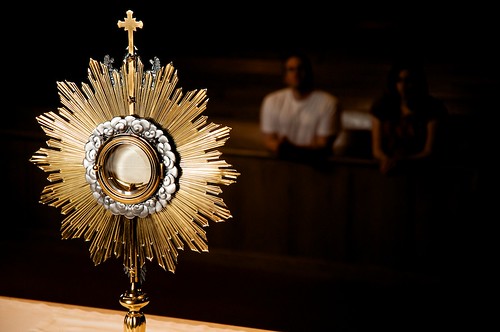
I found this very interesting article in Zenit about Eucharistic Adoration of which I am devoted. I am posting this in its entirety so you can read it and be inspired.
***
ROME, JAN. 19, 2010 (Zenit.org).- Answered by Legionary of Christ Father Edward McNamara, professor of liturgy at the Regina Apostolorum university.
Q: We have a very unusual problem in my parish regarding the exposition of the Blessed Sacrament. Our pastor is very devoted to the Holy Sacrament and dedicated to the adoration of the same. He spends long hours in the chapel and encourages all the parishioners to do the same. However, he believes that the exposition of the Blessed Sacrament is unimportant and unnecessary. Christ is present in the tabernacle, and having the door of the tabernacle open or closed does not make any difference. His logic seems to be: that the parishioners should be taught to pray and adore the Blessed Sacrament all the time and that the practice of exposition in the monstrance is irrelevant and counterproductive to any real devotion. Your thoughts, please. -- J.L., Cumberland County, New Jersey
A: The pastor's devotion to the Eucharist is commendable, and our reader is surely thankful for this. The pastor also has a valid point in stressing adoration of Our Lord in the tabernacle, since reverence toward the tabernacle has often been neglected in recent times. It is necessary to do all that is possible to recover the spirit of silent prayer and adoration in many of our churches.
Adoration of Our Lord in the tabernacle is and remains the normal and most common mode of adoration. There is, however, a small number of Catholics who emphasize exposition of the Blessed Sacrament so much as to give the impression that they consider this to be the only authentic adoration.
That said, I think the pastor should go deeper into Church doctrine so as to discover that it is not a question of aut--aut but of et--et. Almost all magisterial documents recommend both practices. In some cases, they allude to exposition and Benediction as bringing to the fore certain doctrinal aspects that are less apparent in adoration in the tabernacle.
Thus, Pope Pius XII in his 1947 encyclical "Mediator Dei" speaks of how adoration has contributed to doctrinal progress with a deeper understanding of Christ's presence outside of Mass. He points out that the different forms of Eucharistic adoration "have brought a wonderful increase in faith and supernatural life to the Church militant upon earth."
Regarding Benediction, he says: "Of great benefit is that custom which makes the priest raise aloft the Bread of Angels before congregations with heads bowed down in adoration, and forming with It the sign of the cross." This "implores the heavenly Father to deign to look upon His Son who for love of us was nailed to the cross, and for His sake and through Him willed [...] to shower down heavenly favors upon those whom the Immaculate blood of the Lamb has redeemed."
The 1967 instruction on the Eucharistic Mystery underlines the importance of both forms of practice:
"58. Devotion, both private and public, toward the sacrament of the altar even outside Mass that conforms to the norms laid down by lawful authority and in the present Instruction is strongly advocated by the Church, since the eucharistic sacrifice is the source and summit of the whole Christian life …
"60. Exposition of the blessed sacrament, either in a ciborium or a monstrance, draws the faithful to an awareness of the sublime presence of Christ and invites them to inner communion with him. Therefore, it is a strong encouragement toward the worship owed to Christ in spirit and in truth."
It is possible to quote many other magisterial sources, such as Pope Paul VI's encyclical "Mysterium Fidei," and the Catechism of the Catholic Church, No. 1378.
I believe the following texts from the two most recent Holy Fathers is sufficient to illustrate the point.
Pope John Paul II in his final encyclical "Ecclesia de Eucharistia" admirably summed up the doctrinal essentials:
"25. The worship of the Eucharist outside of the Mass is of inestimable value for the life of the Church. This worship is strictly linked to the celebration of the Eucharistic Sacrifice. The presence of Christ under the sacred species reserved after Mass -- a presence which lasts as long as the species of bread and of wine remain -- derives from the celebration of the sacrifice and is directed towards communion, both sacramental and spiritual. It is the responsibility of Pastors to encourage, also by their personal witness, the practice of Eucharistic adoration, and exposition of the Blessed Sacrament in particular, as well as prayer of adoration before Christ present under the Eucharistic species.
"It is pleasant to spend time with him, to lie close to his breast like the Beloved Disciple (cf. Jn 13:25) and to feel the infinite love present in his heart. If in our time Christians must be distinguished above all by the 'art of prayer,' how can we not feel a renewed need to spend time in spiritual converse, in silent adoration, in heartfelt love before Christ present in the Most Holy Sacrament? How often, dear brother and sisters, have I experienced this, and drawn from it strength, consolation and support!
"This practice, repeatedly praised and recommended by the Magisterium, is supported by the example of many saints. Particularly outstanding in this regard was Saint Alphonsus Liguori, who wrote: 'Of all devotions, that of adoring Jesus in the Blessed Sacrament is the greatest after the sacraments, the one dearest to God and the one most helpful to us.' The Eucharist is a priceless treasure: by not only celebrating it but also by praying before it outside of Mass we are enabled to make contact with the very wellspring of grace. A Christian community desirous of contemplating the face of Christ in the spirit which I proposed in the Apostolic Letters Novo Millennio Ineunte and Rosarium Virginis Mariae cannot fail also to develop this aspect of Eucharistic worship, which prolongs and increases the fruits of our communion in the body and blood of the Lord.
"In the course of the day the faithful should not omit visiting the Blessed Sacrament, which in accordance with liturgical law must be reserved in churches with great reverence in a prominent place. Such visits are a sign of gratitude, an expression of love and an acknowledgment of the Lord's presence."
Finally, our present Pope touches on this theme in the postsynodal exhortation "Sacramentum Caritatis," Nos. 67-68:
"The practice of eucharistic adoration
"67. With the Synod Assembly, therefore, I heartily recommend to the Church's pastors and to the People of God the practice of eucharistic adoration, both individually and in community. Great benefit would ensue from a suitable catechesis explaining the importance of this act of worship, which enables the faithful to experience the liturgical celebration more fully and more fruitfully. Wherever possible, it would be appropriate, especially in densely populated areas, to set aside specific churches or oratories for perpetual adoration. I also recommend that, in their catechetical training, and especially in their preparation for First Holy Communion, children be taught the meaning and the beauty of spending time with Jesus, and helped to cultivate a sense of awe before his presence in the Eucharist ….
"Forms of eucharistic devotion
"68. The personal relationship which the individual believer establishes with Jesus present in the Eucharist constantly points beyond itself to the whole communion of the Church and nourishes a fuller sense of membership in the Body of Christ. For this reason, besides encouraging individual believers to make time for personal prayer before the Sacrament of the Altar, I feel obliged to urge parishes and other church groups to set aside times for collective adoration. Naturally, already existing forms of Eucharistic piety retain their full value. I am thinking, for example, of processions with the Blessed Sacrament, especially the traditional procession on the Solemnity of Corpus Christi, the Forty Hours devotion, local, national and international Eucharistic Congresses, and other similar initiatives. If suitably updated and adapted to local circumstances, these forms of devotion are still worthy of being practiced today."
From this, it seems clear that the Church desires the practice of both adoration in the tabernacle and exposition and Benediction of the Blessed Sacrament. If well-prepared, exposition should lead to more-frequent visits to the tabernacle and to a deeper living of the mystery of the Eucharistic sacrifice.
Tuesday, January 19, 2010
$25M from the Catholic Church
Benedict XVI Keeping Up with Haiti Situation, Catholic Relief Services Commits $25M
VATICAN CITY, JAN. 17, 2010 (Zenit.org).- Benedict XVI affirmed today that he is being continually informed about developments in Haiti in the aftermath of last Tuesday's earthquake.
The Pope mentioned the catastrophe during his address after praying the midday Angelus with those gathered in St. Peter's Square.
A 7.0 earthquake struck the capital of Port-au-Prince at about 5 p.m. local time Tuesday. Though rescue efforts continue and an accurate number of victims will be days in coming, it is estimated that between 50-000 and 100,000 people died.
"Our thoughts, in these days, turn to the dear people of Haiti, and [we] raise up sorrowful prayer," the Holy Father said. "The apostolic nuncio, [Archbishop Bernardito Auza], who, thanks be to God, is unhurt, keeps me continually informed, and thus I heard of the sad passing of the archbishop [Joseph Serge-Miot of Port-au-Prince], as well as of many priests, religious and seminarians.
"I am following and encourage the numerous charitable organizations, who are taking charge of the immense necessities of the country. I pray for the injured, the homeless, and for those who tragically lost their lives."
Catholic relief
The Vatican congregation that oversees the Church's charitable activities, the Pontifical Council Cor Unum, has asked U.S.-based Catholic Relief Services to spearhead the Church's relief effort.
CRS had some 300 staff already working in Haiti before the quake.
The agency reported that its initial pledge of $5 million is now five times that, [five times five, folks, is 25.] thanks in part to donations to CRS of more than $10 million [The Knights of Columbus sent an initial $50,000.]-- "including $1 million from the Gates Foundation and $225,000 from the New York Yankees." [I heard that the wife of Bill Gates is a devout Catholic.]
Karel Zelenka, country representative for CRS Haiti, spoke of the stress on the island. Another aftershock hit even today.
"You drive up and down the streets and you see all these bodies that are just laying down there because they have no common grave and they cannot do a proper funeral. The worst part are the children -- these little bodies," he said. "I mean, can I tell you, in general earthquakes are the worst, worst disaster that can happen."
The agency has opened a special Web site for the relief effort and donations can be made by mobile phone.
***
The Catholic Church has pledged $25M for the Haiti relief effort...
Where's the liberal anti-Catholic media when you need them?
Where's the oil rich Islamic nations who are followers of the 'religion of peace'?
Where are the Masonic lodges who are proud of their charitable work?
Just asking...
No need to flare up.
WHAT?! No Masses for a whole week?
MANILA, Jan. 19, 2010—There will be no mass the whole next week in majority of the country’s Catholic Churches—because there are no priests to celebrate it.
A ranking church leader said thousands of priests are going to Manila to attend the 2nd National Congress of the Clergy from Jan. 25 to 29 and many dioceses can’t supply stand-in.
The cancellation of regular masses also means that weddings and other liturgical rites such as baptisms and confession will also temporarily be suspended so that priests could attend the gathering. [What if there are sick calls? ]
But Manila Archbishop Gaudencio Cardinal Rosales said that in the absence of priests, lay ministers will take over in administering communion to the faithful and bless the dead [WHAT?! EXTRAORDINARY MINISTERS OF HOLY COMMUNION (EMHC) DO NOT HAVE THE FACULTIES TO BLESS!!! Only the ordained can do this! This is a perfect example of a liturgical abuse that has been going on. I have witnessed this in several occassions, in several parishes of different dioceses all around the country! Now this proves it!] in at least five-day period.
“There are dioceses where 100 percent of the priests will be here together with the bishop so no one will be left in the parishes. The lay ministers will be the ones to give communion and bless the dead,” he said.
Rosales said there only about 8,000 priests all over the country and around 6,000 clergymen are expected to attend the nationwide gathering in Manila.
More of a spiritual retreat in dynamics, the congress aims to bring the clergy to a deepening of their pastoral commitment through interior renewal, he added.
“The reason also (for the cancellation of Masses) is to let the people realize that priests have also their needs. We also need some solitude. We need to pray also,” the cardinal said. [And some folks don't know that yet. Calling priests even late in the evening.]
Rosales added that even Masses in Metro Manila will also be adjusted for his priests to attend the congress.
“Those in Metro Manila and nearby provinces will just hold early Masses,” he said.
“In Luzon, some of the priests will be shuttling; for example in Tagaytay they leave early in the morning and then they leave in the evening,” added Rosales.
The prelate said he is certain the faithful will understand the need of priests to come together and reflect for the good of the church.
“It’s time for parishioners to realize that we priests also need some quiet and I think that’ll be behind the reasoning,” he said. (Roy Lagarde)
***
I was prepared to rant for having no Mass for the whole week...
But for the Primate of the Philippines and a Prince of the Church to say that EMHCs can bless the dead!
God forgive me...
All those folks can do is sprinkle holy water and that's that. The outstretching of hands and blessings they utter are invalid and illicit!
Remember this post about an EMHC blessing a car?
Maybe it would be practical to ordain some of these hard-working, dedicated, good family man EMHCs to the permanent diaconate...
What do you think?
Monday, January 18, 2010

Excerpt of Pope's address to the Roman Synagogue

Here in this place, how could we not remember the Roman Jews who were snatched from their homes, before these very walls, and who with tremendous brutality were killed at Auschwitz? How could one ever forget their faces, their names, their tears, the desperation faced by these men, women and children? The extermination of the people of the Covenant of Moses, at first announced, then systematically programmed and put into practice in Europe under the Nazi regime, on that day tragically reached as far as Rome. Unfortunately, many remained indifferent, but many, including Italian Catholics, sustained by their faith and by Christian teaching, reacted with courage, often at risk of their lives, opening their arms to assist the Jewish fugitives who were being hunted down, and earning perennial gratitude. The Apostolic See itself provided assistance, often in a hidden and discreet way.
***
Papa Benny's way of telling those who are so into the anti-Pius XII polemics...
You can read the full discourse here.
Hah!
UNIQUELY PINOY: THE GREAT FEAST OF THE HOLY CHILD OF CEBU

"Pit Señor!"
These are the words that ring out in the Basilica and in the streets of Cebu, as devotees and on-lookers alike celebrate the Feast of the Santo Niño of Cebu.
"Pit Señor!" is a shortened form of the Cebuano prayer to the Lord "Sangpit Señor!" or "Hear my Lord!" , a prayer of supplication of the devotees who dance the Sinulog or religious dance. This dance has its pagan origins where according to historians was danced by native Cebuanos before the Christianization of the island and of the country. Natives would dance holding their idols. But after the arrival of Magellan, the newly baptized natives continued the tradition and offered the dance to the Child-King-God!

The Philippines is the only country in the world which the Holy See approved a special liturgical feast for th Holy Child. It is celebrated every 3rd Sunday of the month of January or the week after the Feast of the Baptism of the Lord.
The Santo Niño of Cebu pre-dates the Infant Jesus of Prague. The Cebu icon was given as a gift on 1565 while the Prague image can trace its origins in 1628.
Like the Prague image, devotees (like me) attest to the miracles and graces they have received through the image. My family and I received a special favor from the Holy Child after I made a pilgrimage to Cebu.
Here is the miraculous image where image is kept.

At the base of the image is a small reliquary where you can find the relic of the True Cross. Devotees kiss this also.
Here is a photo of the main altar of the Basilica. The retablo is the original one and survived the liturgical frenzy of the '60s.

You can see in one of the niches an image of the Santo Nino, second row from the top, right above the crucifix. It is a replica. The saints in the other niches are Augustinian saints, the basilica being under the care of the Augustinians. One side chapel features a huge frame containing reliquaries of these saints.
A piazza, if I may call it, was built in front of the Basilica to accommodate the large number of devotees who come to Mass every Friday, which is assigned as the day novena masses are held.

For more interesting articles about the Holy Child of Cebu...
The Wikipedia entry
The official website of the Minor Basilica of the Santo Niño
More before and after photos of the Basilica
Interesting history of the Image
International Association of Devotees
What could have the Pope said to the Chief Rabbi of Rome?

a. I'll be beatifying Pius XII this year, with or without your approval.
b. You know Christ is the Messiah you have long been waiting for.
c. Don't worry. Bishop Williamson is not here.
Saturday, January 16, 2010
FYI: The Papal Nuncio to Haiti

Filipino Archbishop Bernardino Auza, the Papal nuncio to Haiti, during his visit to the Philippine in May 2008. Auza said thousands of people died following a huge quake in Haiti and among them are those of Catholic clergy and missionaries.
(Photo and caption courtesy of CBCPNews.net)
***
Please continue to pray for the people of Haiti and those who are working for the relief, rescue and retrieval operations.
Send in your donations to Catholic Relief Service or through the Knights of Columbus.
Subscribe to:
Posts (Atom)