Pages

Showing posts with label religious archaeology. Show all posts

Saturday, June 14, 2014

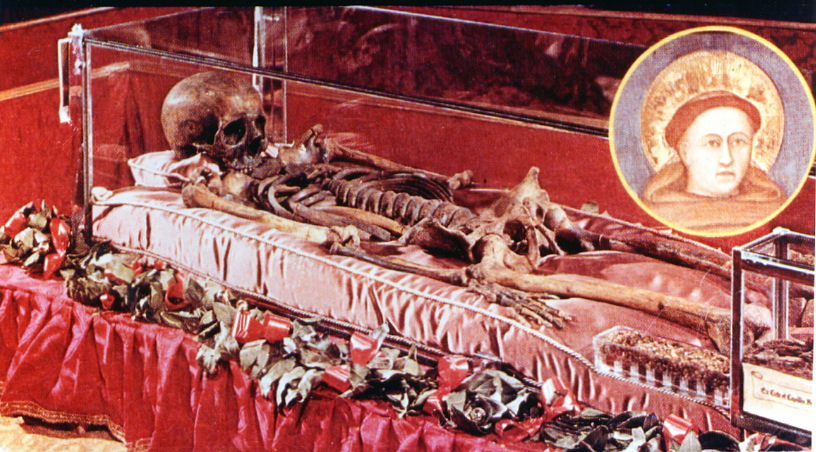
The true face of St. Anthony of Padua

And no he doesn't look very boyish like how most statues portray him.


This was done through 3D forensic facial reconstruction technology by a team of archeological facial reconstruction experts.
 
They relied heavily on a digital copy of the saint's skull.
 
By the way, the remains of the saint are preseved at the basilica built in his honor.


Read the details here.
 
Next time, let's have images of St. Anthony looking like this, ok? Instead of this.


Friday, June 1, 2012

The exact date of the death of the Savior


 Scientists were able to predict the exact date of the death of our Lord Jesus Christ!

***

International Geology Review points to Friday 3rd of April, 33 A.D. as the more likely day of the death of Jesus. This is due to recent researches, focused on earthquake activity at the Dead Sea, located 13 miles from Jerusalem. The Gospel of Matthew, Chapter 27, mentions that an earthquake coincided with the crucifixion [Don't ask theologians at MST and SVST about this.  They'll question even the events written in the Gospel.  They'll call it embellishment, the literary freedom of the writer to make the simple death more fit for storybooks and Hollywood.  That is MODERNISM at work folks, and we call them REVEREND FATHERS.  They know better than the Evangelists because, you know why?  They have the degree and the Evangelists don't!  Matthew was a slimy tax collector, Mark who knows what was doing, he just showed up and wrote SOMETHING, John was lowly fishermen, and Luke was a physician BUT NEVER a theologian or a liturgist....Wah?!  Why did the liturgist thing got inserted here?  Well, force of habit.  Ha!]

To analyze earthquake activity in the region, geologist Jefferson Williams of Supersonic Geophysical and colleagues Markus Schwab and Achim Brauer of the German Research Center for Geosciences studied three cores from the beach of the Ein Gedi Spa adjacent to the Dead Sea.

Varves, which are annual layers of deposition in the sediments, reveal that at least two major earthquakes affected the core: a widespread earthquake in 31 B.C. and an early first century seismic event that happened sometime between 26 A.D. and 36 A.D.

The latter period occurred during “the years when Pontius Pilate was procurator of Judea and when the earthquake of the Gospel of Matthew is historically constrained,” Williams said.

According the researchers, their study proves that a local earthquake happened, strong enough to deform the varves in Ein Gedi, but not strong or wide enough to produce a wider historical memory.


***

And atheists say that science and religion will never co-exist!

Idiots!

Saturday, May 19, 2012

It's from St. Cuthbert's coffin!

The first page of St. Cuthbert's Gospel.  The text seem familiar to those who know the TLM?


LONDON (Reuters) - A seventh century gospel discovered in a saint's coffin more than 900 years ago, and the oldest European book to survive fully intact, has been acquired by the British Library for nine million pounds ($14 million), the library said on Tuesday.

The manuscript copy of the Gospel of St. John called the St. Cuthbert Gospel [also known as the Stonyhurst Gospel] was produced in the northeast of England in the late 7th century and was placed in the saint's coffin on the island of Lindisfarne, probably in 698.

His remains were carried to the mainland when the monks and people of the island fled Viking invaders, and ended up in Durham where the coffin was opened in 1104 and the gospel discovered.

Cuthbert's body was reburied in the new Norman cathedral there and became a focal point for pilgrims.

"It is undoubtedly one of the world's most important books," said Scot McKendrick, head of history and classics at the British Library.

"Most people who know about books know about the St. Cuthbert Gospel. The staggering fact is that we don't have a European book that looks as it did when it was made before this. It's quite astonishing."

According to the British Library, which has had the gospel on long-term loan since 1979 and exhibited it regularly, it will be displayed open temporarily after conservationists and curators deemed it safe to do so.

The manuscript features an original red leather binding in excellent condition and is the only surviving "high status" manuscript from this period of British history to retain its original appearance both inside and out.

In 2010, the library was approached by auction house Christie's who were acting on behalf of the gospel's owners the Society of Jesus (British Province), or Jesuits.

The national library was given first option to purchase the manuscript which was valued at nine million pounds.

Scot said that Jesuits came into possession of the prized artifact in the middle of the 18th century.

The Earl of Lichfield gave it to a priest who in turn passed it to Jesuits living in Europe. They later brought it to Stonyhurst, northwest England, explaining why it was formerly known as the Stonyhurst Gospel.

Little is known of its whereabouts between 1104 and the 1700s, although academics assume it was kept in Durham for much of that time.

Half of the price of the gospel came from the National Heritage Memorial Fund, established in 1980 to safeguard works of art and wildlife havens for the nation.

Other major gifts came from the Art Fund, Garfield Weston Foundation and the Foyle Foundation as well as donations from unnamed charitable trusts and individuals.

The book will be displayed to the public equally in London and the northeast after a formal partnership was agreed between the British Library, Durham University and Durham Cathedral.

The British Library has opened a special display exploring the creation, travels and "near-miraculous" survival of the gospel across 13 centuries and it has also been digitized and made freely available online.

***

St. Cuthbert is not in the General Roman Calendar anymore. In fact, I remembered the name only after I read this article.

I remember listening to the radio program of the late Ernie Baron dubbed "The Walking Encyclopedia" because of his wide range of knowledge in different topics.  He once said, and I remember it vividly, that the Vatican reformed the Roman Calendar because there are too many saints in the calendar whose authenticity the Church cannot verify.  He claims that the Church has these "mythical" saints whose names need to be taken off the Calendar.  And he thanks Vatican II for it.

Uhm....

Right back then I know something was amiss.

And now we know for a fact that it is.

There is one born every decade.  Hey Dan Brown!

Tuesday, December 22, 2009

Probably the neighbor of the Lord?

From AP

***

NAZARETH, Israel – Just in time for Christmas, archaeologists on Monday unveiled what may have been the home of one of Jesus' childhood neighbors. The humble dwelling is the first dating to the era of Jesus to be discovered in Nazareth, then a hamlet of around 50 impoverished Jewish families where Jesus spent his boyhood.

Archaeologists and present-day residents of Nazareth imagined Jesus as a youngster, playing with other children in the isolated village, not far from the spot where the Archangel Gabriel revealed to Mary that she would give birth to the boy.

Today the ornate Basilica of the Annunciation marks that spot, and Nazareth is the largest Arab city in northern Israel, with about 65,000 residents. Muslims now outnumber Christians two to one in the noisy, crowded city.

The archaeological find shows how different it was 2000 years ago: There were no Christians or Muslims, the Jewish Temple stood in Jerusalem and tiny Nazareth stood near a battleground between Roman rulers and Jewish guerrillas.

The Jews of Nazareth dug camouflaged grottos to hide from Roman invaders, said archaeologist Yardena Alexandre, excavations director at the Israel Antiquities Authority. But the hamlet was so far off the beaten path that the caves were apparently not needed, she said.

Based on clay and chalk shards found at the site, the dwelling appeared to house a "simple Jewish family," Alexandre added, as workers carefully chipped away at mud with small pickaxes to reveal stone walls.

"This may well have been a place that Jesus and his contemporaries were familiar with," Alexandre said. A young Jesus may have played around the house with his cousins and friends. "It's a logical suggestion."

The discovery so close to Christmas pleased local Christians.

"They say if the people do not speak, the stones will speak," said the Rev. Jack Karam of the nearby basilica.

Archaeologist Stephen Pfann, president of the University of The Holy Land, noted: "It's the only witness that we have from that area that shows us what the walls and floors were like inside Nazareth in the first century." Pfann was not involved in the dig.

Alexandre said workers uncovered the first signs of the dwelling last summer, but it became clear only this month that it was a structure from the days of Jesus.

Alexandre's team found remains of a wall, a hideout, a courtyard and a water system that appeared to collect water from the roof and supply it to the home. The discovery was made when builders dug up the courtyard of a former convent to make room for a new Christian center, just yards from the Basilica.

It is not clear how big the dwelling is. Alexandre's team has uncovered about 900 square feet of the house, but it may have been for an extended family and could be much larger, she said.

Archaeologists also found a camouflaged entry way into a grotto, which Alexandre believes was used by Jews to hide from Roman soldiers who were battling Jewish rebels for control of the area.

The grotto could have hidden around six people for a few hours, she said.

However, Roman soldiers did not end up battling Nazareth's Jews because the hamlet had little strategic value. The Roman army was more interested in larger towns and strategic hilltop communities, she said.

Alexandre said similar camouflaged grottos were found in other ancient Jewish communities of the lower Galilee, such as the nearby biblical village of Cana, which did witness battles between Jews and Romans.

Archaeologists also found clay and chalk vessels likely used by Galilean Jews of the time. The scientists concluded a Jewish family lived there because of the chalk, which Jews used to ensure the ritual purity of the food and water kept inside the vessels.

The shards also date back to the time of Jesus, which includes the late Hellenic, early Roman period that ranges from around 100 B.C. to the first century, Alexandre said. The determination was made by comparing the findings to shards and remains typical of that period found in other parts of the Galilee, she said.

The absence of any remains of glass vessels or imported products suggested the people who lived in the dwelling were simple, but Alexandre said the remains did not indicate whether they were traders or farmers.

The only other artifacts from the time of Jesus found in the Nazareth area are ancient burial caves that provided a rough idea of the village's population at the time, Alexandre said.

Work is now taking place to clear newer ruins built above the dwelling, which will be preserved. The dwelling will become part of a new international Christian center being built close to the site and funded by a French Roman Catholic group, said Marc Hodara of the Chemin Neuf Community overseeing construction.

Alexandre said limited space and population density makes it unlikely that archaeologists can carry out further excavations in the area, leaving this dwelling to tell the story of what Jesus' boyhood home may have looked like.

The discovery at "this time, this period, is very interesting, especially as a Christian," Karam said. "For me it is a great gift."