Pages

Showing posts with label papal liturgy. Show all posts

Monday, April 13, 2015

The new papal "tiara"?

Pope Francis has used again his piscatorial ring and the ferula of Benedict XVI for the Easter Sunday Mass and the Mass to commemorate the centennial of the Armenian Genocide and the declaration of St. Gregory of Narek as Doctor of the Church.

Photos were sourced from various wire services.

Easter Sunday Mass


But you will notice that after the Easter Sunday Mass, the Holy Father reverted back to his silver ring for the Urbi et Orbi blessing.


And for the Mass for the Centennial of the Armenian Genocide and the declaration of St. Gregory of Narek as Doctor of the Church.


The Holy Father has reserved both his piscatorial ring and the ferula of Benedict XVI for special occasions, much like how the papal tiara was once used prior to its abandonment by Bl. Paul VI.


Sunday, December 7, 2014

In the midst of a brood of vipers

The Master of Apostolic Ceremonies, Mons. Guido Marini, is in town finalizing the liturgy for the Holy Father's Apostolic Visit in January 2015.


He met with the country's TOP LITURGISTS.  Top in hating the the reform of Pope Benedict XVI. Top in promoting the illegal and illicit Misa ng Bayang Pilipino. Top in saying that the Benedictine altar arrangement is ridiculousness.


Let us see how OBEDIENT they will be to Mons. Marini.


Monday, November 17, 2014

Glory to God for the 2015 Papal Masses in PHL

Composed by Fr. Manoling Francisco, SJ now being sung in Catholic churches in the Archdiocese of Manila.

I heard it sung at Edsa Shrine this Sunday.  Lasted for almost 10 minutes!  That beat your usual Gregorian chant, Missa de Angelis Gloria which only runs for 3:20!

The antiphon is in English, Latin, Bisaya, Tagalog and Ilocano.

Three verses.  First in Ilocano, next in Tagalog, and then the last one in Cebuano.

So if you are like most of Filipinos here in Manila, chances are you will only understand two out of five languages/dialects used.

Which makes you scratch your head.

Why not just one language?

Why not just English?  Why not just Tagalog?  Why not just Latin?

So the liturgists of the Archdiocese will spend time asking the people to learn this new song while deriding the centuries old Gregorian chant?

Tell me.  Is this what San Beda and PIL taught you?...........to despise anything from the past just because they are old?

Latin is hard to learn?  Tell it to these youths.

Tell that to the Muslims.  Young people already chant and read Arabic....I mean young FILIPINO people.

It can be done.

They just don't want to.


PS:  I saw photos of a young seminarian serving the Beatification Mass of Lorenzo Ruiz and companion martyrs at Luneta.  That seminarian is now a cathedral rector and the other one is an archbishop.

Why'd I say this?  Simple.  Professional Lay Liturgists especially the one from Cubao would love to take the spotlight even from seminarians.  Why not enter the seminary instead of being a perpetual altar server.  Let me give you a hint.  FLUNKED.  REJECT.


Monday, January 13, 2014

Pope Francis celebrates Mass ad Deum again

This time at the Sistine Chapel for the Feast of the Baptism of the Lord, following the example of his predecessor, Pope Benedict XVI.


This can be done and this is allowed.

Why then, pray tell...

Would Fr. Genaro Diwa continue to push for THE ILLEGAL MISA NG BAYANG PILIPINO, but prohibit the celebration  of the Ad Orientem Mass and the 1962 Missal of Blessed John XXIII when in fact these are LEGAL and his invented Mass is ILLEGAL.

Makes you wonder what education in Liturgy un-educates a Catholic priest.

So sad.


Tuesday, June 11, 2013

Breaking News: RCAM failed to report this!

Either the same sloppy guys who run the RCAM website are still, well, sloppy...

Or they simply don't care at all!

Anywho, let the lowly blogger name The Pinoy Catholic who goes by the REAL name Pedro Lorenzo Ruiz, share this story to all you dear folks.

***
Vatican City, 10 June 2013 (VIS) – The Office of Liturgical Celebrations of the Supreme Pontiff today announced that this coming Saturday, 15 June, at 6:30pm, Cardinal Luis Antonio G. Tagle, archbishop of Manila, Philippines, will take possession of the title of San Felice da Cantalice a Centocelle in Piazza San Felice da Cantalice, 20.

***


This is the same church that Cardinal Tagle went to and celebrated Mass before the latest papal conclave but he hasn't formally taken possession yet of his cardinatial church.


The Latin inscription reads "To God, most good, most great. In Honour of St Felix of Cantalice. Year of Our Lord, 1935"

Deo Optimo Maximo is sometimes abbreviated as D.O.M. and you see this sometimes in old niches and tombs.

That's what DOM stands for...

No not the other one...


Wednesday, May 29, 2013

TLM and Guido Marini to stay under Pope Francis!

Here is a blog entry from Sandro Magister, which was published in Italian.  This one here is from Google translate.

My Italian is a bit rusty so I settled for this one.

***

Among the bishops who went by Italian Francesco in "ad limina" visits, those of Apulia were the most talkative in reporting things said to them by the pope.

There was only the "revelation" - then partly contradicted by Father Federico Lombardi - the bishop of Molfetta Luigi Martella on two encyclicals on the road: the first, on faith, signed by the current pope, but written by his predecessor, the would still finishing up in his hermitage, and the second, on poverty, all at the hands of the reigning Pope.

There were also some rumors regarding the liturgy.

He started the Archbishop of Bari, Francesco Cacucci, which the Vatican Radio said that Pope Francis would have urged the bishops to "live the relationship with the liturgy with simplicity and without superstructures."

Then it was the turn of the Bishop of Conversano and Monopoli, Domenico Padovano, who told their clergy that the bishops had complained of Puglia with the pope on the work of division created within the Church by the champions of the Mass in the ancient rite. [I wish I had a dollar every time I read or heard that!  As if the new Mass did not create any division when it was introduced!  Ha!]

And what would they answered the pope?

According to reports by Monsignor Padovano, Francis would have urged them to be vigilant over extremism of some traditionalist groups, but also to build on the tradition and make it live in the Church with innovation.  [innovation?]

To illustrate this last point, the pope would bring their own example:

"You see? They say that my master of papal ceremonies [Guido Marini] is a traditionalist, and many, after my election, they invited me to lift it [remove him] from office and replace it [him]. [Bad translation.  Many liberals don't like Guido Marini.  I am pretty sure the other Marini would want to get back at the helm.]  Actually meant, I said no, because I myself could draw on its [his] preparation and traditional at the same time he can benefit, in the same way, most of my training emancipated. " [Hmmm...Liberal training.....he learns from me and I learn from him?]

If authentic, words are instructive about the liturgical spirit and style of celebration of the pope.

But not sure in what sense the bishops have interpreted the Puglia region.

Another of them, and one of Cerignola Ascoli Satriano, Felice Di Molfetta, a former president of the Committee of the CEI for the liturgy, in a message to his diocese wrote among other things:

"I did not fail to rejoice with the pope on the style of celebration that has taken, a style inspired by the 'noble simplicity' sanctioned by the Council, showing particular attention to the subject and which has suffered from its high-profile considerations theological and pastoral shared by all the members present.

"I have enjoyed so much for the dialogue created, Having occupied by a life in teaching and sacramental liturgical theology in capturing the interest of the Holy Father on this vital aspect of the Petrine ministry, which he exercised both in the celebrations is working in Santa Marta in those solemn as in the Vatican Basilica for the canonization of the 800 martyrs of Otranto: A Celebration contained in time and in his overall performance ritual.

"Papa Francesco, in the light of certain phenomena of the recent past in which they were recorded in liturgy quite a few drifts, urged us bishops, referring also some concrete examples, to live the relationship with the liturgical action, since the work of God , as true believers beyond every pompous ceremonialism, fully aware that the 'noble simplicity' of which the Council speaks, but it is not sloppiness Beauty, beauty with 'B' capital. "  [Those are full of meaning!  If I read it right, Pope Francis would want to go beyond the ceremonialism but not to the point of being sloppy.  Well, problem is, who determines what is too pompous and what is too sloppy.  That is why you have rules.  Those are the purpose of the rubrics.  Say the Black, Do the Red.]

But Francis Pope enlist in the ranks of the progressives in the liturgical field is at least risky. It does not appear at all, in particular, that he is hostile to the liberalization of the Mass in the ancient rite, determined by Benedict XVI with the motu proprio "Summorum Pontificum" in 2007.

While it is true, that Monsignor Di Molfetta that year was one of the most combative critics of the motu proprio, before and after its publication.

He judged the Mass in the ancient rite "incompatible" with the post-conciliar and busied himself, without success, because the CEI produce an interpretative note - strictly - the "Summorum Pontificum".

***

Seems like Msgr. Guido will definitely stay, which good for him and for those hoping for the retention of the hermenuetic of continuity in the liturgy espoused by Pope Benedict.

And at least Summorum Pontificum stays.

But.....

Liturgy is still a work in progress.

Especially when you have this guy around.


Tuesday, May 14, 2013

No Communion in the Hand for you sweet old lady!


When it comes to receiving Communion, most people prefer the indult rather than the norm.

Yup.  Communion in the Hand is an indult, and not a UNIVERSAL INDULT.

But when it come to the Mass, most people would like the norm rather than the indult even if this indult is UNIVERSAL.


FYI.  The liturgical discipline of receiving communion only in the tongue in Papal Masses remains in force even if the discipline was instituted by Pope Benedict XVI.  Pope Francis has not rescinded it.

FYI.


Monday, March 25, 2013

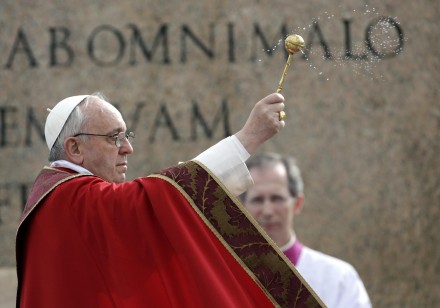
GULP Alert: Holy Sprinkler


From Facebook.

Because the people think that it is the Holy Water that makes sacramentals, well, a sacramental, and these things blessed!  It is the words of the priest, dear people, the words!

Whoever the genius was behind this utter and epic dumbness should get a massive dressing down.

They should have told the popes that what they were doing is wrong since the holy water they sprinkle isn't even reaching the palms fronds.


Tuesday, March 19, 2013

What to expect at today's Mass of the Inauguration to the Petrine Ministry


Yup, that is the official name of that Mass.

This is a lengthy one.  Bear with me.


The video says "The Vatican is expecting at least 200 faithful to attend."

Wha?!

Just 200?

LOL!

***

Vatican City, 18 March 2013 (VIS) – In the press conference held today, Fr. Federico Lombardi, S.J., director of the Press Office of the Holy See, focused on two themes: Pope Francis' first audiences and details of the Mass inaugurating the Petrine Ministry of the Bishop of Rome.

First, Fr. Lombardi relayed the information that the Holy Father was, at the moment, having lunch with the President of Argentina, Cristina Fernandez de Kirchner, whom he received at the Domus Sanctae Marthae “in a private meeting that lasted around 20 minutes, afterwards greeting the other members of the Argentine delegation”. Also this morning, at 10:00am, Francis received in audience Cardinal Secretary of State Tarcisio Bertone, S.D.B. Yesterday afternoon he had two very cordial audiences, one with the Bishop of Albano, Italy, and the other with the Superior General of the Jesuits, Fr. Adolfo Nicolas Pachon.  [He is now doing what a head of state and the Bishop of Rome does.]

The main part of the press conference was dedicated to how the Mass inaugurating the Petrine Ministry of the Bishop of Rome will be celebrated. “The correct term for the ceremony,” Fr. Lombardi clarified, “is not enthronement but inauguration. As successor of Peter, the Pope is Bishop of Rome and the Church of Rome 'presides in love' over the others. Also, it is a celebration rich with symbols that recall the Pope's tie to St. Peter, beginning with the place where, according to tradition, Peter was martyred.”

The Press Office Director also explained where those participating in and attending the Mass will be located. “On the left-hand side of the 'Sagrato' (porch of the Basilica) will be seated bishops and archbishops (around 250 are expected), ecclesiastics, and delegations from other Churches and Christian confessions. On the right-hand side of the 'Sagrato' will be delegations from various countries lead by heads of state, ministers, etc. On the St. Peter’s statue side of the piazza will be seated Jews, Muslims, and members of other religions, then around 1200 priests and seminarians. On the St. Paul’s statue side of the piazza will be seated the diplomatic corps accredited to the Holy See and other civil authorities. The rest of the piazza will be standing-room for all those without tickets. A large number is expected to attend.”

Between 8:45 and 8:50am the Pope will depart the Domus Sanctae Marthae and start to move through the crowd in the various sections of the piazza—either in the Jeep or the Popemobile—and greet those gathered. He will return to the Sacristy, via the Pietà side, around 9:15am. Mass is planned to begin at 9:30am.  [about 4PM Manila time.]

Regarding the beginning of the ceremony, the Pope, once having entered the Basilica, will head to the Confession (St. Peter’s tomb under the high altar) while trumpets will announce the “Tu es Petrus”. The Pope will venerate the tomb of St. Peter, together with the Patriarchs and Major Archbishops of the Eastern Rite Catholic Churches (ten in number, four of whom are cardinals). He will then be presented with the Pallium, Ring, and Book of the Gospels that were placed at St. Peter’s tomb the night before.

The Holy Father will then come back up from the Confession to the main floor of the Basilica, from which the procession continues. The “Laudes Regiae” (Christ is King) will be chanted, with some invocations taken from the Vatican II document on the Church, “Lumen Gentium”. In the Litany of Saints are particularly to be noted, after the Apostles, the Holy Roman Pontiffs who have been canonized up to the most recent: St. Pius X. Fr. Lombardi clarified that these are only the pontiffs who have been named as saints, not those who have been beatified. The procession will then make its entrance into the square.

Fr. Lombardi listed who will be concelebrating the Mass with Francis: all the cardinals present in Rome, joined by the Patriarchs and Major Eastern Rite Archbishops (6); the Secretary of the College of Cardinals; and two Superior Generals (that of the Order of Friars Minor, Jose Rodriguez Carballo and that of the Jesuits, Adolfo Nicolas Pachon, respectively President and Vice-President of the Union of Superior Generals). In total about 180 are expected to concelebrate and they will be seated at the left (that is, in front of the ecclesiastics, not the national delegations).

Before the Mass begins there are the rites specific to the beginning of the Bishop of Rome's Petrine Ministry. These include:

The Imposition of the Pallium:
Made of lamb’s wool and sheep’s wool, the Pallium is placed on the Pope's shoulders recalling the Good Shepherd who carries the lost sheep on his shoulders. The Pope’s Pallium has five red crosses while the Metropolitans’ Palliums have five black crosses. The one used by Francis is the same one that Benedict XVI used. It is placed on the Pope’s shoulders by Cardinal proto-deacon Tauran and, after the imposition, there is a prayer recited by Cardinal proto-presbyter Daneels.

The Fisherman’s Ring:
Peter is the fisherman Apostle, called to be a “fisher of men”. The ring is presented to the Pope by Cardinal Deacon Sodano (first of the Order of Bishops). It bears the image of St. Peter with the keys. It was designed by Enrico Manfrini The ring was in the possession of Archbishop Macchi, Pope Paul VI's personal secretary, and then Msgr. Malnati, who proposed it to Pope Francis through Cardinal Re. It is made of silver and gold.

The Fisherman's Ring of Pope Francis showing St. Peter casting his net while holding the Keys of the Kingdom of Heaven. Western Media calls it "simple".  Eh.....it ain't simple to me.  Almost looks the same as Benedict's.  Expect the media to keep spinning the word "simple" and "humble" for the duration of this pontificate, just to take a swipe at Benedict.

The “Obedience”:
Six cardinals, two from each order, among the first of those present approach the Pope to make an act of obedience. Note that all the Cardinal electors already made an act of obedience in the Sistine Chapel at the end of the Conclave and that all the cardinals were able to meet the Pope in the following day’s audience in the Clementine Hall. Also, at the moment of “taking possession” of the Cathedral of Rome—St. John Lateran—it is expected that the act of obedience will be made by representatives of the various members of the People of God.

The Mass will be that of the Solemnity of St. Joseph, [today!] which has its own readings (therefore they are not directly related to the rite of the Inauguration of the Pontificate). The Gospel will be proclaimed in Greek, as at the highest solemnities, to show that the universal Church is made up of the great traditions of the East and the West. “Latin,” Fr. Lombardi said, “is already abundantly present in the other prayers and Mass parts.”

The Pope will give his homily in Italian and, as is his style, it probably will not follow the written text strictly, but will contain improvisations.

Fr. Lombardi said that the Master of Celebrations [is it still Msgr. Guido Marini?] expects that the ceremony will not last much more than two hours and, always with the intention of simplification and not making the rite overly long, there will not be an Offertory procession. [Which I personally do not prefer and which, FYI, is NOT in the TLM.  Hmmmm...Simplicity gravitating towards the TLM?  Hehehe.  Wishful thinking.  But who knows!] The Eucharistic gifts will be brought to the altar by the ministers who prepare the altar. Also, the Pope will not distribute Communion, which will be done by the deacons on the “Sagrato” and, in the various areas of the piazza, by priests.  [Why............not?]

Regarding the music for the ceremony, several moments are notable. When the Pope enters the Basilica silver trumpets will ring out the “Tu es Petrus”. The Laudes Regiae will be chanted during the procession from St. Peter’s tomb to the “Sagrato”. A 14 piece brass ensemble will play at various moments of the celebration. During the Offertory the “Tu es pastor ovium” (You Are the Shepherd of the Sheep) motet composed by Pierluigi da Palestrina precisely for the Inauguration of the Pontificate will be sung. At the conclusion, the “Te Deum” will be sung with verses alternating between Gregorian chant and a melody by Tomas Luis de Victoria. As it will not be held on a Sunday, there will be no Angelus after the Mass.

At the end of the celebration, and after removing the Liturgical vestments, the Pope will go to the Basilica’s high altar, [In Benedict's case, he wore the mozzetta and state stole when he greeted the delegations.  I do not expect Pope Francis to wear these.] before which he will greet the heads of the official delegations from various countries who will pass before him. He will then go to the Domus Sanctae Marthae for lunch.

Other delegations staying in Rome can meet with Cardinal Tarcisio Bertone, S.D.B., secretary of State of His Holiness, and Archbishop Dominique Mamberti, secretary for Relations with States the following day, Wednesday (for example, the President of Brazil in light of the upcoming World Youth Day). As is known, the Pope will receive delegations of the Christian Churches and Ecclesial Communities and of other religions in audience on Wednesday.

At the present moment, the main delegations that are expected to attend are:
- 33 delegations representing Christian Churches and Ecclesial Communities (14 Oriental; 10 Western; 3 Christian organizations; others). Among these will be present: Ecumenical Patriarch Bartholomew I; Supreme Patriarch and Catholicos of all Armenians Karekin II; Metropolitan Hilarion of the Patriarchate of Moscow; many metropolitans; Anglican Archbishop Sentamu; Secretary of the World Council of Churches Fykse Tveit; etc.

- 16 members of important Jewish delegations including: the Jewish community of Rome; international Jewish committees; the Chief Rabbinate of Israel; the World Jewish Congress; the Anti-Defamation League, etc.

- As well as delegations of Muslims, Buddhists, Sikhs, Jainists, etc.

To date, delegations of various sizes and levels from 132 countries have confirmed their attendance.

“The delegations,” Fr. Lombardi emphasized, “are coming to Rome following information of the event made public by the Secretary of State. There were no 'invitations' sent out. All who wish to come are warmly welcomed. It must be made clear that no one has privileged status or will be refused. The order will depend on protocol and the level of the delegation.”

Naturally, the most important delegations will be those from Argentina, led by President Cristina Kirchner and Italy, led by President Napolitano and Prime Minister Monti with presidents of the Italian Senate, House, and Constitutional Court.

Also expected are six reigning sovereigns (Belgium, Monaco…); 31 heads of state (Austria, Brazil, Chile, Mexico, Canada, Poland, Portugal, European Union…); three crown princes (Spain, Holland, Bahrain); 11 heads of government (Germany, France, the Vice President of the United States, …); and delegations led by: first ladies, vice presidents, vice prime ministers, parliament presidents, ministers, ambassadors, and other dignitaries.

Papal Coat of Arms:
The last topic that Fr. Lombardi covered was the now pontiff's papal coat of arms and motto. These are the same that he used as bishop. The shield has a bright blue background, at the centre top of which is a yellow radiant sun with the IHS christogram on it representing Jesus (it is also the Jesuit logo). The IHS monogram, as well as a cross that pierces the H, are in red with three black nails directly under them. Under that, to the left, is a star representing Mary, Mother of Christ and the Church. To the right of the star is a nard flower representing Joseph, Patron of the Universal Church. With these symbols the Pope demonstrates his love for the Holy Family.

What distinguishes his coat of arms as pontiff is that, instead of the wide-brimmed, red cardinal's hat atop the shield, it is now crowned by the papal tiara and crossed keys.

[So it won't be this one after all!]
According to Fr. Lombardi, this is NOT the papal crest!

[Then...what is he holding here???]


[Geewhiz!  There is really something wrong with the Vatican Information Service, no?]


His motto—“miserando atque eligendo” (because he saw him through the eyes of mercy and chose him)—is taken from the Venerable Bede's homily on the Gospel account of the call of Matthew. It holds special meaning for the Pope because—when he was only 17-years-old, after going to confession on the Feast of St. Matthew in 1953—he perceived God's mercy in his life and felt the call to the priesthood, following the example of St. Ignatius of Loyola.


***

I'll be watching via EWTN Live streaming or via the Centro Televisivo Vaticano.


Tuesday, November 27, 2012

The Pope's Homily for Christ the King 2012


***

Your Eminences,
Dear Brother Bishops and Priests,
Dear Brothers and Sisters,

Today’s Solemnity of Christ, King of the Universe, the crowning of the liturgical year, is enriched by our reception into the College of Cardinals of six new members whom, following tradition, I have invited to celebrate the Eucharist with me this morning. I greet each of them most cordially and I thank Cardinal James Michael Harvey for the gracious words which he addressed to me in the name of all. I greet the other Cardinals and Bishops present, as well as the distinguished civil Authorities, Ambassadors, priests, religious and all the faithful, especially those coming from the Dioceses entrusted to the pastoral care of the new Cardinals.

In this final Sunday of the liturgical year, the Church invites us to celebrate the Lord Jesus as King of the Universe. She calls us to look to the future, or more properly into the depths, to the ultimate goal of history, which will be the definitive and eternal kingdom of Christ. He was with the Father in the beginning, when the world was created, and he will fully manifest his lordship at the end of time, when he will judge all mankind. Today’s three readings speak to us of this kingdom. In the Gospel passage which we have just heard, drawn from the Gospel of Saint John, Jesus appears in humiliating circumstances – he stands accused – before the might of Rome. He had been arrested, insulted, mocked, and now his enemies hope to obtain his condemnation to death by crucifixion. They had presented him to Pilate as one who sought political power, as the self-proclaimed King of the Jews. The Roman procurator conducts his inquiry and asks Jesus: "Are you the King of the Jews?" (Jn 18:33). In reply to this question, Jesus clarifies the nature of his kingship and his messiahship itself, which is no worldly power but a love which serves. He states that his kingdom is in no way to be confused with a political reign: "My kingship is not of this world … is not from the world" (v. 36).

Jesus clearly had no political ambitions. After the multiplication of the loaves, the people, enthralled by the miracle, wanted to take him away and make him their king, in order to overthrow the power of Rome and thus establish a new political kingdom which would be considered the long-awaited kingdom of God. But Jesus knows that God’s kingdom is of a completely different kind; it is not built on arms and violence. The multiplication of the loaves itself becomes both the sign that he is the Messiah and a watershed in his activity: henceforth the path to the Cross becomes ever clearer; there, in the supreme act of love, the promised kingdom, the kingdom of God, will shine forth. But the crowd does not understand this; they are disappointed and Jesus retires to the mountain to pray in solitude, to pray with the Father (cf. Jn 6:1-15). In the Passion narrative we see how even the disciples, though they had shared Jesus’ life and listened to his words, were still thinking of a political kingdom, brought about also by force. In Gethsemane, Peter had unsheathed his sword and began to fight, but Jesus stopped him (cf. Jn 18:10-11). He does not wish to be defended by arms, but to accomplish the Father’s will to the end, and to establish his kingdom not by armed conflict, but by the apparent weakness of life-giving love. The kingdom of God is a kingdom utterly different from earthly kingdoms.

That is why, faced with a defenseless, weak and humiliated man, as Jesus was, a man of power like Pilate is taken aback; taken aback because he hears of a kingdom and servants. So he asks an apparently odd question: "So you are a king?" What sort of king can such a man as this be? But Jesus answers in the affirmative: "You say that I am a king. For this I was born, and for this I have come into the world, to bear witness to the truth. Every one who is of the truth hears my voice" (18:37). Jesus speaks of kings and kingship, yet he is not referring to power but to truth. Pilate fails to understand: can there be a power not obtained by human means? A power which does not respond to the logic of domination and force? Jesus came to reveal and bring a new kingship, that of God; he came to bear witness to the truth of a God who is love (cf. 1 Jn 4:8,16), who wants to establish a kingdom of justice, love and peace (cf. Preface). Whoever is open to love hears this testimony and accepts it with faith, to enter the kingdom of God.

We find this same perspective in the first reading we heard. The prophet Daniel foretells the power of a mysterious personage set between heaven and earth: "Behold, with the clouds of heaven there came one like a son of man, and he came to the Ancient of Days and was presented before him. To him was given dominion and glory and kingdom, that all peoples, nations and languages should serve him; his dominion is an everlasting dominion, which shall not pass away, and his kingdom one that shall not be destroyed" (7:13-14). These words present a king who reigns from sea to sea, to the very ends of the earth, possessed of an absolute power which will never be destroyed. This vision of the prophet, a messianic vision, is made clear and brought to fulfillment in Christ: the power of the true Messiah, the power which will never pass away or be destroyed, is not the power of the kingdoms of the earth which rise and fall, but the power of truth and love. In this way we understand how the kingship proclaimed by Jesus in the parables and openly and explicitly revealed before the Roman procurator, is the kingship of truth, the one which gives all things their light and grandeur.

In the second reading, the author of the Book of Revelation states that we too share in Christ’s kingship. In the acclamation addressed "to him who loves us and has freed us from our sins by his blood", he declares that Christ "has made us a kingdom, priests to his God and Father" (1:5-6). Here too it is clear that we are speaking of a kingdom based on a relationship with God, with truth, and not a political kingdom. By his sacrifice, Jesus has opened for us the path to a profound relationship with God: in him we have become true adopted children and thus sharers in his kingship over the world. To be disciples of Jesus, then, means not letting ourselves be allured by the worldly logic of power, but bringing into the world the light of truth and God’s love. The author of the Book of Revelation broadens his gaze to include Jesus’ second coming to judge mankind and to establish forever his divine kingdom, and he reminds us that conversion, as a response to God’s grace, is the condition for the establishment of this kingdom (cf. 1:7). It is a pressing invitation addressed to each and all: to be converted ever anew to the kingdom of God, to the lordship of God, of Truth, in our lives. We invoke the kingdom daily in the prayer of the "Our Father" with the words "Thy kingdom come"; in effect we say to Jesus: Lord, make us yours, live in us, gather together a scattered and suffering humanity, so that in you all may be subjected to the Father of mercy and love.

To you, dear and venerable Brother Cardinals – I think in particular of those created yesterday – is entrusted this demanding responsibility: to bear witness to the kingdom of God, to the truth. This means working to bring out ever more clearly the priority of God and his will over the interests of the world and its powers. Become imitators of Jesus, who, before Pilate, in the humiliating scene described by the Gospel, manifested his glory: that of loving to the utmost, giving his own life for those whom he loves. This is the revelation of the kingdom of Jesus. And for this reason, with one heart and one soul, let us pray: Adveniat regnum tuum – Thy kingdom come. Amen.

Monday, October 22, 2012

The return of the Papal Fanon


Yup.

Someone is throwing a nutty fit again.

Oh well.

He and his minions would just think.

"The Pope can do whatever he wants, just as long as it is not done in Manila or in the entire Philippines."

Yup.  That is the plan all along.

Pope Benedict can display all the old liturgical vestments he wants for as long as he does not use his "papal powers" to impose it on all dioceses in the world, including Imperial Archdiocese of Manila who so blatantly and arrogantly issued a directive against a Papal Motu Propio, Summorum Pontificum.  Who wrote it?  Who else?!?!?

Fr. Anscar Chupungco.

But who signed it?

The former archbishop, Cardinal Gaudencio Rosales, benefactor and protector of Fr. Chupungco's Paul VI Institute for Liturgy in Malaybalay, Bukidnon.

But what these liturgical rebels think is just plain liturgical fancy of an old man, is actually a deeper expression of faith and the bringing forth of a worship worth the Lord and Creator of the Universe.

So mass vestments and other devotionals are not just mere externals.  They are an expression of what you feel inside.

So when you over simplify, you get the point.

So when you emphasize more on inculturation of the liturgy, you put more weight on the culture.  Surprising to note that for a liturgical expert to just trash away all the traditional elements of liturgy to tell you that your pious expression is WRONG and that his research on liturgy is right.

Yeah.......for the sake of selling books.

Ugh!

You can read a wonderful article about the Papal Fanon by Fr. Z.

San Pedro Calungsod, i-ampo mo kami!


Here is the text of the Pope's homily in English:

The Son of Man came to serve, and to give his life as a ransom for many (cf. Mk 10:45)

Dear Brother Bishops,
Dear brothers and sisters!

“Today the Church listens again to these words of Jesus, spoken by the Lord during his journey to Jerusalem, where he was to accomplish the mystery of his passion, death and resurrection. They are words which enshrine the meaning of Christ’s mission on earth, marked by his sacrifice, by his total self-giving.

On this third Sunday of October, on which we celebrate World Mission Sunday, the Church listens to them with special attention and renews her conviction that she should always be fully dedicated to serve mankind and the Gospel, after the example of the One who gave himself up even to the sacrifice of his life. I extend warm greetings to all of you who fill Saint Peter’s Square, especially the official delegations and the pilgrims who have come to celebrate the seven new saints. I greet with
affection the Cardinals and Bishops who, during these days, are taking part in the Synodal Assembly on the New Evangelization.

The coincidence between this ecclesiastical meeting and World Mission Sunday is a happy one; and the word of God that we have listened to sheds light on both subjects. It shows how to be evangelizers, called to bear witness and to proclaim the Christian message, configuring ourselves to Christ and following his very path. This is true both for the mission ad Gentes and for the new evangelization in places with ancient Christian roots.

The Son of Man came to serve, and to give his life as a ransom for many (cf. Mk 10:45) These words were the blueprint for living of the seven Blessed men and women that the Church solemnly enrols this morning in the glorious ranks of the saints. With heroic courage they spent their lives in total consecration to the Lord and in the generous service of their brethren. They are sons and daughters of the Church who chose the path of service following the Lord. Holiness always rises up in the Church from the well-spring of the mystery of redemption, as foretold by the prophet Isaiah in the first reading: the Servant of the Lord is the righteous one who “shall make many to be accounted as righteous; and he shall bear their iniquities” (Is 53:11); he is Jesus Christ, crucified, risen and living in glory.

Today’s canonization is an eloquent confirmation of this mysterious saving reality. The tenacious profession of faith of these seven generous disciples of Christ, their configuration to the Son of Man shines out brightly today in the whole Church.

Jacques Berthieu, born in 1838 in France, was passionate about Jesus Christ at an early age. During his parish ministry, he had the burning desire to save souls. Becoming a Jesuit, he wished to journey through the world for the glory of God. A tireless pastor on the island of Sainte Marie, then in Madagascar, he struggled against injustice while bringing succour to the poor and sick. The Malagasies thought of him as a priest come down from heaven, saying, You are our “father and mother!” He made himself all things to all men, drawing from prayer and his love of the sacred heart of Jesus the human and priestly force to face martyrdom in 1896. He died, saying “I prefer to die rather than renounce my faith”. Dear friends, may the life of this evangelizer be an encouragement and a model for priests that, like him, they will be men of God! May his example aid the many Christians of today persecuted for their faith! In this Year of Faith, may his intercession bring forth many fruits for Madagascar and the African Continent! May God bless the Malagasy people!

Pedro Calungsod was born around the year sixteen fifty-four, in the Visayas region of the Philippines. His love for Christ inspired him to train as a catechist with the Jesuit missionaries there. In sixteen sixty-eight, along with other young catechists, he accompanied Father Diego Luís de San Vitores to the Marianas Islands in order to evangelize the Chamorro people. Life there was hard and the missionaries also faced persecution arising from envy and slander. Pedro, however, displayed deep faith and charity and continued to catechize his many converts, giving witness to Christ by a life of purity and dedication to the Gospel. Uppermost was his desire to win souls for Christ, and this made him resolute in accepting martyrdom. He died on the second of April, sixteen seventy-two. Witnesses record that Pedro could have fled for safety but chose to stay at Father Diego’s side. The priest was able to give Pedro absolution before he himself was killed. May the example and courageous witness of Pedro Calungsod inspire the dear people of the Philippines to announce the Kingdom bravely and to win souls for God!

Giovanni Battista Piamarta, priest of the Diocese of Brescia, was a great apostle of charity and of young people. He raised awareness of the need for a cultural and social presence of Catholicism in the modern world, and so he dedicated himself to the Christian, moral and professional growth of the younger generations with an enlightened input of humanity and goodness. Animated by unshakable faith in divine providence and by a profound spirit of sacrifice, he faced difficulties and fatigue to breathe life into various apostolic works, including the Artigianelli Institute, Queriniana Publishers, the Congregation of the Holy Family of Nazareth for men, and for women the Congregation of the Humble Sister Servants of the Lord. The secret of his intense and busy life is found in the long hours he gave to prayer. When he was overburdened with work, he increased the length of his encounter, heart to heart, with the Lord. He preferred to pause before the Blessed Sacrament, meditating upon the passion, death and resurrection of Christ, to gain spiritual fortitude and return to gaining people’s hearts, especially the young, to bring them back to the sources of life with fresh pastoral initiatives.

“May your love be upon us, O Lord, as we place all our hope in you” (Ps 32:22). With these words, the liturgy invites us to make our own this hymn to God, creator and provider, accepting his plan into our lives. María Carmelo Sallés y Barangueras, a religious born in Vic in Spain in 1848, did just so. Filled with hope in spite of many trials, she, on seeing the progress of the Congregation of the Conceptionist Missionary Sisters of Teaching, which she founded in 1892, was able to sing with the Mother of God, “His mercy is on those who fear him from generation to generation” (Lk 1:50). Her educational work, entrusted to the Immaculate Virgin Mary, continues to bear abundant fruit among young people through the generous dedication of her daughters who, like her, entrust themselves to God for whom all is possible.

I now turn to Marianne Cope, born in eighteen thirty-eight in Heppenheim, Germany. Only one year old when taken to the United States, in eighteen sixty-two she entered the Third Order Regular of Saint Francis at Syracuse, New York. Later, as Superior General of her congregation, Mother Marianne willingly embraced a call to care for the lepers of Hawaii after many others had refused. She personally went, with six of her fellow sisters, to manage a hospital on Oahu, later founding Malulani Hospital on Maui and opening a home for girls whose parents were lepers. Five years after that she accepted the invitation to open a home for women and girls on the island of Molokai itself, bravely going there herself and effectively ending her contact with the outside world.

There she looked after Father Damien, already famous for his heroic work among the lepers, nursed him as he died and took over his work among male lepers. At a time when little could be done for those suffering from this terrible disease, Marianne Cope showed the highest love, courage and enthusiasm. She is a shining and energetic example of the best of the tradition of Catholic nursing sisters and of the spirit of her beloved Saint Francis.

Kateri Tekakwitha was born in today’s New York state in sixteen fifty-six to a Mohawk father and a Christian Algonquin mother who gave to her a sense of the living God. She was baptized at twenty years of age and, to escape persecution, she took refuge in Saint Francis Xavier Mission near Montreal. There she worked, faithful to the traditions of her people, although renouncing their religious convictions until her death at the age of twenty-four. Leading a simple life, Kateri remained faithful to her love for Jesus, to prayer and to daily Mass. Her greatest wish was to know and to do what pleased God. She lived a life radiant with faith and purity. Kateri impresses us by the action of grace in her life in spite of the absence of external help and by the courage of her vocation, so unusual in her culture. In her, faith and culture enrich each other! May her example help us to live where we are, loving Jesus without denying who we are. Saint Kateri, Protectress of Canada and the first native American saint, we Entrust to you the renewal of the faith in the first nations and in all of North America! May God bless the first nations!

Anna Schaeffer, from Mindelstetten, as a young woman wished to enter a missionary order. She came from a poor background so, in order to earn the dowry needed for acceptance into the cloister, she worked as a maid. One day she suffered a terrible accident and received incurable burns on her legs which forced her to be bed-ridden for the rest of her life. So her sick-bed became her cloister cell and her suffering a missionary service. She struggled for a time to accept her fate, but then understood her situation as a loving call from the crucified One to follow him. Strengthened by daily communion, she became an untiring intercessor in prayer and a mirror of God’s love for the many who sought her counsel. May her apostolate of prayer and suffering, of sacrifice and expiation, be a shining example for believers in her homeland, and may her intercession strengthen the Christian hospice movement in its beneficial activity.

Dear brothers and sisters, these new saints, different in origin, language, nationality and social condition, are united among themselves and with the whole People of God in the mystery of salvation of Christ the Redeemer. With them, we too, together with the Synod Fathers from all parts of the world, proclaim to the Lord in the words of the psalm that he “is our help and our shield” and we invoke him saying, “may your love be upon us, O Lord, as we place all our hope in you” (Ps 32:20.22). May the witness of these new saints, and their lives generously spent for love of Christ, speak today to the whole Church, and may their intercession strengthen and sustain her in her mission to proclaim the Gospel to the whole world.

Saturday, April 7, 2012

Holy Week Papal Liturgies in Video

Palm Sunday at St. Peter's Square


Chrism Mass at the Papal Basilica of St. Peter's in the Vatican
(This is the same Mass that the Holy Father directly addressed the issue of women's ordination and the public dissenters from Austria and serves as a warning too to all public dissenters.)


Mass of the Lord's Supper at the Papal Archbasilica of the Most Holy Savior and St. John (St. John Lateran Archbasilica)


Good Friday Liturgy at St. Peter's Basilica