Pages

Sunday, December 13, 2009

Another Knights of Columbus supported project


That is the bronze monument tomb of Pope Sixtus IV who reigned from 1471 to 1484. He rose to the Throne of Peter at the time, when Rome was  ramshackle town due to abandonment to Avignon in the 14th century.  He repaired the city and famously constructed the Sistine Chapel, hence the name of the chapel.

His tomb was commissioned by Pope Julius II, who was his nephew.  The tomb took two years to restore.  This project was funded by the Knights of Columbus along with the restoration of the facade of St. Peter's.

I am proud to be a Knight!

To read more of the story of Sixtus' tomb, click here.

How to foster priestly vocation in young male kids

Take note! Male kids.

And how to foster it?  Let's ask Archbishop Raymund Burke:

"When I was in first grade, I used to like to play Mass with the participation of my siblings and neighboring children. My parents bought for me a Mass kit for children, which was available at the time. [...] To this day I feel badly that it was lost somewhere along the way. [...] I can tell you that the little Mass kit played its part in fostering my vocation to the priesthood."
***

Two points.

One, I would LOVE to get my hands on that Mass kit play set!  What a wonderful way to help foster vocations to the priesthood.  I know my wife would get mad if I give this to our only son, but... what the heck!  It's a toy, right?  And a healthy one at that!  No gun firing, no violence, no carnapping, etc.

Two, manufacturers of this kit must put a label "For boys only!" unless we start getting little girls playing like Jefferts-Schori (belch!)

***

By the way, the quote above was from an article from Zenit which you can read here.  It mentions a store named Wee Believers who makes toys that help strengthen the faith of little catholic children.  Here is the play Mass kit that they are selling.


retails for $76.49.  Kit includes twelve cleanable pieces and a detailed companion booklet contained in a durable, canvas case. Crucifix, Chalice, Thurible, Finger Bowl, 2 Cruets, 2 Candles, Paten (cotton/polyester blend), Corporal & Purificator (cotton cloth), and play Hosts (foam). All other pieces are cotton/polyester blend, carrying case is nylon. Ages 3-8. MagnifiKid! included while supplies last.  Made in Thailand. Kit and pieces are created from all new materials. Companion booklet and packaging sleeve are printed on 80% recycled materials


Just a few more clicks of the keyboard and mouse, and voila!  Here's more:


retails for $49.99.  You can buy it here.

And here's another one


Here's what they had to say:
Looking for an awesome visual and tangible activity that makes the Mass more meaningful for your kids? Do you want a terrific tangible tool for explaining the sacred vessels and linens used? Would you like to know what a corporal or an incense boat is? Do they know the names and uses of the things they see on the altar?

Not bad, eh?

Maybe a good Christmas gift for our kids.

***
DISCLAIMER:  The companies above are not paying any advertising fee to be featured on my blog. (damn!)  I featured them so that you may have better choices as gifts for our kids this Christmas. (Huzzah!)

Saturday, December 12, 2009

Back to blogging

Just got back from a long business trip.  No internet connection from where I went and even no cellphone signal!

Welcome to the new century!

Anways, back to blogging!

Wednesday, December 9, 2009

This bishop knows what is needed to be done!

(At least in the area of peace and order that is...)


The Philippines is now officially more dangerous to journalists than Iraq. Yes that's true. No thanks to those murderous clans in the south where they kill anyone who goes up against them, even if they are still going to file their certificate of candidacy.

One thing led to another until the president declared martial law in the province where the massacre of 57 men and women, one is 4-months pregnant, happened. Most of the victims are journalists covering the supposed-to-be filing of candidacy. For more details, click here.

As expected, politically smart-aleck bishops, gave their unsolicited comments on the declaration of martial law.

Martial law still leaves a bad taste in the mouth as the country has not gotten over what Marcos and his goons did to the country.  So it is understandable to get such frantic reactions.

But quite frankly, from someone who lived and worked in that province for more than 6 years, declaring Martial law is the next best thing!

Political clans live off the blood of their nemesis.  It's like going back to the pre-Spanish times in the country where the word of the Datu is the rule of law.

***


State of emergency not enough to solve Maguindanao crisis, says prelate


COTABATO CITY, December 8, 2009 — Saying that he favors the imposition of martial law for “short period of time,” Cotabato Archbishop Orlando Quevedo [pictured at right] also said that even a “state of emergency” did not seem adequate to solve the complex problem in Maguindanao.

Martial law critics said that the imposition of military rule in Maguindanao is part and parcel of the great plan of the Arroyo administration to impose martial law in the country. They said, “state of emergency” would have been enough. [Unfortunately, these loud mouths did not even live in Maguindanao nor have they stayed long enough to know what the real situation in Maguindanao is, peace time or not.]

But, Cotabato Archbishop Orlando Quevedo said that when the government imposed the state of emergency it did not really help solve the problem.

“The state of emergency did not seem adequate to cope with the situation. The situation of injustice and unpeace in Maguindanao is very complex and it needs a very extraordinary measure to solve it,” said Quevedo. [I totally agree!]

He also reminded the opponents of Martial law especially in Manila to understand the “complex situation” in Maguindanao.

“Media and politicians from far away Manila do not seem to be familiar with these social, political, and cultural situation in Maguindanao,” said Archbishop Quevedo, adding:

“They seem to think that the police and the military can easily go into an area and just arrest the suspected culprits.” [Just like what I said.  What if we bring these know-it-all chin waggers to Maguindanao and let us see if they'll talk about peace and justice the same way again?]

Quevedo said that Martial law as a last resort in Maguindanao is being prayed to help solve the already abnormal situation.

“One has to consider the incredible proliferation of firearms, legal and illegal, throughout the province—and these not only in the hands of so-called warlords, civilian volunteers and police. Liquidations by motorcycle-riding men, kidnapping by armed groups, despite deterrence provided by the army’s Operation Tugis, still occasionally take place,” he said. [Which was very common when I was there.]

He added that guns seem to be everywhere in Maguindanao [like politicians banners here in Manila, they are everywhere!] and that the functioning of courts of justice and of election bodies have been highly suspected for a long time partly due to the political allegiances of court officers.

“Competence, transparency, and accountability in political governance in many places have to be significantly improved. In Maguindanao, family name and relationships is most important,” said Quevedo.

Meanwhile, Cotabateños on the feast of the Immaculate Conception also offered prayer for the victims of Maguindanao massacre and their families. [The archdiocese's patroness is the Immaculate Conception.]

Quevedo reiterated their call for the quick apprehension and fair trial of all suspects including the disbanding of all armed groups, the confiscation of all illegal arms, the reform and restructuring of electoral, peace and security agencies.

“We pray for the arrest and prosecution of kidnapping and liquidating bandits groups. We pray for the return of functioning governing municipal and regional agencies not beholden to any political name. We pray for all the people of Maguindanao, Christian, Muslims, Lumads, Buddhists, Confucianists, etc that all may live in peace together as brothers and sisters, with leaders that are, in a very true sense, public servants,” said Quevedo. [With Muslims?  Nah.]

***

If there is one bishop who knows what is really going on in that part of the Philippines, Quevedo is the one. He is the Archbishop of Cotabato and Maguindanao is in his archdiocese.  And he KNOWS what it is to be there.

So I hope that those who are against the declaration of Martial Law think before they talk.  Archbishop Cruzz, please enjoy your early retirement and just ..... up!  You don't know what goes on in Maguindanao.

Don't get me wrong.  I am no fan of Gloria Arroyo.  I even hope to see her and her family behind bars after she steps down.  With the vast amount of money that Gloria, her husband and sons stole from the country's coffers, Ferdinand and Imelda Marcos' would look like petty pick pockets of the streets of Quiapo, Manila!

But if there's one thing that she did that I totally support her, this is it!

RANT TIME: Something to make you scratch your head!

Thanks to TPC reader, Josemaria Lazaro Paulo Jeronimo Martin Carvalho-von verster, for alerting me to this.

If you think altar girls can make you shake your head, wait till you read this!

***


KOREA Parish progresses from altar boys to ‘altar families’

SEOUL (UCAN) -- A parish in Korea now has entire families as altar servers during Mass, [is this a liturgical dynasty or what?] a move that family members say has strengthened their bonds and deepened their faith in a special way. [really?  So the family that serves at the altar together, attends Mass together?  Sorry Father Peyton for toying with your famous rallying cry.  But puhleease! We got to church as a family EVEN if we are not in the sanctuary!  Is this a family's motivation to go to Mass?]

"I was surprised when our parish priest asked me and my whole family to serve as an 'altar family.' [Damn right you are!  You're not the only one!] I had never heard of this before," [Damn right you are again!] said Athanasius Kim Gi-ho, who instructs altar servers at Nammok Church in Pusan diocese.

He and his two sons had assisted priests separately as altar servers in the past, but not his wife. So his family had to practice a bit for a few days before serving at Mass together.

When the Mass was over, parishioners gave them a round of applause, [Nice performance?  Did they sing and dance?  So the people went to Mass to see the serving family and got the spectacle of their lives Great!] Kim recalled. "I have never been so honored and I was so proud of my family," the parish council member said.

Several parishes in Korea have families serving at the altar, but Nammok is the first Pusan diocese parish to do so, according to Father Justine Jun Dong-ki, diocesan pastoral director. [Silent dissent.]

The parish priest, Father Augustine Kim Weon-seok, commented that people nowadays are so busy that that they find it hard to spend time with their families. "That's why I suggested the service last March. It also helps deepen their faith," he said. [Why not just go to Mass together and sit at the same pew together, eh?]

If a whole family is not available, couples can serve at the altar without their children, he added. [Now they have liturgical provisions for uncomplete families!  I thought this was meant to bring the family together!]

Iliano Kim Yong-soo and his wife, Seraphina An Chang-im, are one such couple.

“We discussed a lot” before serving together, Kim said. “When I was actually assisting the priest at the altar with my wife, I felt an unspeakable joy from inside me which I never experienced before." [Ho-hum.  Can we have some chips in here?  A Korean verison of Dynasty is on TV.]

An said it would have been better had their two children served with them. But they were away at university, and the whole family served together only later. [Oh.]

Father Jun says the practice of having altar family servers is "recommendable and relevant to Catholics today." [I heard that term too before.  Relevant today!  Like women priests, gay bishops.  Some bishops in medieval times even said that divorcing the rightfully married queen so that their adulterous king can marry another woman in order to produce a successor to the throne!  Oh yeah.  Relevant for their day and where is that church headed?  Relevant...I'd call that "Easy-way-for-me-to-do-what-I-want-even-if-it-is-forbidden!"]

He pointed out that family members often do not attend Mass together. “The children go to Sunday school while adults attend Mass. We need things that a family can do together, both at home and in the church." [And this is his brilliant plan!]

Traditionally, only boys assisted Catholic priests during Mass, and the term "altar boys" came into general use. In 1994, a letter from the Vatican to episcopal conferences around the world affirmed that altar service can be performed by male and female laypeople.

***
Below is an excerpt of a response to a letter from the then prefect of the Congregation for the Divine Worship, Jorge Cardinal Medina Estevez.  This letter issued in July 2001, was issued in response to a bishop's question also known as a dubium concerning the possible admission of girls and women as altar servers. The response, which was a further explanation of the Circular Letter of 1994 as mentioned above, especially on the matter granting permission for bishops to admit female altar servers, made it clear that only a diocesan bishop may decide whether to permit female servers in his diocese; furthermore, that no priest is obliged to have female servers, even in dioceses where this is permitted. The letter stressed that no one has a "right" to serve at the altar, and also strongly reaffirmed that altar boys should be encouraged

Here is the excerpt

***

In accord with the above cited instructions of the Holy See such an authorization may not, in any way, exclude men or, in particular, boys from service at the altar, nor require that priests of the diocese would make use of female altar servers, since "it will always be very appropriate to follow the noble tradition of having boys serve at the altar" (Circular Letter to the Presidents of Episcopal Conference, March 15, 1994, no. 2). Indeed, the obligation to support groups of altar boys will always remain, not least of all due to the well known assistance that such programs have provided since time immemorial in encouraging future priestly vocations (cf. ibid.) [Get that?  Priestly vocations from where?  Young boys, of course but if you give the impression to this young girls that they can too move up a notch higher in the sanctuary and end up like Jefferts-Schori.]


With respect to whether the practice of women serving at the altar would truly be of pastoral advantage in the local pastoral situation, [is it really a pastoral question or another slimy approach towards women's rights?] it is perhaps helpful to recall that the non-ordained faithful do not have a right to service at the altar, [service in the Church is not a matter that you can bark at the United Nations if you are not allowed to or something you take to the streets.  It is a privilege and only Holy Mother Church gives that privilege!] rather they are capable of being admitted to such service by the Sacred Pastors (cf. Circular Letter to the Presidents of Episcopal Conferences, March 15, 1994, no. 4, cf. also can 228, §1, Interdicasterial Instruction Esslesiae de mysterio, August 15, 1997, no. 4, see Notitiae 34 [1998] 9-42). Therefore, in the event that Your Excellency found it opportune to authorize service of women at the altar, it would remain important to explain clearly to the faithful the nature of this innovation, lest confusion might be introduced, thereby hampering the development of priestly vocations. [Confusion?  Hmm... I think women priests are some of it.  Oh yeah, nuns in pants are too!]

***

What's your take on this?

To encourage more families to go to Mass together, we make them altar servers?

Please help me.  I'm having migraine attacks trying to make sense out of that proposition.

Tuesday, December 8, 2009

Tota pulchra es, Maria!


The high altar of the Minor Basilica and Metropolitan Cathedral of the Immaculate Conception also known as the Manila Cathedral.


My boss who was a principal sponsor in a wedding held at the Manila Basilica-Cathedral, asked me what the letters in the ciborium that covers the statue of our Lady in the Basilica. He knows I know Latin and he asked me for a quick translation which his relatives in attendance, who are Born-against Christians (very rabidly anti-Catholic) were asking the meaning of. According to him, they called the Latin inscription some sort "of medieval magic thing." Duh!

Well, here is the beautiful prayer and its meaning.


Tota pulchra es, Maria
et macula originalis non est in te.
Vestimentum tuum candidum quasi nix, et facies tua sicut sol.
Tota pulchra es, Maria,
et macula originalis non est in te.
Tu gloria Jerusalem, tu laetitia Israel, tu honorificentia populi nostri.
Tota pulchra es, Maria.

***

You are all beautiful, Mary,
and the original stain [of sin] is not in you.
Your clothing is white as snow, and your face is like the sun.
You are all beautiful, Mary,
and the original stain [of sin] is not in you.
You are the glory of Jerusalem, you are the joy of Israel, you give honour to our people.
You are all beautiful, Mary.

Viva Immaculada Concepcion!

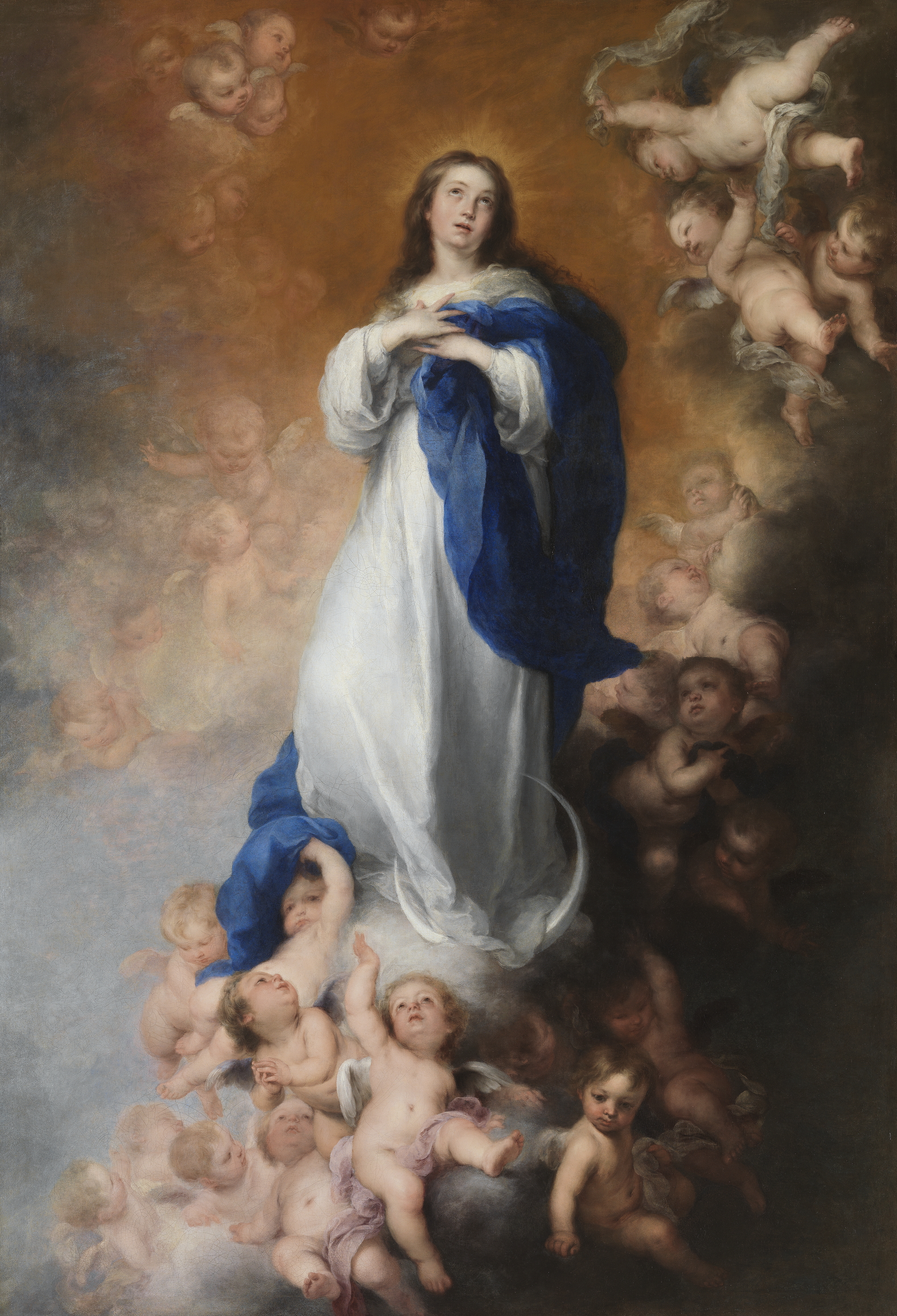
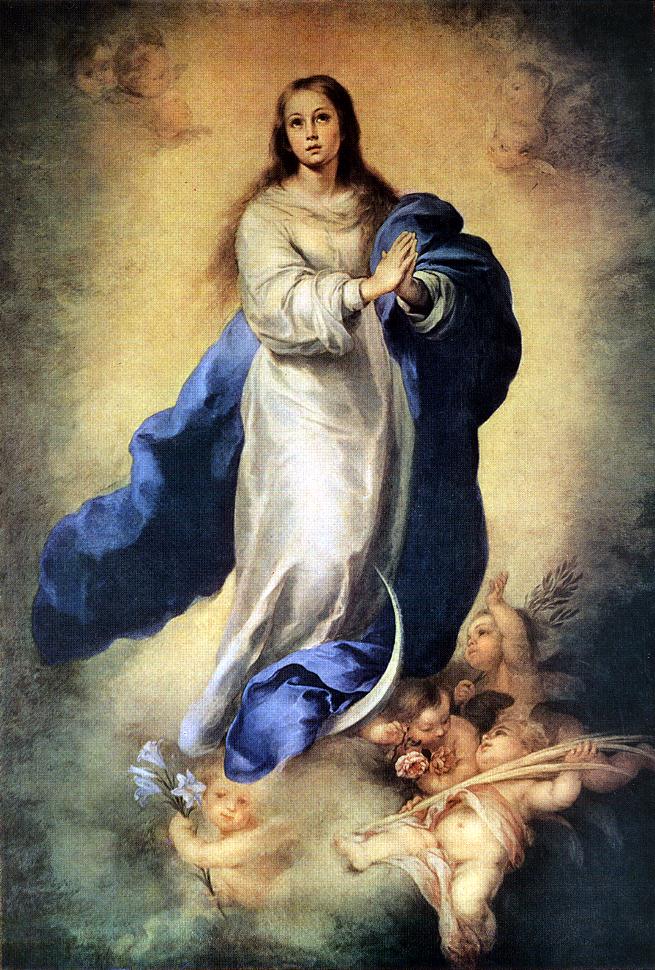
My favorite representations of our Lady, The Immaculate Conception.

The traditional one by Murillo


Where she taught us to pray, "O Mary conceived without original sin, pray for us who have recourse to thee."


Where she declared to the whole world, that SHE IS THE IMMACULATE CONCEPTION

Arch of Manila reminds priests of decorum in celebrating Eucharist

We are all aware of the meaning our celebration of the Eucharist. [Are we?] And in this sacrifice that we offer the presence of Jesus Christ in the bread and wine that the priests consecrate. [Hmmm.  It's not just His presence.  It is Him Who is present.  He offers Himself.  Priest and Victim.]  There is no need to reiterate the sacredness of the Sacred Host because of what it [He] is.

It is in this regard that we issue the following reminders with the aim of according the Sacred Host the proper respect and dignified treatment. Also these practices are aimed at preventing transmission of diseases through human contact. [Watch this.  This is more of the disease thing than the respect it purports to trumpet.]


Priests celebrating the mass and distributing communion should see to it that their hands are clean because these will handle the Sacred Host.  The hands should also be free of any element (dirt or substances that can be passed on to others through the Sacred Host).

The Extraordinary Ministers of Holy Communion distributing Holy Communion at a specified Mass should also observe the same cleanliness of hands as indicated above.

Extraordinary Ministers of Holy Communion should wash their hands if possible with soap and water or with sanitizer lotion or gel. But this should not be done as if this becomes an added liturgical action within the celebration of the Mass. [Meaning it should be done OUTSIDE of Mass.]

To avoid having their hands get in touch with dirt or possible germs, it is suggested that they [who?] assume the praying position [orans?  or clasped hands] during the duration of the Mass. It is also advised that they [who? both priest and EMHC?] do not handle money at any time during the Mass or after they have washed their hands. As much as possible they should not also touch their hair or faces, again, actions which a praying position can prevent.

We will appreciate all efforts on your part to observe the practices which we have suggested above. We are sure that by doing so we will enhance further our spiritual affinity with the ministry while at the same being witnesses to the faithful of the proper respect and honor that we should all accord the Sacred Host.

Thank you.


***

Are clean hands the only way we can treat the Sacred Host with respect?

Why so suddenly is the Archdiocese of Manila so Mysophobic?

How about the priest doing this?


In the TLM, after the consecration of the Host, the priest keeps his forefinger and thumb together of both hands. These fingers DO NOT touch anything other than the Sacred Host.  Notice this frame grab from a Traditional Mass in the Henceville Alabama Shrine of Mother Angelica.


 This is the liturgically correct position, YET, this is not emphasized in the Manila directive. Is this not respectful? Or this is not part of the disease thing?

How about this? Will this generate respect for the Eucharist?


Maybe we can start banning this form of communion if we really mean respect for the Eucharist, eh?

Just asking.

My take on the directive?  Better something than nothing.  But next time, mean what you say and say what you mean!  If it is for respect, then don't do it half-baked!

And before, I end this post, let us listen to some words of wisdom from a "not so known" theologian (at least from the guys at Maryhill!)
 
"Out of reverence towards this sacrament, nothing touches it, but what is consecrated; hence the corporal and chalice are consecrated, and likewise the priest's hands, for touching this sacrament."
-ST. THOMAS AQUINAS, Summa Theologica

Monday, December 7, 2009

SNAPSHOT: Archbishop visits cloistered Dominican nuns


Sisters, for the nth time. There is no such thing as a canonical "parole"!

Meditations for the Year of the Priest


Capuchin Friar Fr. Raniero Cantalamessa, Apostolic Preacher at the Vatican since 1980, will be starting the traditional Friday meditations for Advent in the Papal chapel, Redemptoris Mater, today. The subject of the meditations will be "Ministers of Christ and dispensers of the mystery of God."

Fr. Cantalamessa said that the series will "follow in line with the scope of Holy Father Benedict XVI's designation of the Year of the Priest..."

He said that the the meditations will "shed light on the original identity of 'the spirit of each priesthood,' returning to the foundation among all of the historic tasks and details taken on over the course of the centuries."

He added that the meditations will center around two biblical passages:

"Thus should one regard us: as servants of Christ and stewards of the mysteries of God. " (1 Corinthians 4:1) 

and

"Every high priest is taken from among men and made their representative before God, to offer gifts and sacrifices for sins. " (Hebrews 5:1)

***

Hmm...

Nothing about politics and about environmental protection...

"to offer gifts and sacrifices for sins."  Hmmm... another nail on the coffin of Liberation Theology and Participative Liturgy?

Hmm...

Sunday, December 6, 2009

A gift for those who bought the Da Vinci Code

There have been many books written about the rubbish and I believe this book will set the record-straight.  The intent of the authors drew me to post this on TPC.

Courtesy of Zenit.org

***

Righting the Da Vinci Code Record: Inside Secret Places, Hidden Sanctuaries

By Carrie Gress

NEW YORK, DEC. 4, 2009 (Zenit.org).- Truth is always more interesting than fiction, say the authors of "Secret Places, Hidden Sanctuaries."

In this interview with ZENIT, authors Stephen Klimczuk and Gerald Warner discuss debunking the falsehoods in "The Da Vinci Code" and their survey of the authentic mysteries that span the globe.

Q: What was the inspiration for writing this book?

Klimczuk: Having watched the explosion of interest worldwide in gnosticism, "alternative history," secret societies, the occult, Templar myths, conspiracy theories, government cover-ups, UFOs and the like, we felt there was an urgent need for someone to step forward and set the record straight across a wide spectrum of subjects that are actually fundamentally related on some level.

What started gradually some two decades ago with the New Age movement and such precursors to Dan Brown's books as "Holy Blood, Holy Grail" (with its bogus claims of "proof" that Christ married and left descendants) has since become a global multi-billion dollar industry and a substitute for religion for tens, if not hundreds, of millions of people.

We thought that the right kind of compendium could provide a robust and skeptical debunking of esoteric nonsense, while highlighting potentially authentic mysteries of genuine interest -- on the principle that truth is actually more interesting, satisfying, and even entertaining than falsehood.

According to one poll, some 6 million people in Britain believe that Dan Brown's books are true. This seems to be a particularly fertile time for quacks, frauds and false prophets.

Q: Many of the sites in your book are Catholic. It is the Church's extensive history that provides so many sites, or do you think there is something particular about Catholicism, as opposed to say Protestantism, that lends itself to mystery?

Warner: Most certainly. The word "mystery" permeates Catholic belief and theology: the Mystery of the Blessed Trinity, the Mysteries of the Rosary, and so on.

One of the many things that differentiates the Catholic mentality from the secular is the humility whereby we acknowledge that so much of God's Providence is unknowable to our puny human intellect, unlike secular scientists who press on with investigation of the universe in the humanist delusion that one day everything will have been explained satisfactorily.

It is true that, as Catholics, we have a right, even a duty, to attempt respectfully to find out more about God and his intentions for us. But we do so within the context of acknowledging our own limitations and seeking only knowledge that may be of help to us in working out our salvation.

Klimczuk: One only needs to visit the bare, whitewashed church interiors in the Protestant parts of Switzerland, Holland, Scotland and America's New England region to realize that there is something in the Reformed tradition that was (and is) deeply uncomfortable with mystery and the mystical, and with rich iconography and visual symbolism.

So it's not surprising that so many of the sites we cover in our book are Catholic -- or Eastern Orthodox, as with our reportage of the Monastery of St. Catherine of Sinai, the Autonomous Monastic Republic of Holy Mount Athos, and the former Great Church of Holy Wisdom (now the Hagia Sophia museum in Istanbul).

Those of us who are Latin Catholics would do well to note that the Eastern churches refer to what we call the sacraments as the "holy mysteries" -- a beautiful complement to our understanding of sacramental life.

Q: The first chapter of your book deals with the "secrets" of "The Da Vinci Code." From your research, are any of them valid?

Klimczuk: Although Dan Brown writes at the beginning of "The Da Vinci Code" that his novel is based on genuine facts about the Priory of Sion, Opus Dei, various "secret rituals" and other matters, it's actually hard to find anything that passes any reasonable test for historical accuracy.

Not only was Opus Dei falsely portrayed, but the so-called Priory of Sion was a colossal hoax cooked up in 1956 by a convicted French fraudster.

In our book, we also take the readers on a detailed tour of Rennes-le-Chateau in France and Rosslyn Chapel in Scotland, two sites which play a key role in the myths spun in "The Da Vinci Code."

It's just possible to ascribe some limited authenticity to the shocking sex rite depicted in the book, as similar rituals have had a place in some pagan and neopagan rites.

Warner: If Dan Brown wants to amass a great fortune through his writing then I, as a fellow writer, say good luck to him. But he could have done so without concocting an offensive blasphemy against Our Lord and St. Mary Magdalene, to which I strongly object.

As a British resident, as soon as I found the aircraft from the United States that Brown depicts descending over "the misty hills of Kent," I realized we were entering a very esoteric landscape indeed, considering that flat Kent, famous for its hop fields, is known as the "Garden of England."

Q: How did your knowledge of Catholicism help you to substantiate or debunk many of the false claims in the Da Vinci code and other secret places in general?

Klimczuk: Fides et Ratio -- faith and reason -- clearly go together, but one doesn't have to be Catholic or indeed any kind of practicing Christian to exercise discernment given the avalanche of bizarre claims that has hit the marketplace.

Any reasonable person of good will could conceivably begin with the available facts, always a good starting point.

Warner: Yes, that’s right. Any moderately educated agnostic would be able to see through most of the hocus that is swamping the Internet and crowding the bookshops.

Q: What have been the most surprising secret sanctuaries you found?

Klimczuk:  Perhaps the most important site we cover is one of the least known: Wewelsburg Castle, in Germany, which was Heinrich's Himmler's "Black Camelot" and "Nazi Vatican" -- the centerpiece of the Nazi pseudo-religion that brought so much suffering to the world.

When visitors to Auschwitz ask, "How could they do it?" we think the answer lies at least partly in this too-little-known Westphalian castle.

Of course, people are fascinated by pirate stories and legends of buried treasure, and we think it is quite possible, for reasons we explain, that the greatest undiscovered treasure of all time remains concealed on the island of Montecristo in the Mediterranean.

It is also an Italian government total exclusion zone, and even sailboats and fishing vessels are forbidden from getting too close. All this makes for a very good tale, and one that has the ring of plausibility.

We couldn't write a book of this kind without covering theories of the survival of the Ark of Covenant and of the Holy Grail.

It is just possible that the Ark has survived and is kept in a small chapel in Aksum, Ethiopia, where a monk (who is its guardian for life) guards it. However, since no other person on earth is allowed to see it, it's not possible to verify the claims.

As for the cup used by Christ at the Last Supper, the most plausible existing object is the Holy Chalice of Valencia in Spain, with which Benedict XVI celebrated Mass when he was there.

The Church makes no claims about its authenticity, and it is not associated with any mystical, supernatural or miraculous phenomena. We take the view that this is not surprising, given that -- in some sense -- every chalice used at Catholic Mass (or at Orthodox divine liturgy) is the Holy Grail, as time and space are rendered obsolete in the mystery of the Eucharist.

That would arguably make the original holy cup, should it still exist, no more or less exalted than any other consecrated chalice used around the world today.

Q: Why do you think secret places have found such a niche in our culture? Is there something particular about our era, such as more information because of the Internet, or is this a timeless interest?

Klimczuk: This interest in secret places, hidden history and gnostic ideas is not a passing fad -- it is likely to with us in even further strengthened form in the years and decades to come.

When you combine rapid societal change and disorientation, the natural, perennial human hunger for the spiritual, and a low standard of religious and historical literacy, this is what you get. One might even say that it is the world's fastest-growing "industry."

Benedict XVI's emphasis on restoring the beauty, integrity and richness of the liturgy is one way of responding to a world hungering for something genuinely satisfying.

We think of the words of Father Walton Hannah, a Church of England clergyman who emigrated to Canada in the late 1950s and became a Catholic priest: "[given the elimination of] most of the color, glamour, and ceremonial from Christian worship, ... When the soul is starved of these elements in religion, it will naturally tend to compensate itself in less desirable ways."

Warner: Humanity's need for the numinous cannot be denied. The dubious quotation often attributed to G.K. Chesterton -- that when man ceases to believe in God he does not believe in nothing, but will believe in anything -- is sadly true.

***

ALL TOGETHER NOW.....AMEN!

Friday, December 4, 2009

Great new Facebook Group


I found this great new group on Facebook.  "GET BACK IN THE BOX".  It is a "Movement to Encourage Catholics to frequent the Sacrament of Reconciliation / Penance".  It was recommended to me by a very dear friend and I encourage those with Facebook accounts to join in.


When was the last time you received this sacrament?

See the guy behind the confession screen?

Other great FB groups are SLAP (Survivors of Liturgical Abuse of Parishes), GULP (God's Undercover Liturgical Police).  Come and join!

Pass the word!

***

Just in...from Zenit


Benedict XVI Invites Faithful to Confession 

Notes 25 Years Since John Paul II's Document on Sacrament

VATICAN CITY, DEC. 2, 2009 (Zenit.org).- Benedict XVI today encouraged the faithful -- and particularly priests -- to trust in God's goodness and approach the sacrament of confession.

The Pope spoke of this sacrament today as he concluded the general audience in St. Peter's Square. In his customary greeting to youth, the sick and newlyweds, he observed that today marks the 25th anniversary of Pope John Paul II's apostolic exhortation, "Reconciliatio et paenitentia."

The document "called attention to the importance of the sacrament of penance [hmm interesting term the Holy Father used.] in the life of the Church," the Holy Father said. And he pointed to some "extraordinary 'apostles of the confessional,' tireless dispensers of divine mercy: Sts. John Mary Vianney, Joseph Cafasso, Leopold Mandic, Pio of Pietrelcina."[Another reason why Papa Benny declared the Year of the Priest!  I personally experience priests who are devoted to this Sacrament exude an aura of holiness around them.  And related to that, they celebrate Mass, solemnly!  Do you notice the same in your priests?  Share your thoughts.]

Turning to youth, he expressed his hope that the witness of these saints would be an encouragement "to flee from sin and to plan your future as a generous service to God and neighbor."

The Holy Father continued: "May it help you, dear sick people, to experience in suffering the mercy of Christ crucified. And may it solicit you, dear newlyweds, to create in the family a climate of faith and of mutual understanding."[Calls to mind the great apostolic letter of John Paul II, "Salvifici Doloris".  Worth reading!]

Finally, the Pontiff expressed his wish that these saints -- "assiduous and faithful ministers of divine forgiveness" -- would be for priests especially and for all Christians "an invitation to always have confidence in God's goodness, approaching and celebrating with trust the sacrament of reconciliation."