

The blog of a group of Filipino Catholics and their frank commentary on anything that affects their lives as a citizen of the Philippines and as a Roman Catholics.
Tuesday, March 5, 2013


Holy Water....holy!!!
(%@&!!!
Well, a quick research on YouTube showed that the priest Juan Ramon Hernandez, has been doing this Holy Water Gun since 2011!
Along with the superhero chasubles...
And here is the most recent one.
And the bishops are not doing anything against it.
Is this Mexico or the Philippines or Los Angeles or...
Grrr....
What's next?
This for incense?

This for Ash Wednesday?

Sacred actions are accompanied with sacred items. A water toy gun is not set aside for holy things.
And Superman and Spiderman???
Good grief!
***
By the way, thanks for AJP and our dear friend in the clergy for sending this to me.
Yes, Father.
He has been GULPED!
HA!
Well, a quick research on YouTube showed that the priest Juan Ramon Hernandez, has been doing this Holy Water Gun since 2011!
Along with the superhero chasubles...
And here is the most recent one.
And the bishops are not doing anything against it.
Is this Mexico or the Philippines or Los Angeles or...
Grrr....
What's next?
This for incense?
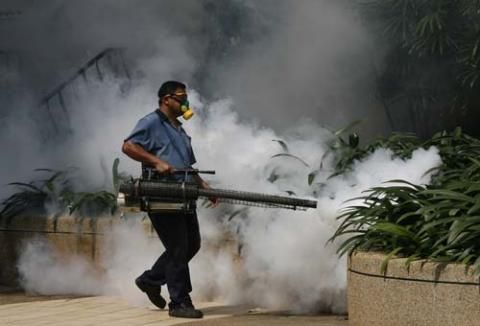
This for Ash Wednesday?

Sacred actions are accompanied with sacred items. A water toy gun is not set aside for holy things.
And Superman and Spiderman???
Good grief!
***
By the way, thanks for AJP and our dear friend in the clergy for sending this to me.
Yes, Father.
He has been GULPED!
HA!
The Conclave: A quick overview
Courtesy of the Vatican News website
 Click the image for a larger view.
Indulgenced prayer before a crucifix during Lent
Lest we forget because of all the talk about the recent papal resignation and upcoming conclave...
Don't miss praying this during Lent.

Taken from a paper from the Supreme Council of the Order of the Knights of Columbus:
One can obtain a plenary indulgences for himself. However, we can offer that plenary indulgence for a soul in purgatory. This is an act of charity and spiritual tithing to do during Lent. A plenary indulgence is gained every Friday in Lent by saying the following prayer before a Crucifix after receiving Holy Communion. The usual requirements for a plenary indulgence also apply
Conditions to Obtain the Indulgence
Handbook of Indulgences, Norms
An indulgence is the remission in the eyes of God of the temporal punishment due to sins whose culpable element has already been taken away. The Christian faithful who are rightly disposed and observe the definite, prescribed conditions gain this remission through the effective assistance of the Church, which, as the minister of redemption, authoritatively distributes and applies the treasury of the expiatory works of Christ and the Saints.
***
I posted this a year ago.
Don't miss praying this during Lent.

Taken from a paper from the Supreme Council of the Order of the Knights of Columbus:
On any Friday during Lent a plenary indulgence is granted the Christian faithful who, after Communion, devoutly recite the above prayer before an image of Jesus Christ crucified. On other days of the year the indulgence is a partial one.Handbook of Indulgences
One can obtain a plenary indulgences for himself. However, we can offer that plenary indulgence for a soul in purgatory. This is an act of charity and spiritual tithing to do during Lent. A plenary indulgence is gained every Friday in Lent by saying the following prayer before a Crucifix after receiving Holy Communion. The usual requirements for a plenary indulgence also apply
PRAYER BEFORE A CRUCIFIX
Behold, O kind and most sweet Jesus,
I cast myself upon my knees in Your sight,
and with the most fervent desire of my soul I pray and beseech You
that You would impress upon my heart
lively sentiments of Faith, Hope, and Charity,
lively sentiments of Faith, Hope, and Charity,
with true repentance for my sins,
and a firm purpose of amendment,
and a firm purpose of amendment,
while with deep affection and grief of soul
I ponder within myself and mentally contemplate
I ponder within myself and mentally contemplate
Your five most precious Wounds;
having before my eyes the words which David in prophecy
spoke concerning Yourself,
O good Jesus:
“They have pierced my hands and feet;
they have numbered all my bones.
Conditions to Obtain the Indulgence
Handbook of Indulgences, Norms
An indulgence is the remission in the eyes of God of the temporal punishment due to sins whose culpable element has already been taken away. The Christian faithful who are rightly disposed and observe the definite, prescribed conditions gain this remission through the effective assistance of the Church, which, as the minister of redemption, authoritatively distributes and applies the treasury of the expiatory works of Christ and the Saints.
1. Besides the exclusion of all attachment to sin, even venial sin, the requirements for gaining a Plenary Indulgence are the performance of the indulgenced work and fulfillment of three conditions: Sacramental Confession, Eucharistic Communion, and prayer for the Pope’s intentions.
2. Several Plenary Indulgences may be gained on the basis of a single Sacramental Confession; only one may be gained, however, on the basis of a single Eucharistic Communion and prayer for the Pope’s intentions.
3. The three conditions may be carried out several days preceding or following performance of the prescribed work. But it is more fitting that the Communion and the prayer for the Pope’s intentions take place on the day the work is performed.
4. If a person is not fully disposed or if the prescribed work and the three mentioned conditions are not fulfilled, the Indulgence will only be partial ...”
5. The condition requiring prayer for the Pope’s intentions is satisfied by reciting once the Our Father and Hail Mary for his intentions (Pater Noster and Ave Maria); nevertheless all the faithful have the option of reciting any other prayer suited to their own piety and devotion.”
***
I posted this a year ago.
What to say at Mass during a Sede Vacante
Rome, February 19, 2013 (Zenit.org) Father Edward McNamara, LC
***
Answered by Legionary of Christ Father Edward McNamara, professor of liturgy and dean of theology at the Regina Apostolorum university.
Q: After Feb. 28, and before the election of a new pope, do we continue to name Benedict in the Eucharistic Prayer of the Mass? My opinion is that we do what we do when the pope dies: Say no name but continue on to the bishop. -- E.R., Keimoes, South Africa
A: Our reader's opinion is correct. Even though Pope Benedict XVI will be thankfully still alive, the Holy See will be vacant as of 8 p.m. Rome time (2 p.m. New York time; 4 a.m. March 1, Sydney time).
With respect to naming the pope most of the recent liturgical manuals don't go into such detail, but manuals from before the Second Vatican Council can still be found that touch on the more arcane aspects of liturgy. [Arcane but useful! Most of the liturgical books pre-Vatican II are down pat to the last detail of what to do. That is the reason for the rubrics and the liturgical laws. For order! Remember that does who love to use the term "rubricism" and being too "tied down with liturgical laws" are most likely to commit liturgical abuse. Mark my words.]
In this case the pope's name, and the entire phrase referring to the pope, is omitted from the Eucharistic Prayer during the period of the sede vacante. Mention is made only of the local bishop and the clergy according to the literary form of each prayer.
For example, in Eucharistic Prayer II it would be: "Together with … N. our bishop, and all the clergy." [This goes out to all Catholic churches, chapels and oratories.]
In the Diocese of Rome: "Together with …. all the clergy." Even though the cardinal vicar of Rome and the auxiliary bishops remain in their functions, their collective mention is optional.
An analogous procedure is followed in each diocese following the death or retirement of the local ordinary. During a time of vacancy of the episcopal see, the clause "N., our Bishop" is also simply omitted. The name of an apostolic administrator is mentioned but not that of a temporary diocesan administrator. [It should go like "For N., our apostolic administrator. There are dioceses in the Philippines that are still sede vacante or have only an apostolic administrator like Bontoc - Lagawe, Infanta, Imus, Gumaca, Dumaguete, Romblon, Kalookan, San Carlos and the Archdiocese of Zamboanga. Liturgists and those in the...uhm..."Worship Ministry" would have to take note of this.]
In the case where both diocese and the Holy See are currently vacant, the priests would follow the same practice as in Rome, omitting both names.
***
Praying for the cardinal electors...
...that is what we need to do also!

Monday, March 4, 2013

Padre Pio's advice to us during the Sede Vacante...
...and against all those end of the world prophecies.


The meaning of the Arms of the Sede Vacante
I will not be writing who loses his job or who gets to keep his during a Sede Vacante. Wikipedia has written about that quite extensively.
What I'll be posting today is the explanation of the arms of the Holy See Sede Vacante.
Since most people have been using this emblem as their own profile photo in Facebook during this Sede Vacante, I thought of making a post to explain each of the ecclesiastical devices used in the Arms of the Holy See Sede Vacante.
But before continuing on look at the difference at the Arms of the Holy See and the Arms of Vatican City.
 |
| Arms of the Holy See |
 |
| Arms of Vatican City |
Notice the difference?
It is the placement of the keys.
The meaning of the keys also accounts for the meaning of the arms.
The Gold Key represents the Key presented by Christ to Peter with the power lose and bound those in Heaven and on Earth. While the Silver Key represents his earthly powers of governance in the Vatican City State.
So as you can see, the gold key's end points to the left for the arms of the Holy See, with the left or dexter side traditionally representative of Heaven. That of the right side or sinister side to that of the earth, thus the end of the silver key pointing to the right side. The ends of the keys are in the lower part of the arms indicating the power to turn the keys rests in the hands of the the bearer of the keys, the Pope. As in traditional chivalric charges, the headdresses of the owner of the arms rests above the keys. For knights it is their helmets, kings have their crowns, dukes and princes their coronets, and for the pope, the triple crown symbolical of the Pope's power as Supreme Pastor, Supreme Teacher and Supreme Priest.
So you can see how the keys are differently placed in the arms of the Holy See and the arms of Vatican City State.
(The meaning of the red and gold cords on both the Arms of Vatican City and the Holy See were not properly defined.)
Now during a sede vacante, the tiara is taken out to symbolize the absence of a reigning Pope. But what we have "crowning" the keys is an umbrella known as umbraculum (in Latin) or ombrellino in Italian and in English uhm...it's called an umbrella.

It can trace its origin with the Borgia Pope Alexander VI who used during processions. Royalty used these ornate umbrellas when they go out for processions and Alexander VI who had a very nasty reputation for flare and pageantry used it to emphasize his temporal powers.
The canopies also denote the power of the cardinals as a collegial bodies. This is evident in conclaves before the 1978 Conclave when the number of cardinals were so few that there were canopies above the heads of each sitting cardinal in the Sistine Chapel sitting in conclave.
Once the cardinal elected responds "Accepto" to the question of the cardinal dean whether he accepts his canonical election to the papacy, the other cardinals stand and pull the strings holding their canopies. This will cause the canopies to fold up thus acknowledging that there, among them, is someone of higher authority than them. The only canopy left unfolded is that of the cardinal elected into the papacy.
I highly suggest you watch "The Shoes of the Fisherman" for a more accurate portrayal of the papal conclave.
The canopies also denote the power of the cardinals as a collegial bodies. This is evident in conclaves before the 1978 Conclave when the number of cardinals were so few that there were canopies above the heads of each sitting cardinal in the Sistine Chapel sitting in conclave.
Once the cardinal elected responds "Accepto" to the question of the cardinal dean whether he accepts his canonical election to the papacy, the other cardinals stand and pull the strings holding their canopies. This will cause the canopies to fold up thus acknowledging that there, among them, is someone of higher authority than them. The only canopy left unfolded is that of the cardinal elected into the papacy.
I highly suggest you watch "The Shoes of the Fisherman" for a more accurate portrayal of the papal conclave.
The ombrellino then became the symbol of the Pope's temporal powers and it is actually given as one of the privileges of minor basilicas along with the use of the Tiara and Crossed Keys.
Ombrellinos are now used as the power of the Holy See over papal basilicas. It is commonly seen in minor basilicas with the bell on a rod known as a tintinnabulum.
 |
| Tintinnabulum of Mission Dolores Basilica, San Francisco, USA |
 |
| St. Louis Cathedral - Basilica, St. Louis, MO |
Don't strain yourself. You won't find this in any minor basilica in the Philippines. Filipino rectors of these basilicas either don't know about this or simply don't care about these "popishry".
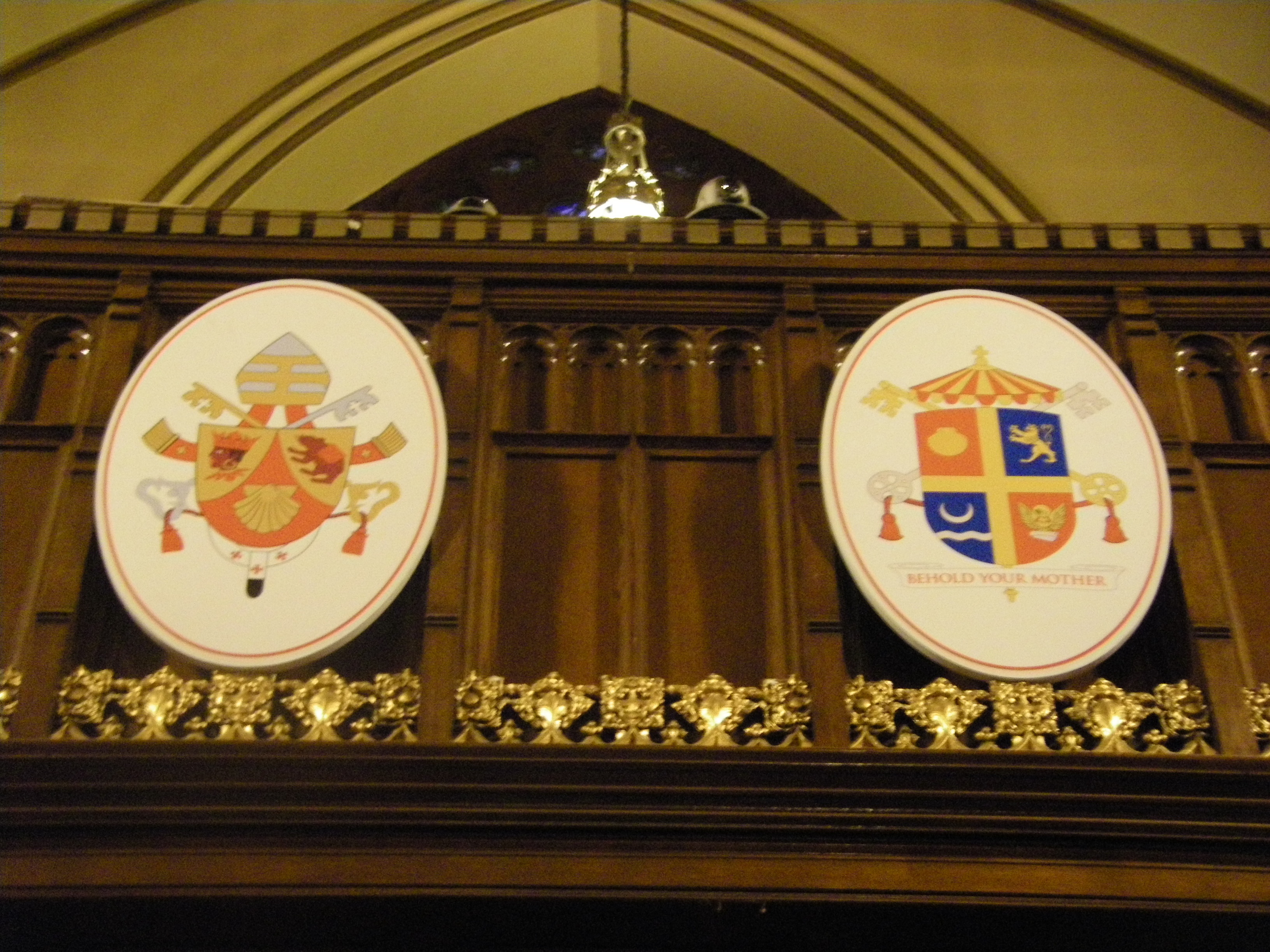 |
| Basilica of St. John the Evangelist Stamford, CT |
And here is the arms of the reigning pope, which at that time the photo was taken was Benedict XVI and the arms of the basilica which....is ALSO not done here in the Philippines.

And here is the arms of the Cardinal Camerlengo. He possesses these arms even though not is sede vacante to mark him as not just your "usual cardinal".
So what does the arms of the Holy See Sede Vacante denote?
Just like the functions of the Camerlengo...Temporal Governance of the Holy See. Just as the ombrellino denotes temporal powers, so does the Holy See Sede Vacante is being governed on purely temporal matters, until the successor of St. Peter sits upon his chair.
Saturday, March 2, 2013
The Sede Vacante begins...
...along with the sealing of the papal apartments.
Honestly, my first time to see this actually being done.
Honestly, my first time to see this actually being done.
Friday, March 1, 2013
The Vatican website Sede Vacante

This is the arms of the Holy See sede vacante. Keys in saltire with the ombrellino in the center...NO arms of the former pope, who ever made that one does not know heraldry.
Sede Vacante: Now we must pray harder
It is the first Friday of the month, Sacred Heart Day!
Pray! Pray! Pray!

The Chair of Peter awaits...
Pray! Pray! Pray!

The Chair of Peter awaits...
Subscribe to:
Posts (Atom)