Pages

Monday, January 11, 2010

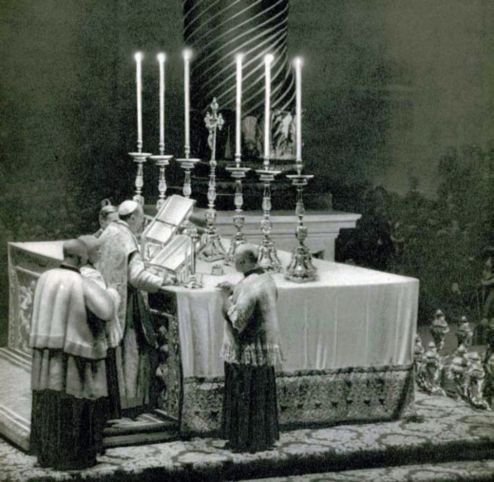
Why the crucifix MUST BE in the center of the altar


Pope Benedict XVI

 
Venerable Pius XII

Hence the reason for the proposal made by the then Cardinal Ratzinger, and presently reaffirmed during the course of his pontificate, to place the Crucifix on the centre of the altar, in order that all, during the celebration of the liturgy, may concretely face and look upon Lord, in such a way as to orient also their prayer and hearts. Let us listen to the words of his Holiness, Benedict XVI, directly, who in the preface to the first book of his Complete Works, dedicated to the liturgy, writes the following: “The idea that the priest and people should stare at one another during prayer was born only in modern Christianity, and is completely alien to the ancient Church. [As some liturgists purports that celebrating Mass facing each other is an ancient way, listen to what the pope has to say.] The priest and people most certainly do not pray one to the other, but to the one Lord. Therefore, they stare in the same direction during prayer: either towards the east as a cosmic symbol of the Lord who comes, or, where this is not possible, towards the image of Christ in the apse, towards a crucifix, or simply towards the heavens, as our Lord Himself did in his priestly prayer the night before His Passion (John 17.1) In the meantime the proposal made by me at the end of the chapter treating this question in my work ‘The Spirit of the Liturgy’ is fortunately becoming more and more common: rather than proceeding with further transformations, simply to place the crucifix at the center of the altar, which both priest and the faithful can face and be lead in this way towards the Lord, whom everyone addresses in prayer together.”

***

Does your parish church place the cross at the center of the altar?

Another bombing of the Jolo Cathedral

In a follow up with the immediately preceding post.

***

ZAMBOANGA CITY, Philippines/10 January 2010 by Frencie Carreon

Police authorities in Jolo, the capital town of Sulu province some kilometers away from this city, said there was zero casualty in today’s bombing of the Jolo cathedral. [The cathedral again.]

A police report said that an Improvised Explosive Device blew off at said Roman Catholic church in Walled City, Jolo, causing damage to the window jalosies.

Said IED went off at about 5:40 in the morning, police said.

As of press time, the Explosive Ordnance Disposal Team of the Jolo Municipal Police Station as well as the Scene-Of-the-Crime Operation were jointly conducting an investigation as to who could be behind the blast and for what specific motive was the IED planted for.

This is not the first time that a bomb exploded within the vicinity of the Jolo cathedral, the biggest Catholic church in the entire Sulu province, the most recent being on New Year’s Eve and in late October last year where the bomb exploded the back of the church, near the cemetery of the Notre Dame fathers. [I don't think there are any Notre Dame Fathers.  I think the reporter is referring to the Oblate Fathers who are the missionaries of the archipelago.  The current bishop is an Oblate, Bishop Lito Lampon] In early July 2009, a bomb placed in a parked motorcycle in front of a hardware near said church exploded. [See the trend here?  It is the persecution of Christians!]

Police and military authorities theorized in all instances that the Abu Sayyaf Group are behind these incidents as part of the latter’s terror activities. However, no one from the ASG may confirm nor deny whether any or all indeed of these activities are the terror group’s handiwork. (Frencie Carreon, The PhilSouth Angle)

***
Pray for the Christians in Jolo.  They are suffering.
For photos of the Jolo Cathedral, click here

Sunday, January 10, 2010

The "religion of peace"?

More Christian Churches attacked by Muslims

KUALA LUMPUR, Malaysia – Firebombs were thrown at two more churches in Malaysia early Sunday and another church was splashed with black paint, the latest in a series of assaults on Christian houses of worship following a court decision allowing non-Muslims to use "Allah" to refer to God.

Hundreds of worshippers whose parish church was partly gutted in a firebomb attack last week gathered at a makeshift prayer hall for their Sunday service and called for national unity and an end to violence.

On Sunday, a Molotov cocktail was hurled at the All Saints Church in Taiping town in central Perak state early in the morning before it had opened, said state police chief Zulkifli Abdullah. He told The Associated Press that the building was not damaged but police found burn marks on the wall.

A broken kerosene bottle with an unlit wick was found early Sunday inside the compound of the St. Louis Catholic church, also in Taiping, said the Rev. David Lourdes. He said it appeared to be a failed attack.

In southern Malacca state, the outer wall of the Malacca Baptist Church was splashed with black paint, police said.

Four other churches were hit by gasoline bombs on Friday and Saturday. All except the Metro Tabernacle, whose parishioners moved their services, suffered little damage, and no one was hurt. The other three held normal services Sunday.

The unprecedented attacks have set off a wave of disquiet among Malaysia's minority Christians and strained their ties with the majority Malay Muslims.

The dispute is over a Dec. 31 High Court decision that overturned a government order banning non-Muslims from using the word "Allah" in their prayers and literature. The court was ruling on a petition by Malaysia's Roman Catholic Church, whose main publication, the Herald, uses the word "Allah" in its Malay-language edition. The government has appealed the verdict.

About 9 percent of Malaysia's 28 million people are Christian, most of whom are ethnic Chinese or Indian. Muslims make 60 percent of the population and most of them are ethnic Malays.

On Sunday, men, women and children from the Metro Tabernacle parish assembled in the cavernous, 1,800-seat meeting hall of the Malaysian Chinese Association party for the service. They lifted their hands and sang "We put all our faith in you," and "You are the God of love and peace" during the Sunday service.

"My wife was worried, but we want to be here to support the church," said Michael Chew, 40, who came to the service with two children, aged 1 and 6.

The service was in English, as are most Christian services in mainland Malaysia, though some are in Chinese and Tamil languages. Such services do not use the word "Allah." Only the Malay-language prayers for indigenous tribespeople in the remote states of Sabah and Sarawak use "Allah," as they have for decades.

Rev. Hermen Shastri, general secretary of the Council of Churches of Malaysia, said Christians won't be intimidated by the attacks, describing them as the work of extremist minority among Muslims. [you think?]

"What is clear is that it is done by extremist groups. It does not reflect the majority Muslims in the country. We all have to stand together to stamp out terror perpetuated by these extremist groups," he said. [really?  we always here that but try counting the number of religion based attacks and see that majority are caused by those working in the name of their religion.]

The government contends that making Allah synonymous with God may confuse Muslims and ultimately mislead them into converting to Christianity. [which they are afraid of.  Look at Saudi and other Islamic countries where Christians do not enjoy religious freedom yet Muslims enjoy this in non-Muslim countries.]

Still, government leaders and many Muslims have condemned the firebombings, saying it is un-Islamic to attack places of worship.

Prime Minister Najib Razak visited the Metro Tabernacle church late Saturday and announced a grant of 500,000 ringgit ($147,000) for rebuilding it at a new location, a major concession in a country where permission is rarely given for building new churches or temples.

The Allah ban is unusual in the Muslim world. The Arabic word is commonly used by Christians to describe God in such countries as Egypt, Syria and Indonesia, the world's largest Muslim nation.

***
Attacks on Christians everywhere are not just cased on the Allah ban but mainly extremists Muslim who want a Muslim dominated world.

Read the Islamization Watch to get the real picture.

A bishop of the Coptic Church, Anba Kirolos, puts it bluntly.

    It might seem natural that at least some attention would be paid in the West to the plight of these Christians. Instead, attention seems endlessly focused on "Islamophobia," not least at the U.N.'s misnamed Human Rights Council. In November, much of Europe went berserk over the Swiss referendum to ban the construction of minarets (though not of mosques). But the West's tolerance for its large Muslim populations stands in sharp contrast to the Muslim world's bigotry and persecution of its own religious minorities. That's a fact that ought to be borne in mind the next time Westerners berate themselves about their own supposed "intolerance."
    See more proof here.

SIGN THE PETITION

We believe that the newly approved English translation of the 2002 Missale Romanum needs to be implemented as soon as possible.


We believe that the Church in English-speaking nations has waited far too long for an accurate, faithful translation of the original Latin.


We believe that the current translation currently in use in English-speaking nations is overdue to be replaced, as it was developed using the method of dynamic translation, a method rejected by the Vatican in the document Liturgiam Authenticam.


We stand united with the English-speaking bishops' conferences in their approval of the new translation.

We oppose any efforts to continue to delay this new translation.


***

Need I say more?

To sign the petition, click here.

Friday, January 8, 2010

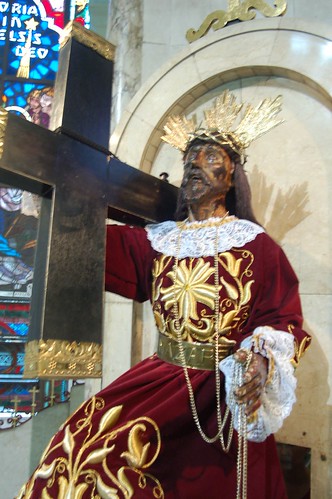
THE GREAT FEAST OF THE BLACK NAZARENE


Tomorrow is the Great Feast of the Black Nazarene.

I will be heading to the Minor Basilica tomorrow morning to hear Holy Mass (OF Mass) of course. (hi blackshama!) and will spend an hour in Eucharistic Adoration to pray for my and my family's intentions and also to pray for my dear TPC readers.

I am a devotee of the Black Nazarene.  I carry a novena with His picture in my clutch bag all the time.  It started when I went to the Basilica to ask for a favor.  It was days before my masteral thesis defense.  I assisted at Mass, kept vigil and asked him for a specific grade for my thesis.

The Lord granted my petition exactly as I asked Him, right on to the last detail!  Exactly the numbers I was asking him.  The Lord really works in mysterious ways.  From then on, I know that I need not worry and just trust the Lord who labored to bring the heavy cross to complete His work of saving my poor soul.

Whenever I go to Quiapo, even if I am too hungry and if I need to heed the call of nature, the first order of business is to say hi to the Lord at Quiapo Church.  I make it a point to pray at the Basilica to honor our Lord, the Black Nazarene and to trust in His Goodness and Divine Mercy.

Now my wife is a devotee too.  And we both have miniature images of the Señor.

Tomorrow, I will be praying to the Lord that He may grant my and my family's petition.  And a very special one, too.  And I will also include all those who pass by my lowly blog.

All in His own good time.

Viva Señor!

***

That is the picture of the Black Nazarene in the shrine.

The one below is courtesy of Robby de La Vega in his Flicker account.

Upon closer examination, you can see on the left cheek of the Nazarene, (viewer's right) one can see a hole mark.  According to accounts, that was made by a bullet fired by a member of the dreadful Iglesia ni Cristo when the procession carrying the revered image passed through their chapel.

Here is a photo showing the bullet hole.


For more about the Black Nazarene, click here and here.

***
I will also be praying for the conversion of my boss who is now an apostate, who besmirch our Holy Mother Church for her stand on the sanctity of life.  He even told me that people who go to Quiapo are the desperate ones, (he doesn't know I am a devotee.) and that is why the Church would want overpopulation to happen so that more people will hope hopelessly to go touch the Nazarene.

Please pray for his conversion.

Please say this prayer:  "Dear Lord, Señor Nazareno, please convert and touch the heart of the boss of Pinoy Catholic and bring him back into your fold.  For the sake of your Sorrowful Passion and the Sorrows of Your dearly beloved Mother, we ask this favor. Amen."

A simple prayer that will go a long way.

Viva Señor!

The Sedia...almost

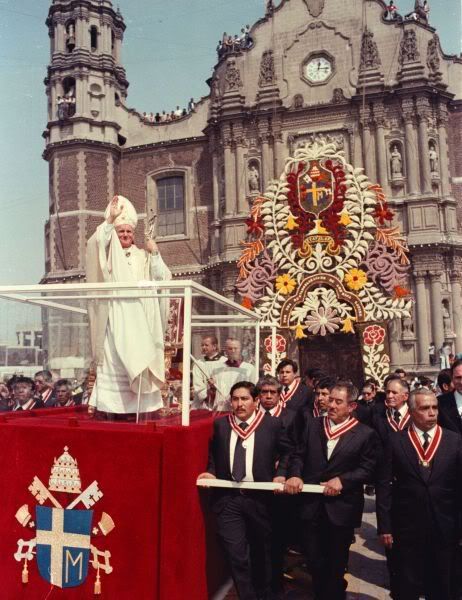
With all the buzz about bringing back the Sedia Gestatoria to prevent a similar attack on the Pope on Christmas ever from happening again...

Here's an interesting photo courtesy of hallowedground.wordpress.com


John Paul II in Guadalupe, standing on a mobile platform.

Not bad.

Thursday, January 7, 2010

What is TRUE ACTIVE PARTICIPATION

After the publication of Sacrosanctum Concilium, liberal-do-it-yourself-liturgist trumpet "active participation" as some sort of a license to pick any Tom, Dick and Harry and Jane out of the pew to give them a more active role in the celebration of the Church's liturgy.  So you have liturgical dancers, female altar servers and what have you.

So for purpose of clarification, let us read what the not so known cardinal, Joseph Ratzinger, wrote, in his not-so-like book The Spirit of the Liturgy.

The emphasis and comments are from the great Fr. Z.


***

Cardinal Ratzinger, from his fundamental study “The Spirit of the Liturgy”: “What does this active participation come down to? What does it mean that we have to do? Unfortunately the word was very quickly misunderstood to mean something external, entailing a need for general activity, as if as many people as possible, as often as possible, should be visibly engaged in action. However, the word ‘part-icipation’ refers to a principal action in which everyone has a ‘part’... [Not everyone’s actions as individuals, even if they are doing things in a coordinated way.  Remember: there is one true Actor in the sacred action.] By the actio of the liturgy the sources mean the Eucharistic prayer. The real liturgical action, the true liturgical act, is the oratio....This oratio—the Eucharistic Prayer, the “Canon”—is really more than speech; it is actio in the highest sense of the word.” (pp. 171-2) [And that is not a moment in which the congregation, for example, traditionally has an outwardly active role expect to kneel at the proper place and rise at the end.  I will leave aside the problematic issue of the "acclamation" after the consecration.] Christ is made present in all of his salvific work, and for this reason the human actio becomes secondary and makes room for the divine actio, to God’s work.  [Right.  The true Actor in the sacred action is Christ the High Priest.]

Thus the true action which is carried out in the liturgy is the action of God Himself, his saving work in Christ, in which we participate. This is, among other things, the true novelty of the Christian liturgy with respect to every other act of worship: God Himself acts and accomplishes that which is essential, whilst man is called to open himself to the activity of God, in order to be left transformed. [Again, we must be actively receptive to what God wants to give us and be transformed in our encounter with mystery.] Consequently, the essential aspect of active participation is to overcome the difference between God’s act and our own, that we might become one with Christ. [We can control our own disposition, by fasting and confession, and engaging our minds and wills, but God is the true Actor.] This is why, that I might stress what has been said up to now, it is not possible to participate without adoration. [I tend to stress the issue of having that encounter with mystery.  I think that the way the liturgy is carried out bears a great burden in this.] Let us listen to another passage from Sacrosanctum Concilium: “The Church, therefore, earnestly desires that Christ’s faithful, when present at this mystery of faith, should not be there as strangers or silent spectators; on the contrary, through a good understanding of the rites and prayers they should take part in the sacred action conscious of what they are doing, with devotion and full collaboration. They should be instructed by God’s word and be nourished at the table of the Lord’s body; they should give thanks to God; by offering the Immaculate Victim, not only through the hands of the priest, but also with him, they should learn also to offer themselves; through Christ the Mediator, they should be drawn day by day into ever more perfect union with God and with each other, so that finally God may be all in all.” (n. 48)

***

I once went to Totus Bookstore at Greenhills with my brother.  The kind lady cashier told us that Fr. Diwa, the protege of master inculturator Anscar Chupungco bought a copy of "The Spirit of the Liturgy".  I asked my brother, "Is this a sign that they are re-orienting their liturgical agenda now that Papa Benny is in Peter's Chair?"  "I don't think so?"  he said.  "It is more of knowing the enemy."

Hmmm... After the intensive seminars about the liturgy that the dynamic duo of inculturation has been doing, my brother makes sense.

SNAPSHOT: Similarities?

In a discussion in WDPTRS of the great Fr. John Zuhlsdorf, Spanish pro-lifers sent gifts of coal to pro-abortion and agnostic Pres. Zapatero of Spain.  One of those who commented on the post said "Somebody sabotaged the official Spanish government website a couple of days ago and substituted a picture of Mr. Bean for that of Zapatero (there’s a distinct resemblance). Spaniards loved it!"

So I googled and found these.


Would you agree?

Physically and/or...

Just asking...

Playing the same numbers game

Those in the US who are in favor of abortion once trumpeted that "majority" are in favor of abortion.   The same is happening here in the Philippines for those who are in favor of artificial birth control.  Josemaria Lazaro Paulo Jeronimo Martin Carvalho-von verste sent me an interesting link about the so-called filibusters but which I call "Dan Brown clones" for fabricating history and concocting conspiracy theories all for sexual promiscuity masked as reproductive health.  Does it seem like the filth of Obamanation is creeping slowly into Philippine shores? [Sorry Josemaria.  It's taking me a while to post it.  Tons of work.  I'll try to catch up.]

Read below to see how the numbers game is being used against the pro-abortion champs who play the same game.

***

Most Favor Abortion Ban for Federally Subsidized Health Plans

Washington D.C., Jan 5, 2010 (CNA).- A new national telephone survey reports that a majority of American voters favor a ban on abortion coverage in federally subsidized health insurance plans, with 39 percent saying they strongly favor it.

About 53 percent of American voters surveyed by Rasmussen Reports said that they support the ban. Another 40 percent said they were opposed, with 26 percent saying they were strongly opposed.

A slight majority of those who strongly support the proposed health care plan were opposed to the provision on abortion funding, while 65 percent of those who strongly oppose the overall plan favor the provision.

Thirteen percent of respondents said they wanted mandatory coverage of abortion.

Overall, about 39 percent of Americans surveyed by Rasmussen support the health care legislation. [but without abortion funding which pro-abortion Catholic politicians like Pelosi, Kennedy, Sebelius, et al are championing.  I say...EXCOMMUNICATE THEM NOW!]

The Rasmussen Reports survey, whose results were released on Jan. 3, focused on abortion in federally subsidized insurance plans.

Opposition to direct government funding of abortion is reportedly stronger. A Dec. 22 Quinnipiac University survey said that 72 percent of Americans oppose public funding of abortion in health care legislation.

***

Will the agents of death honor the voice of the American people?

Wednesday, January 6, 2010

SNAPSHOT: To what denomination does this church belong to?


a. Lutheran
b. Episcopalian
c. Roman Catholic
d. none of the above
e. all of a, b and c.


The answer, click here.

Monday, January 4, 2010

Pinoy archbishop lays the smack down on liturgical discipline

From CBCP News. Gerald of Pro Deo et Patria also blogged about this.  I read the news in the CBCP website but had no time to comment.

***

MANILA, Jan. 3, 2010—Saying that a decorous and solemn celebration of the liturgy is a mandate imposed on priests by virtue of their ordination, [exactly!  it is in the nature of the priesthood!] a young Catholic prelate called on his clergy to celebrate the Eucharist with the dignity and solemnity it deserves. [unfortunately, it is only for his clergy.  How I wish other bishops are like him.]

Lingayen-Dagupan Archbishop Socrates Villegas, in a fraternal letter sent to his priests on December 31, said it is a solemn duty of priests to celebrate the Mass with utmost reverence and attentive care.

“Although we have many duties and functions as priests, in the mind of the ordinary Catholic faithful, we are priests because we can preside at the Eucharist and absolve sins in the confessional. We are priests called to bring to the Lord the sacrifice of thanksgiving from His worshipping people. We are priests called to bring the blessings of God to His chosen people. We are caretakers of the mysteries of God.” Villegas said. [Some priests say they are priests to fight for justice and peace!  Do you need ordination to be a Gandhi or Mandela?  Duh?!]

The young prelate said a solemn and inspiring liturgical celebration does not just happen. Instead it becomes so because of the ardent and careful preparation that goes with it.

“Within this spirit, I wish to raise some issues in our Catholic parishes and communities to help bring about a more inspiring and truly edifying liturgical worship,” he said.

Quoting the maxim that cleanliness is next to Godliness, Villegas encouraged his clergy to preserve the cleanliness of sacred vessels even advising them to regularly subject these to “metal plating to maintain their luster befitting the divine worship.”

“God deserves the best,” he stressed. [See below how the archbishop emphasizes name of the linens and the nature of its purpose, much the same with how he emphasized the role and nature of the presbyteros, aka priest.]

He said the altar linens—corporal, purificator, and finger towel—should be used according to their specific purpose, and not to be interchanged with the other.

Explaining further, he said the corporal is called such because it receives the “corpus” crumbs that may fall from the Host when the priest breaks the Host at the Lamb of God.

“The corporal must be laid out on the altar only at the presentation of bread and wine and folded back after the purification of the vessels,” Villegas said, stressing that “it must not be left on the altar.”

He said the purificator is used to wipe the chalice for droplets of water and wine during the preparation of the gifts and for purifying the chalice, paten and ciborium after Communion, while the finger towel is used for drying the hands after washing.

The purificator has an embroidered cross in the middle while that of the finger towel is normally in the corner.

Villegas reminded the priests to instruct their sacristans and altar servers to observe the proper use of the altar linens.

He said it is important to keep the vestments used for liturgical celebrations clean and dignified while stressing that “cleanliness and dignity need not be expensive.” [Some priests are too stingy when it comes to linens and vestments used for the liturgy but are too flamboyant when it comes to their signature secular clothes.  Oh yeah, I know some.  They'll trumpet the "Vatican II simplicity" in the liturgy, whatever that means, despising the beautiful pre-conciliar vestments for their drab plain white chasuble with an equally drab overlay stole.  But when you see them in their street clothes, man! Are they in their Giordanos!  Now who gets the best?  God or the priest? Hmmm.  No brainer there.]

“The church and its surroundings must be kept clean too from trash candy wrappers, soiled missalettes and even stuck chewing gums on the church flooring,” Villegas said, adding that “the church must be the cleanest place in the community.”

Villegas also reminded his priests on the importance of animating seriously the liturgical singing in their parishes. As a form of worship, singing together also promotes the spirit of unity and communion, he said. [And bring back Gregorian chant.  "But its too hard to understand!"  Yeah?  Tell that to the 9 year old altar servers of the EF Mass I attend to.  He chants the Credo without any guides!  Better than me actually!]

Please encourage the choirs to undertake their task as a ministry and not as a performance for public adulation,” the prelate said. [the reason why some choirs sing secular songs.]

He said secular love songs, even with religious themes, should not be used for liturgical rites. [how about songs from born-against, ehem, again "Christians" like from Don Moen, and Hill Song?  Nice to listen to but should we even give these songs a chance to be sung in a Catholic Mass?  Songs from these groups are being given more priority than those composed by the Jesuits, Franciscans and SVD Fathers.  And how about Gregorian Chant which Vatican 2 mandates that be given priority, hmm?]

Villegas also advised the clergy to “refrain from the practice of having children or young people dance in the parish sanctuary” during liturgical celebrations until the Episcopal Commission on Liturgy approved the rules pertaining to dancing within the liturgy. [Hah!  That could have hurt Diwa and Chupungco!  Redemptionis Sacramentum is against liturgical dancing.  This instruction bear a universal weight, if I may use the term, than those produced by episcopal conferences.  An essay published by the official organ of the then Congregation for the Sacraments and Divine Worship, Notitiae, 11 (1975) 202-205, is labeled as a "qualified and authoritative sketch." The congregation consideres this as "an authoritative point of reference for every discussion on the matter." Therefore, diocesan liturgical commissions and offices of worship must base their discussion on the liturgy on this essay!  But, I don't have much faith on the CBCP's Liturgy Commission being headed by the master inculturator.  Chupungco even wrote an instruction which prohibits the EF Mass from being celebrated in the Archdiocese of Manila, in direct defiance of the Pope!  On another note, Studio 23 televises a Mass from the SM Megamall chapel.  Their is a regular liturgical dance, performed during the singing of the Gloria.  Again a clear defiance of Redemptionis Sacramentum!  What do we do about these dissenters?]

The prelate said it is likewise important to observe silence as a means of communing with God. [which is so rare nowadays.  Why?  After the homily, there is little to no time at all to reflect on what the priest has given since he or the commentator asks the people to rise for the Credo.  Or even after communion where the parish announcements are made.  Why in such a hurry?  Are we too afraid to sit still and know that He is God?  (cf. PS. 46:10)]

Quoting St. Charles Borromeo, he said: “You must realize that for us churchmen, nothing is more necessary than meditation. We must meditate before, during and after everything we do. Would you like me to tell you how to give God more pleasing worship? Stay quiet with God. Do not spend your time in useless chatter.” [Beautiful quote!]


Villegas told the clergy to teach again their parishioners the practice of genuflecting before the tabernacle, the observance of prayerful silence in the church, modesty in dress and the discourtesy of chewing gum or using cell phones in the church. [genuflection becomes rare nowadays, why?  because the hippie priests say it is so "pre-Vatican 2" and "Vatican 2 did away with the medieval mumbo jumbo".  Yeah, right.  As if I would believe that.  I understand older priests who have joint problems, but for younger ones who play bowling at weekends, my golly!  Bend your knees for the Lord!  Genuflection is an age-old sign of respect to someone who is superior that the one making the genuflection.  A knight's respect for his king!  Here are the specific instructions of the GIRM for genuflection:  
  • Three genuflections are made by the priest celebrant: namely, after the showing of the host, after the showing of the chalice, and before Communion. 
  •  Certain specific features to be observed in a concelebrated Mass are noted in their proper place.
  • If, however, the tabernacle with the Most Blessed Sacrament is present in the sanctuary, the priest, the deacon, and the other ministers genuflect when they approach the altar and when they depart from the sanctuary, but not during the celebration of Mass itself.
  • Otherwise all who pass before the Most Blessed Sacrament genuflect, unless they are moving in procession.
  • Ministers carrying the processional cross or candles bow their heads instead of genuflecting.]

The archbishop concluded his letter by saying that celebrating the liturgy should bring the priest-celebrant to “become more caring and attentive to the needs of the least, the last and the lost.”

“Good liturgy can sanctify only to the extent that it leads us to serve, imitating the example of Him who stooped down to wash the feet of His disciples,” he said, adding that “Sunday must not only be the dies Domini. May it become too our dies caritatis.”

 ***

We need more of the likes of Archbishop Villegas for the Catholic Church in the Philippines!

Ad multos annos, Your Grace!

Friday, January 1, 2010

HAPPY NEW YEAR!!!

To all my dear TPC readers,

My prayers and warmest regards to you and your loved ones for the year 2010!

The Lord bless you and keep you;
The Lord make his face shine upon you and be gracious to you;
The Lord turn his face toward you and give you peace.