VATICAN CITY (CNS) -- Pope Francis' first encyclical, which he has said is largely the work of retired Pope Benedict XVI, will be published July 5.
The Vatican announced July 1 that "Lumen fidei" (The Light of Faith) will be presented at a news conference featuring Cardinal Marc Ouellet, prefect of the Congregation of Bishops; Archbishop Gerhard Ludwig Muller, prefect of the Congregation for the Doctrine of the Faith; and Archbishop Rino Fisichella, president of the Pontifical Council for Promoting the New Evangelization.
An encyclical on faith was long expected as the last volume in Pope Benedict's trilogy on the three "theological virtues," following his encyclicals "Deus Caritas Est" (2005) on charity, and "Spe Salvi" (2007) on hope.
In June, Pope Francis told bishops meeting in Rome that his first encyclical would be largely the work of his predecessor.
"It's an encyclical written with four hands, so to speak, because Pope Benedict began writing it and he gave it to me," Pope Francis said. "It's a strong document. I will say in it that I received it and most of the work was done by him and I completed it."
***
Another report says Fr. Lomabardi commented that the encyclical is not extensive.
What "extensive" means, remains to be seen.
As always, the encyclical can be downloaded in the Holy See'w website www.vatican.va.

The blog of a group of Filipino Catholics and their frank commentary on anything that affects their lives as a citizen of the Philippines and as a Roman Catholics.
Showing posts with label papal encyclicals. Show all posts
Showing posts with label papal encyclicals. Show all posts
Monday, July 1, 2013


Tuesday, February 5, 2013
About the Liturgy: Something worth thinking about

From the Papal Bull Auctorem Fidei by Pope Pius VI:
The Suitable Order to Be Observed in Worship
31. The proposition of the synod (The Synod of Pistoia which was condemned as heretical by the same pope) enunciating that it is fitting, in accordance with the order of divine
services and ancient custom, that there be only one altar in each temple, and therefore, that it is pleased to restore that custom,—rash, injurious to the very ancient pious custom flourishing and approved for these many centuries in the Church, especially in the Latin Church.
32. Likewise, the prescription forbidding cases of sacred relics or flowers being placed on the altar,— rash, injurious to the pious and approved custom of the Church.
[One liturgist from Paul VI Institute praised this bare altar! And one defender of the splendor of the Church ever so boldly defended this practice of putting the candles on the floor. Well, as I have said before, it was never a liturgical heritage of the Church to put candles on the floor or near the altar. It was always ON the altar, until liturgical hijackers post-Vatican II did it led by suspect mason Annibale Bugnini. What is wrong with putting relics and candles and flowers on the altar. "They will obscure the people from seeing the sacred action on the altar." So goes professional liturgists from PIL. Not so. When you attend Mass at huge churches and cathedrals like St. Peter's or even here at Manila Cathedral, can you see what is going on? You need opera glasses to see them. You need to see them in order to worship? Was it really about the sacred action or about the priest's need to be seen ALL THE TIME?]
33. The proposition of the synod by which it shows itself eager to remove the cause through which, in part, there has been induced a forgetfulness of the principles relating to the order of the liturgy, "by recalling it (the liturgy) to a greater simplicity of rites, by expressing it in the vernacular language, by uttering it in a loud voice"; as if the present order of the liturgy, received and approved by the Church, had emanated in some part from the forgetfulness of the principles by which it should be regulated,— rash, offensive to pious ears, insulting to the Church, favorable to the charges of heretics against it.
Pius XII, may he be soon beatified!, said this too in Mediator Dei but sadly called upon by Vatican II which you still wonder why, oh why, oh why????
Something to think about.
Wednesday, September 19, 2012
Benedict XVI and symbols
Remember that famous visit of Pope Benedict XVI to Westminster Abbey where he wore the stole of Leo XIII in the presence of the Anglican Archbishop Dr. Rowan Williams in 2010?

Why did he wear that stole?
Remember that Pope Leo XIII was the pope who declared Anglican Orders to be null and void through his papal bull Apostolicae Curae. So, by coming to Westminster Abbey whose patron is St. Peter, the pope, being the successor of St. Peter, preaches "through signs and symbols", in this case with the stole of Leo XIII, his predecessor, that he sends a message and reiterates what Leo said. Remember also that then-Cardinal Joseph Ratzinger, reiterated the position of the Church regarding the nullity of the Anglican orders in 1989 through a doctrinal commentary to Bl. John Paul II's apostolic letter Ad tuendam fidem.
And now you see below the photos of Papa Benny in Lebanon.


Notice the coat of arms in the stole?
Yup. It is the coat of arms of Blessed Pius IX and yes that is the Blessed Pope's stole.
Now why you ask did Papa Benny wear that stole to Lebanon?
He actually wore this in Lebanon most of the time but it is of interest that he wore this when he addressed the Melkite Greek Catholic Church community.
The Melkite Greek Catholic Church is an Eastern Church in communion with the Holy See but they almost broke off from communion because of the controversy of the Dogma of Papal Infallibility. The Patriarch of the Melkites refused to sign the dogmatic Constitution on Papal Infallibility, Pastor Aeternus, during the First Vatican Council. There was also a brewing controversy that it may lead to a formal schism which the Old Catholics actually did. To cut the long story short, it was a momentay impasse and the Melkites remained under the care of Peter's staff.
So what was Pope Benedict XVI the successor of Bl. Pius IX, who called the First Vatican Council and pronounced the Dogma of Papal Infallibility trying to say in Lebanon?
He is the Successor of St. Peter. And what his predecessor proclaimed, holds true today.
Pope Benedict XVI preaches not only through words but also through signs and symbols. He does this all the time. He is an expert liturgist and you can see how much he values the richness of our liturgy that was either watered down or completely lost. Sacred art has been taken out of our churches. Vestments look like school work art projects. Sacred vessels look more like typical country home dinnerware!
That is how the Church teaches, through ALL our senses!
St. Peter's Basilica, the Sistine Chapel, Notre Dame Cathedral in France and Notre Dame Basilica in Montreal were not made because of "Medieval excesses" just as historico-revisionists would want you to believe. Every nook and cranny of those churches was filled with sacred art to tell a STORY. To teach! To catechize both the learned and the uneducated.
Not all can read, even in today's Internet age. But all can understand images and pictures!
Even Bible-thumping Born-against Christians can't help but use pictures and images!
That is how Pope Benedict teaches!
Thank God for our Pope!
Long live Pope Benedict XVI!

Why did he wear that stole?
Remember that Pope Leo XIII was the pope who declared Anglican Orders to be null and void through his papal bull Apostolicae Curae. So, by coming to Westminster Abbey whose patron is St. Peter, the pope, being the successor of St. Peter, preaches "through signs and symbols", in this case with the stole of Leo XIII, his predecessor, that he sends a message and reiterates what Leo said. Remember also that then-Cardinal Joseph Ratzinger, reiterated the position of the Church regarding the nullity of the Anglican orders in 1989 through a doctrinal commentary to Bl. John Paul II's apostolic letter Ad tuendam fidem.
And now you see below the photos of Papa Benny in Lebanon.

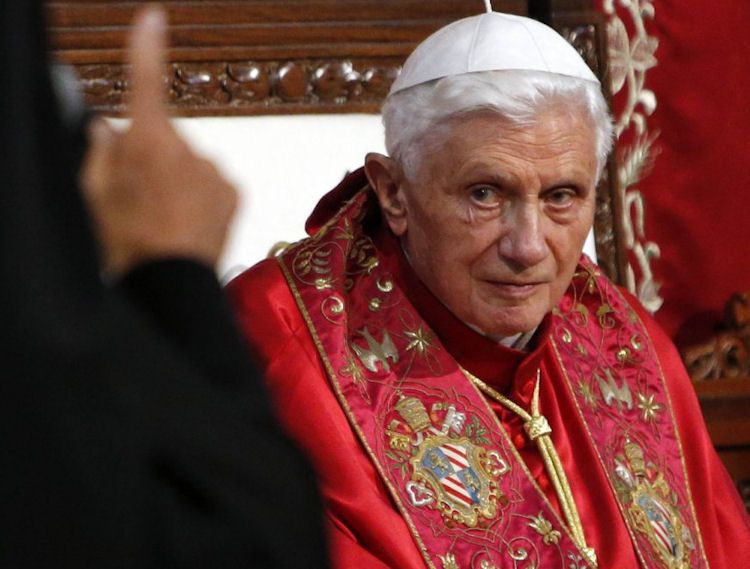
Notice the coat of arms in the stole?
Yup. It is the coat of arms of Blessed Pius IX and yes that is the Blessed Pope's stole.
Now why you ask did Papa Benny wear that stole to Lebanon?
He actually wore this in Lebanon most of the time but it is of interest that he wore this when he addressed the Melkite Greek Catholic Church community.
The Melkite Greek Catholic Church is an Eastern Church in communion with the Holy See but they almost broke off from communion because of the controversy of the Dogma of Papal Infallibility. The Patriarch of the Melkites refused to sign the dogmatic Constitution on Papal Infallibility, Pastor Aeternus, during the First Vatican Council. There was also a brewing controversy that it may lead to a formal schism which the Old Catholics actually did. To cut the long story short, it was a momentay impasse and the Melkites remained under the care of Peter's staff.
So what was Pope Benedict XVI the successor of Bl. Pius IX, who called the First Vatican Council and pronounced the Dogma of Papal Infallibility trying to say in Lebanon?
He is the Successor of St. Peter. And what his predecessor proclaimed, holds true today.
Pope Benedict XVI preaches not only through words but also through signs and symbols. He does this all the time. He is an expert liturgist and you can see how much he values the richness of our liturgy that was either watered down or completely lost. Sacred art has been taken out of our churches. Vestments look like school work art projects. Sacred vessels look more like typical country home dinnerware!
That is how the Church teaches, through ALL our senses!
St. Peter's Basilica, the Sistine Chapel, Notre Dame Cathedral in France and Notre Dame Basilica in Montreal were not made because of "Medieval excesses" just as historico-revisionists would want you to believe. Every nook and cranny of those churches was filled with sacred art to tell a STORY. To teach! To catechize both the learned and the uneducated.
Not all can read, even in today's Internet age. But all can understand images and pictures!
Even Bible-thumping Born-against Christians can't help but use pictures and images!
That is how Pope Benedict teaches!
Thank God for our Pope!
Long live Pope Benedict XVI!
Monday, August 6, 2012
The irony of those against Paul VI
From Fr. Rolando de la Rosa, OP
***
FORTY-FOUR years ago, Pope Paul VI prophesied the horrible effects of contraception to marriage, family, the individual, and society. It was a Cassandra prophecy: Fated to be right, but never heeded. [Someone told me before that if we elect the bald one, we would have a problem with contraception. Guess he was right too!]

In his encyclical Humanae Vitae, Pope Paul VI warned that a contraceptive mentality would lead to the prevalence of divorce, unmitigated premarital sex, the lowering of moral standards among the youth, the phenomenal increase in the number of children born out of wedlock, and rapid decrease of population in countries advocating contraception. He also prophesied that the pervasive use of contraception would diminish our innate sense of responsibility and commitment. Finally, he predicted that contraception would lead to the legalization of abortion.
The Pope’s prophecy is now a reality in many contraceptive-minded countries. Nearly all couples in these countries believe that their marriage is viable only as long as they have no children. The divorce rate is consistently rising. Abortion is so rampant that the disposal of aborted fetus has become a problem. Also, the number of unwed mothers (by choice) has phenomenally increased. With easy access to birth control pills and gadgets, consequence-less sex is now a fad among the youth because it does not entail any responsibility or commitment. [And the pro-contraception people call the practice of no contraception going back to the Dark Ages!]
Sex without procreation gave way to its corollary: procreation without sex. Sexless procreation is in vogue now: test-tube babies, artificial placentas, surrogate mothers, artificial insemination, etc. Ironically, those countries that aggressively limited the possibility of procreation are now desperately inventing means to procreate even without sex.
Drumbeaters for contraception have recently found another potent way of advertising it: by scaring people with the dangers of AIDS, the doomsday scenario of overpopulation, and linking contraception with women’s reproductive health. [how can it be reproductive when you are preventing reproduction!]
We sometimes regard the attempts of the Church to adapt her life to the exigencies of modern times as a way of compromise, a search for a soft, convenient, and comfortable gospel. Thus, when Humanae Vitae was published, people speculated that it would contain modernized, streamlined, less demanding doctrine on birth regulation. Many hoped that perhaps the Church had reconsidered its traditional stand, and would come up with a more lenient position.
To their dismay, [and a lot of Catholic cardinals, bishops and like-minded modernist theologians!] the Church defied all predictions and reaffirmed instead her traditional teaching on marriage, sex, and the value of human life.
Undoubtedly, Pope Paul VI did not bring peace to many couples. In fact, he destroyed the peace that they cherished – a peace based on the belief that whatever is legal is also moral, or that the easiest and most convenient solution to a problem is the best solution. [I call it: the INSTANT NOODLE solution. People would rather pour hot water than cook food. Easy, hassle free.] Humanae Vitae has proven that the Church does not conform to the majority opinion but to the Word of God, and the Pope must proclaim the truth even when it contradicts the current of the times.
***
You may weave the most intricate web of conspiracy theories you may have against Paul VI...
he was also a Mason like Annibale...
...he was drugged for so many years and an actor replaced him...
...he was an apostate who made an apostate Mass...
Call him whatever you want.
Sure he has his flaws in his style of governance.
All popes get that kind of evaluation! Was Bl. John Paul's style of travel everywhere, interview here and there and leave the Vatican to a group of power hungry cardinals who issue their own decrees left and right?
Go and criticize Paul VI.
But one thing is for sure.
He "poped" at the right place and at the right time.
Even if the most liberal, and noisiest cardinals were almost at his neck...
Peter spoke and put his foot forward, and BOOM!
We have Humane Vitae.
The greatest legacy of Paul VI.
And ironically, even the most rabid, sedevacantists praise Paul VI for issuing this great encyclical.
Paul VI is smiling and "whispering" at his tomb at St. Peter's right now:
"Told you so."
Great article from Fr. de la Rosa!
***
FORTY-FOUR years ago, Pope Paul VI prophesied the horrible effects of contraception to marriage, family, the individual, and society. It was a Cassandra prophecy: Fated to be right, but never heeded. [Someone told me before that if we elect the bald one, we would have a problem with contraception. Guess he was right too!]

In his encyclical Humanae Vitae, Pope Paul VI warned that a contraceptive mentality would lead to the prevalence of divorce, unmitigated premarital sex, the lowering of moral standards among the youth, the phenomenal increase in the number of children born out of wedlock, and rapid decrease of population in countries advocating contraception. He also prophesied that the pervasive use of contraception would diminish our innate sense of responsibility and commitment. Finally, he predicted that contraception would lead to the legalization of abortion.
The Pope’s prophecy is now a reality in many contraceptive-minded countries. Nearly all couples in these countries believe that their marriage is viable only as long as they have no children. The divorce rate is consistently rising. Abortion is so rampant that the disposal of aborted fetus has become a problem. Also, the number of unwed mothers (by choice) has phenomenally increased. With easy access to birth control pills and gadgets, consequence-less sex is now a fad among the youth because it does not entail any responsibility or commitment. [And the pro-contraception people call the practice of no contraception going back to the Dark Ages!]
Sex without procreation gave way to its corollary: procreation without sex. Sexless procreation is in vogue now: test-tube babies, artificial placentas, surrogate mothers, artificial insemination, etc. Ironically, those countries that aggressively limited the possibility of procreation are now desperately inventing means to procreate even without sex.
Drumbeaters for contraception have recently found another potent way of advertising it: by scaring people with the dangers of AIDS, the doomsday scenario of overpopulation, and linking contraception with women’s reproductive health. [how can it be reproductive when you are preventing reproduction!]
We sometimes regard the attempts of the Church to adapt her life to the exigencies of modern times as a way of compromise, a search for a soft, convenient, and comfortable gospel. Thus, when Humanae Vitae was published, people speculated that it would contain modernized, streamlined, less demanding doctrine on birth regulation. Many hoped that perhaps the Church had reconsidered its traditional stand, and would come up with a more lenient position.
To their dismay, [and a lot of Catholic cardinals, bishops and like-minded modernist theologians!] the Church defied all predictions and reaffirmed instead her traditional teaching on marriage, sex, and the value of human life.
Undoubtedly, Pope Paul VI did not bring peace to many couples. In fact, he destroyed the peace that they cherished – a peace based on the belief that whatever is legal is also moral, or that the easiest and most convenient solution to a problem is the best solution. [I call it: the INSTANT NOODLE solution. People would rather pour hot water than cook food. Easy, hassle free.] Humanae Vitae has proven that the Church does not conform to the majority opinion but to the Word of God, and the Pope must proclaim the truth even when it contradicts the current of the times.
***
You may weave the most intricate web of conspiracy theories you may have against Paul VI...
he was also a Mason like Annibale...
...he was drugged for so many years and an actor replaced him...
...he was an apostate who made an apostate Mass...
Call him whatever you want.
Sure he has his flaws in his style of governance.
All popes get that kind of evaluation! Was Bl. John Paul's style of travel everywhere, interview here and there and leave the Vatican to a group of power hungry cardinals who issue their own decrees left and right?
Go and criticize Paul VI.
But one thing is for sure.
He "poped" at the right place and at the right time.
Even if the most liberal, and noisiest cardinals were almost at his neck...
Peter spoke and put his foot forward, and BOOM!
We have Humane Vitae.
The greatest legacy of Paul VI.
And ironically, even the most rabid, sedevacantists praise Paul VI for issuing this great encyclical.
Paul VI is smiling and "whispering" at his tomb at St. Peter's right now:
"Told you so."
Great article from Fr. de la Rosa!
Saturday, June 23, 2012
"That they may be one!"
The prayer of Jesus in John 17:21 is the TRUE MEANING of ecumenism.
And Pope Benedict XVI is the Pope of Christian Unity.
His visit to Westminster Abbey is just that.
Note that he is wearing the stole of Pope Leo XIII. Do you know Apostolicae curae?
Well, you should read it. :)
And Pope Benedict XVI is the Pope of Christian Unity.
His visit to Westminster Abbey is just that.
Note that he is wearing the stole of Pope Leo XIII. Do you know Apostolicae curae?
Well, you should read it. :)
Wednesday, September 7, 2011
Ex corde ecclesiae, where are we?

The Catholic University of America has reported its progress in implementing Ex Corde Ecclesia, the papal is an Apostolic constitution written by Pope John Paul II regarding Catholic colleges and universities
Well, how about us here in the Philippines?
Shall we start with the Ateneo?
Then followed by...
Monday, July 18, 2011
Commemorating Humanae Vitae
From the CBCP Episcopal Commission on Family and Life
***
Dear Family and Life Warriors,
In the 60’s, due to the sexual revolution, problems of overpopulation and economics had arisen, making it needful for Paul Paul VI to address the issues of birth control. Pope Paul VI took a stand on July 25, 1968 in an encyclical known as Humanae Vitae (Of Human Life).
[This year, we will be celebrating the 43rd anniversary of Humanae Vitae (HV) with various activities in the Catholic Church, beginning tomorrow July 19, (Schedules as outlined further below this page,
after the highlights of HV)]
Highlights of HV are as follows:
1) "Marriage and conjugal love are by their nature ordained toward the begetting and educating of children. Children are really the supreme gift of marriage and contribute very substantially to the welfare of their parents."
2) “Married love is a very special form of personal friendship in which husband and wife generously share everything, without undue reservations or selfish calculations. Whoever truly loves his marriage
partner loves not only for what he receives, but for the partner's self, rejoicing that he can enrich his partner with the gift of himself."
3) “… one is not the master of the sources of life but rather the minister of the design established by the Creator. Just as man does not have unlimited dominion over his body in general, so also, and
with more particular reason, he has no such dominion over his specifically sexual faculties, for these are concerned by their very nature with the generation of life, of which God is the source.”
4) It is held that the sexual act must "retain its intrinsic relationship to the procreation of human life", and the "direct interruption of the generative process already begun" is unlawful. Abortion, even for therapeutic reasons, is absolutely forbidden, as is sterilization, even if temporary. Similarly, every action specifically intended to prevent procreation is forbidden. All these are held to directly contradict the moral order.
5) Therapeutic means which induce infertility are allowed, if they are not specifically intended to induce infertility. Natural Family Planning are allowed, since they take advantage of "a faculty provided by nature."
6) The dangers of artificial methods of contraception are outlined: by allowing sex without consequences, moral standards would fall.
Our Mother Church will celebrate HV's 43rd year, with the following activities:
A. July 19, simultaneous CBCP Humane Vitae Forums at the Adamson University Gym and USTChapel. 2PM;
B. July 25:
1) 7AM Mass by Bp Tobias, at the St Peter's Church in Commonwealth Ave, QC. The Blessed Sacrament will be exposed after until 5PM;
2) 9AM Mass by Bp Pabillo, in Santuario de San Jose, Greenhills to be followed by a Soul of the State of the Nation Address at the Club Filipino.
LET THIS BE A WEEK OF PRAYER AND FASTING FOR THE ENLIGHTENMENT OF OUR LEGISLATORS AGAINST THE ANTI-LIFE BILLS (RH AND DIVORCE).
May God, the Author of life, bless all our efforts. And may Mary, Queen of the Family and Mediatrix of All Grace, protect all human life.
Blessings and prayers,
Rev. Fr. Melvin Castro
***
Just one reaction...
The Vincentians are not against HUMANAE VITAE?!?!?!
SVST is this true?!?!?!
***
Dear Family and Life Warriors,
In the 60’s, due to the sexual revolution, problems of overpopulation and economics had arisen, making it needful for Paul Paul VI to address the issues of birth control. Pope Paul VI took a stand on July 25, 1968 in an encyclical known as Humanae Vitae (Of Human Life).
[This year, we will be celebrating the 43rd anniversary of Humanae Vitae (HV) with various activities in the Catholic Church, beginning tomorrow July 19, (Schedules as outlined further below this page,
after the highlights of HV)]
Highlights of HV are as follows:
1) "Marriage and conjugal love are by their nature ordained toward the begetting and educating of children. Children are really the supreme gift of marriage and contribute very substantially to the welfare of their parents."
2) “Married love is a very special form of personal friendship in which husband and wife generously share everything, without undue reservations or selfish calculations. Whoever truly loves his marriage
partner loves not only for what he receives, but for the partner's self, rejoicing that he can enrich his partner with the gift of himself."
3) “… one is not the master of the sources of life but rather the minister of the design established by the Creator. Just as man does not have unlimited dominion over his body in general, so also, and
with more particular reason, he has no such dominion over his specifically sexual faculties, for these are concerned by their very nature with the generation of life, of which God is the source.”
4) It is held that the sexual act must "retain its intrinsic relationship to the procreation of human life", and the "direct interruption of the generative process already begun" is unlawful. Abortion, even for therapeutic reasons, is absolutely forbidden, as is sterilization, even if temporary. Similarly, every action specifically intended to prevent procreation is forbidden. All these are held to directly contradict the moral order.
5) Therapeutic means which induce infertility are allowed, if they are not specifically intended to induce infertility. Natural Family Planning are allowed, since they take advantage of "a faculty provided by nature."
6) The dangers of artificial methods of contraception are outlined: by allowing sex without consequences, moral standards would fall.
Our Mother Church will celebrate HV's 43rd year, with the following activities:
A. July 19, simultaneous CBCP Humane Vitae Forums at the Adamson University Gym and USTChapel. 2PM;
B. July 25:
1) 7AM Mass by Bp Tobias, at the St Peter's Church in Commonwealth Ave, QC. The Blessed Sacrament will be exposed after until 5PM;
2) 9AM Mass by Bp Pabillo, in Santuario de San Jose, Greenhills to be followed by a Soul of the State of the Nation Address at the Club Filipino.
LET THIS BE A WEEK OF PRAYER AND FASTING FOR THE ENLIGHTENMENT OF OUR LEGISLATORS AGAINST THE ANTI-LIFE BILLS (RH AND DIVORCE).
May God, the Author of life, bless all our efforts. And may Mary, Queen of the Family and Mediatrix of All Grace, protect all human life.
Blessings and prayers,
Rev. Fr. Melvin Castro
***
Just one reaction...
The Vincentians are not against HUMANAE VITAE?!?!?!
SVST is this true?!?!?!
Friday, July 15, 2011
Church continues fight against Bills of Death and Immorality
MANILA, Philippines - Catholic bishops are ramping up activities to oppose the passage of a controversial birth control measure a full week before President Aquino's State of the Nation Address (SONA).
 Msgr. Juanito Figura, Catholic Bishops Conference of the Philippines secretary general, said the Catholic Church is preparing several activities to celebrate the 43rd anniversary of the Humanae Vitae, the landmark encyclical by Pope Paul VI that deals with the Church’s uncompromising stand on birth control.
Since the date of the anniversary -- July 25 -- falls on the SONA, the celebration will be held in advance. [ain't that a happy coincidence?]
“We’ll be doing activities a week before that just to stay away from the SONA,” said Figura.
Aside from Humanae Vitae, the Church is also marking the 20th anniversary of Familiaris Consortio (The Role of Christian family), an apostolic exhortation written by Pope John Paul II. The document describes the church’s position concerning the meaning and role of marriage and the family, and outlines challenges towards realizing that ideal. [and they hate that also.]
The apostolic exhortation also defines marriage "as a personal union in which the spouses reciprocally give and receive." [Oooo... homosexuals fighting for 'marriage' can misquote this. Beware!]
The document restates the opposition to artificial birth control stated earlier in Humanae Vitae, and mentions opposition to abortion.
During the bishops’ plenary assembly last week, Pope Benedict XVI urged them to continue protect the sanctity of life and marriage.
CBCP President and Tandag Bishop Nereo Odchimar earlier said that they will continue to speak out against the Reproductive Health bill as this is their duty to the people.
“We are the last bastion standing against the RH bill, divorce and now there is also the possibility of same-sex marriage and we won’t be surprised if after that would come euthanasia,” he said.
***
Beware when you talk with Catholic bashers. They will misquote Church documents and even say that the Church's stand on contraception only became 'official' after Humanae Vitae. Read the encyclical and you'll see that that is not true!
14. Therefore We base Our words on the first principles of a human and Christian doctrine of marriage when We are obliged once more to declare that the direct interruption of the generative process already begun and, above all, all direct abortion, even for therapeutic reasons, are to be absolutely excluded as lawful means of regulating the number of children. (14) Equally to be condemned, as the magisterium of the Church has affirmed on many occasions, is direct sterilization, whether of the man or of the woman, whether permanent or temporary. (15)
Similarly excluded is any action which either before, at the moment of, or after sexual intercourse, is specifically intended to prevent procreation—whether as an end or as a means. (16)
Neither is it valid to argue, as a justification for sexual intercourse which is deliberately contraceptive, that a lesser evil is to be preferred to a greater one, or that such intercourse would merge with procreative acts of past and future to form a single entity, and so be qualified by exactly the same moral goodness as these. Though it is true that sometimes it is lawful to tolerate a lesser moral evil in order to avoid a greater evil or in order to promote a greater good," it is never lawful, even for the gravest reasons, to do evil that good may come of it (18)—in other words, to intend directly something which of its very nature contradicts the moral order, and which must therefore be judged unworthy of man, even though the intention is to protect or promote the welfare of an individual, of a family or of society in general. Consequently, it is a serious error to think that a whole married life of otherwise normal relations can justify sexual intercourse which is deliberately contraceptive and so intrinsically wrong.
Monday, May 30, 2011
Is Humanae Vitae infallible?
And as a follow-up to what constitutionalist Jesuit Fr. Joaquin Bernas claims as what his colleagues claim that Humanae Vitae and other teachings of the Church about artificial contraceptives, like Evangelium Vitae.
Let us see what Church AUTHORITIES have to say about this, and not some dissident Modernist theologians who rant in their little classrooms, yet are unafraid to come out and put in writing what they preach in their classes:
***
I think he might have spoken to the theologians of LST. One of them is a bishop, who is sooooooo silent about the RH Bill. He made a video about this.
As a fellow Knight shared to me his observation, being a psychologist and all that:
Need I name the bishop?
Nah.
Let us see what Church AUTHORITIES have to say about this, and not some dissident Modernist theologians who rant in their little classrooms, yet are unafraid to come out and put in writing what they preach in their classes:
In "Humanae Vitae" the Pope taught, with the divine assistance he enjoys (cf. "Lumen Gentium", n. 25a), what the Church's ordinary Magisterium had always held to be true and right, and what had been reconfirmed by the extraordinary Magisterium of Vatican II. The arguments of those who claim to pass judgment on the basis of their knowledge do not stand up against this Magisterium: between the two teachings there is a substantial difference of quality and not only of degree. The teaching of "Humanae Vitae" is Magisterium - though ordinary - which contains decisions belonging to a divinely established authority (cf. canon 331; "Lumen Gentium" nn. 18a, 20c, 22b, 23c; "Christus Dominus" n. 2a) and exercised in order to interpret and teach (as in our case) the moral norms of human conduct. If he were not the Pope, he would lose his legitimate power and the intrinsic reason for his ministry; at most he could carry out a scholarly magisterium, which, however, would not be of use to the Church and to which he has not been appointed by the Church's Founder; he would lack the supernatural "virtus" of assisting and confirming his brethren in the faith and in the moral law (cf. Lk. 22:32, Mt. 16:29; Vatican I, Dogm. Const. "Pastor Aeternus", DS 3074)...
Archbishop Vincenzo Fagiolo, President of the Pontifical Council for the Interpretation of Legislative Texts
***
I think he might have spoken to the theologians of LST. One of them is a bishop, who is sooooooo silent about the RH Bill. He made a video about this.
As a fellow Knight shared to me his observation, being a psychologist and all that:
"His expression betrays what he is saying."
Need I name the bishop?
Nah.
Monday, March 7, 2011
Is Humanae Vitae infallible?
Courtesy of EWTN.com
NOTE TO DISSIDENTS!
We know that you bark wildly inside the confines of your seminaries and classrooms defying the official teachings of the Church.
Red this and know that you are not the Pope!
***

I. THE MAGISTERIUM OF THE CHURCH, A MAGISTERIUM OF AUTHORITY, NOT OF SCIENCE
The encyclical "Humanae Vitae" foresaw that it would encounter strenuous opposition, heightened by the communication media. Whereas, every day hundreds of Bishops, priests and faithful express their gratitude to the Pope, current newspapers are filled with protests, criticisms, and reproofs. Truly, in the likeness of her Divine Founder, the Church seems, more than ever, a "sign of contradiction". But what is still worse, some sons of the Church, even some theologians, rank among the opponents, while simultaneously affirming their submission to the Church to which they profess their allegiance. They, too, are products of the times and why should we be surprised at their being imbued with the widespread spirit of criticism? However, though they often do not take it into account, this criticism touches upon essential principles of our faith. It can disturb the Christian people and prevent the papal teaching from bearing fruit. Therefore, without indulging in polemics, it is necessary to bring into the open the equivocations and ambiguities on which criticism rests and which it spreads.
Issue not a scientific one
The first reaction to this criticism is the astonishing fact that certain Catholics seem to have lost sight of the proper character of the Church's teaching authority. It is not a scientific magisterium, it is one of authority. The Pope, supreme doctor of faith, authentically interprets the divine law and teaches that its observance is binding "on all the faithful." Undoubtedly he is acting within the limits of his supreme authority. If he does not quote Scriptural texts, it is because this divine law is a natural law, written in the heart of man to dispose him to acts by which he attains his perfection. That the Pope has authority in this regard is evident, since Christians need to know with certainty the precepts of the natural law by which they must abide to attain their salvation. Furthermore, like all natural truths under God, this natural law, with regard to its essential principles, is contained in Sacred Scripture. Therefore, it behooves the Pope to clarify these principles and to draw from them conclusions that might escape the ordinary discernment of the greater part of the faithful. For this two-fold reason, the interpretation the Pope gives to this law, as it bears on the use of marriage, is an act of his supreme authority, designed to interpret authentically all divine law, both natural and supernatural. In this instance, resorting to the case of Galileo is absolutely irrelevant. The issue here does not bear on science but on morality.
"He who hears you, hears me!"
The judgment of the Pope is supported by justifying arguments. Without wishing to diminish in any way the value of these arguments, without denying the role they played in shaping the papal decision, we must forcibly affirm that they do not constitute the essential of the encyclical. The essential is a moral rule which is therein taught and prescribed. It is taught, because in the light of the divine assistance which he possesses, the Pope declared it to be true and good. It is binding by reason of the divine authority of the Vicar of Christ, who commands through him. "He who hears you, hears Me!"
Addressing the priests, the encyclical makes reference to this fact: "Be the first to give, in the exercise of your ministry, the example of loyal, internal and external obedience to the teaching authority of the Church. That obedience, as you well know, obliges not only because of the reasons adduced but rather because of the light of the Holy Spirit, which is given in a particular way to the pastors of the Church in order that you may illustrate the truth (cf. Lumen Gentium, n. 25).
St. Thomas did not attempt, even by way of hypothesis, to counter this authority of the Magisterium of the Church, which resides principally in the Sovereign Pontiff, with arguments of even the greatest theologians and doctors. "We must abide rather by the Pope's judgment," he writes, "than by the opinion of any of the theologians, however well versed he may be in divine scriptures." (Quodl. IX, Art. A.16). "Against his authority, neither Jerome nor Augustine nor any other of the holy doctors defends his own personal views" (Summa, IIa, IIae). Pope Alexander VIII condemned the proposition of the Jansenists who claimed to support their errors by means of St. Augustine's teaching: When we have discovered a doctrine clearly grounded in Augustine, we can adhere to it and teach it without having regard to any Bull whatsoever of the Holy Roman Pontiff." (D. Sch. 2330). The great German theologian of the last century, Scheeben, considered it theological rationalism for theologians to attempt to judge, by their own science, the decisions of the divinely established authority, which interprets the truths of faith and teaches moral rules.
Jesus Christ promised divine assistance
To judge by the newspapers, which report the utterances of some wayward theologians which are then taken up by the entire international press, one would be inclined to think that this evil is actually widespread. The reasoning of certain theologians, the views of certain intellectuals are set in opposition to the arguments of the Encyclical. Emboldened by this criticism, they attempt denying his authority. Such an attitude would be lawful if the Church's teaching authority were scientific. In such a case, the conclusion would be as valid as its supporting arguments, but controversies pertaining to matters of faith and morals would be endless. In the present controversy, the two schools would continue to clash. Worry and insecurity would continue to thrive among the faithful and confessors. To preclude such disadvantages, which the actual controversy clearly reveals, our Lord willed that the Church's magisterium be one of authority. He confided to it the mission of teaching men the truths they should believe and the duties they should practice. However, if the men who have received this mission were left to their own personal enlightenment, they could, as others, err in the authentic meaning of the truths they teach and the nature of the obligations they impose. Though they were convinced they were right, though they were to offer the soundest arguments, they would not succeed in convincing all the faithful. As evidence of this, it suffices to note that the first principles of human reason are questioned by certain philosophical schools. Moreover, let us not forget that we are dealing with truths which are generally beyond the natural strength of our minds.
The way of scientific argumentation, therefore, makes it impossible to guarantee the maintenance of the authentic meaning of divine truths and the unanimous profession of faith. Therefore, Jesus Christ promised his pastors—authentic teachers of the faith—and, in particular, to Peter, His daily help to guard against error in matters of faith and morals and, through His pastors, to keep His people faithful.
Obligation to obey
It is on the strength of this assistance, that Pope Paul VI resolved the grave controversy on the use of marriage which had kept the teachers and the faithful in a state of uncertainty. Submission to this pronouncement requires the acknowledgment of an authority which is based on divine assistance. Although a Catholic might, because of his scientific training or for some other reason, find it difficult to grasp the compelling nature of the argumentation, nevertheless his obligation to obey would be no less. For this duty is grounded not on reason, but on the authority of the Roman Pontiff.
But—so they say—men of our times are not inclined to obey without reasons. This is certainly true. It is equally true that they practise such obedience in their everyday lives. The sick, without any knowledge of medicine, follows the prescription of his physician without being able to see its usefulness. In the last war, soldiers carried out the orders of their officers without knowing the strategy of their great leaders and the tactics of their immediate superiors. Why, then, in matters of faith and morals, should not the divine authority of the pastors of the Church require a like submission, after they have done everything in their power to enlighten themselves and their subjects? But most of, all, it is sheer nonsense to refuse the Pope's moral decision by opposing it. with a theological position he rejects with all his authority. This means placing on the same level the fallible light of a. human science and the divine light of Pastors whom the Holy Spirit guides.
II. CERTITUDE OF THE DOCTRINE OF THE ENCYCLICAL
Some object that the Encyclical "Humanae Vitae" is not a document of the infallible magisterium. They hold that the teaching contained therein does not bear the highest guarantee of certitude which, alone, could put an end to all dispute. In this way, one could admit the Pope's authority without submitting to this decree.
Duty of obedience
In the first place, let us point out that, according to the teaching of the last council, the doctrinal authority of the Pope and the Bishops is not limited to infallible teaching. The duty of obedience is not restricted to definitions of faith: "That religious assent of mind and will is due in a very singular way to the authentic Magisterium of the Sovereign Pontiff, even when he does not speak ex cathedra: this implies the respectful acknowledgement of his supreme teaching authority and the earnest adherence to his statements, in conformity with his manifest thought and desires, as well as with the deductions possible, especially because of the nature of the document or the frequent repetition of the same doctrine or the mode of expression".
Let us apply these criteria to the recent encyclical. Obviously the Pope intended to resolve a controversy which questions the time-honoured teaching of theologians approved by the Magisterium. On the same topic, Pius XII specifically stated, in the Encyclical "Humani Generis" (D. Sch. 3885), "this question is no longer open to the free discussion of theologians". Furthermore, Paul VI is not innovating in this matter. Without wishing to go further back into history, from the time of Pius VI, the teaching of the Holy See has never varied in this matter. In a particularly solemn manner, Pius XI propounded it in the Encyclical "Casti Connubii"; Pius XII, as well as John XXIII, taught it consistently. The council did not touch this question set aside for the Sovereign Pontiff, but affirmed its underlying principle: " ...sons of the Church may not undertake methods of regulating procreation which are found blameworthy by the teaching authority of the Church in its unfolding of the divine law". (Gaudium et Spes, N.51). Finally, the document in which the Pope expounds his teaching is an Encyclical is an authentic interpretation of the natural law which declares the use of marriage which is conformable to the law and that which is not.
Divine assistance not restricted
Those who substantiate their denial of the documentary teaching by maintaining that it lacks infallibility, seem to forget that Catholic doctrine contains teaching which is. certain, outside that which has been the object of an infallible proposition. The recent Council proposed the doctrine of collegiality as a teaching which is certain and contained in Scripture, though it did not propose it as a defined doctrine to be believed as a truth of divine faith. Undoubtedly, it is an infallible doctrine, but it has never been defined, since the Council refrained from promulgating new dogmas of faith. Who would deny that, in unfolding this doctrine, the Council received Divine assistance?
To restrict Divine assistance to a few extraordinary acts of the solemn Magisterium made through the centuries, is to forget that the Lord promised to be with the Church all days unto the end of time. At any rate, it is a theologically certain doctrine that the Holy Spirit aids the Church in proclaiming moral and disciplinary laws. This Divine assistance guarantees that, when it is a question of laws imposed on the universal Church, the Church can contradict neither Revelation nor the natural moral law. The Constitution "Auctorem Fidei" condemned a proposition of the pseudo-synod of Pistoia, according to which "the Church, governed by the Holy Spirit, could impose a disciplinary law that would be not only useless and more burdensome for the faithful than Christian liberty allows, but also dangerous and harmful". (D. Sch. 2678). If this is true of disciplinary laws, a fortiori it ought to be true of moral laws imposed by the Church on all the faithful.
Universal call to perfection
The Holy Spirit furnished such assistance in the case of the Encyclical "Humanae Vitae", which authentically interprets natural law. The line of conduct which the Pope followed is in keeping with Divine demands. It is not an unbearable weight that uselessly burdens the faithful; rather, its observance is necessary in order to avoid evil and do good in this matter. Those who proclaim the contrary are forgetting a little too soon the conciliar teaching on the universal call of all men to perfection. It is not merely man in the abstract who is called to perfection (the "thesis", as one journalist puts it), but it is man—poor, weak and sinful, as we all are in varying degrees ("the hypothesis" of our journalist). If we were left to our own resources, not only would this precept be impossible for the majority to observe, but many others besides. "Without Me, you can do nothing," says the Lord. And, commenting, Saint Augustine declares: "He does not say: without Me, you can not do something big, but: without Me, you can do absolutely nothing". And consequently, side by side with the precept is found the grace to help men of good will. Because men are weak, the Lord instituted a sacrament to remedy the evil they bring upon themselves by sin, Like its Divine Founder, the Church will never cease to proclaim to men God's demands. For these demands are the path which must be followed in order to attain to the fullness of both heavenly and earthly joy. Moreover, the Church, like Christ, is merciful. She takes to her heart the sinners, whose tears She dries whose wounds She heals. Therefore, though the Encyclical is not infallible, it proposes a sure way of life which Catholics ought to follow with an untroubled conscience. They may rest assured that this road will lead them to God, and that, in Him, married couples will find joys which the satisfaction of their natural desires could never give them.
III. THE POPE CAN DECIDE ALONE.
In the last place, criticisms bear upon a third topic: The Pope made a one-man decision. He uttered this pronouncement against the advice of his counsellors. He did not solicit the collaboration of the Episcopal College to decide with him. He disregarded the faithful's "consensus of opinion". One journalist asked whether this was the first time that one man was right against all others.
It is strange to find fault with the Pope for not accepting the advice of the majority of the commission. It was up to the Pope to decide. In this task, the Holy Spirit helps him and he alone assumes the incommunicable responsibility for this decision, since it was on him that Christ conferred the authority to do so and the mission to guide the faithful to life everlasting. This mandate, this authority, this assistance cannot belong to any commission of experts, learned and prudent as they may be. The latter's function is to inform and gather data that may bring light upon the decision. As in this commission there was a majority in favour of an opinion never before held by the Church, it was urgently important to hear these learned and loyal men who had thought it possible to depart from the Church's traditional position. It was necessary that the arguments and objections be known and forcibly set forth by the very persons who had energetically proposed them. If the Pope had decided without hearing them, what would now be said? The encyclical explains why the Pope did not follow that advice. It is needless to labor the point further.
The Pope made a decision alone without and even, some hint, against the College. This view rests on a false notion concerning the College, on a theory propagated by certain theologians before the Council, and not accepted by the Council. According to this opinion, the exercise of supreme power in the Church should always be collegial. The day-to-day government and current affairs would be left to the Pope, as in the case of the resignation of a government which continues to tend to current affairs. Nevertheless, serious decisions should be taken collegially, either in Council or with the synod. This position is erroneous. Its promoters themselves admit that it is not in accordance with the Constitution "Lumen Gentium": "For in virtue of his office, that is, as Vicar of Christ and pastor of the whole Church, the Roman Pontiff has full, supreme, and universal power over the Church. And be can always exercise this power freely."
The explanatory note authentically clarifies the meaning of this passage: "The care of the whole flock of Christ has been entrusted to the Supreme Pontiff. It belongs to him, according to the changing needs of the Church during the passage of time, to determine the way in which it is fitting for this care to be exercised, whether personally or collegially...As supreme pastor of the Church, the Sovereign Pontiff can always exercise his authority as he chooses, as is demanded by his office itself. While the College always exists, it does not for that reason permanently operate through strictly collegial action, as the tradition of. the Church shows...It operates through collegial action only at intervals and only with the consent of its head". (Prefatory Note of Explanation, nos 3, 4). These texts are clear. Let us leave aside easily-adducible proofs. It is evident that no one in. the Church can reproach the Roman Pontiff for preferring, when he deals with such and such a question, the personal exercise of his supreme power. When the Holy Father deferred the personal treatment of this question till the close of the Commission's work, no one at the Council protested; nor could anyone have done so. The Pope did not neglect to consult the bishops, who could freely submit their opinions on the topic, as the Encyclical itself asserts.
But on what grounds do certain journalists affirm that the majority of the Episcopal body favoured the new opinion rejected by the Holy Father? Indeed, one can hardly forget some of the resounding conciliar speeches, but here again there is no evidence whatever that they represented the view of the majority of Fathers. Since the publication of the Encyclical two weeks ago, the "L'Osservatore Romano" has been printing daily statements of its acceptance by episcopal conferences, cardinals and bishops the world over. Better than newspapermen, the Catholic bishops know the duty that binds them of submitting to the Roman Pontiff. Reports from every corner of the earth show their docility to the Papal decision and their efforts to have the faithful abide by it.
Finally, a statement of American theologians, which the world press played up, hinges upon another strange argument: the Pope would not have taken notice of the faithful's "consensus of opinion". Despite their intention of remaining in God's grace, the faithful do not hesitate to have recourse to contraceptive means. How can we suppose that the guiding Holy Spirit is urging them to acts intrinsically bad? No Catholic doubts, the Holy Spirit's assistance to the Pope, but among the people of God it is not limited to the Pope; all benefit by it. One must not attribute too readily such a line of conduct to the Holy Spirit. Many other reasons explain it, notably the worldwide unbridled propaganda in favour of contraception and the imprudent approval that certain theologians gave to them, thus disregarding the Pope's caution before his pronouncement. An additional and still weightier fact: this alleged "consensus" of the faithful is far from being unanimous. On this matter, confessors are better informed than pressmen. I know confessors who hear penitents of all races and nations. They are unanimous in stating that Christians are heroically faithful to the moral laws confirmed by the Pope, even at the cost of tremendous sacrifices. Others there are who fail in this respect; but they recognize their guilt, and come to the holy tribunal to seek forgiveness and strength. Finally, it is true that the Holy Spirit's aid to the Church is not restricted to the Pope and bishops. It extends to all of its members and goes beyond the visible frontiers of the Church. However, in addition to this ordinary aid, promised to all, that they may fulfil the individual and social duties of the Christian life, a special assistance is provided for those who, in the Church, must exercise a public function in view of the common good. To settle the disputes that arise in matters of faith and morals is not the general function of all the faithful. First and foremost, this mission belongs to the Vicar of Christ. Likewise this special assistance belongs primarily and principally to him. Why attempt to confuse the faithful by such sophisms? The laity is not easily taken in by them. In the Pope's voice, they detect Christ's voice. One would read with profit in the "L'Osservatore Romano" the soul-stirring letters addressed to the Roman Pontiff. As the Constitution "Lumen Gentium", asserts, the adherence that the faithful instinctively give to the teachings of the Magisterium, even when these doctrines entail painful privation, manifests the "consensus" of the people.
They are grateful to the Roman Pontiff, who so courageously is fulfilling his arduous mission for their spiritual welfare. Throughout the world, contradictory voices may resound. The faithful do not allow themselves to be deceived. They know the Shepherd's voice and they follow it, for he alone has the words of eternal life and guides them to the fullness of the Christian life and to the joy of heaven.
M. R. GAGNEBET O.P.
***
Article in three parts,
taken from:
L'Osservatore Romano
Weekly Edition in English
12 September 1968, page 6
19 September 1968, page 5
26 September 1968, page 6
NOTE TO DISSIDENTS!
We know that you bark wildly inside the confines of your seminaries and classrooms defying the official teachings of the Church.
Red this and know that you are not the Pope!
***

THE AUTHORITY OF THE ENCYCLICAL HUMANAE VITAE
M. R. Gagnebet O.P.
I. THE MAGISTERIUM OF THE CHURCH, A MAGISTERIUM OF AUTHORITY, NOT OF SCIENCE
The encyclical "Humanae Vitae" foresaw that it would encounter strenuous opposition, heightened by the communication media. Whereas, every day hundreds of Bishops, priests and faithful express their gratitude to the Pope, current newspapers are filled with protests, criticisms, and reproofs. Truly, in the likeness of her Divine Founder, the Church seems, more than ever, a "sign of contradiction". But what is still worse, some sons of the Church, even some theologians, rank among the opponents, while simultaneously affirming their submission to the Church to which they profess their allegiance. They, too, are products of the times and why should we be surprised at their being imbued with the widespread spirit of criticism? However, though they often do not take it into account, this criticism touches upon essential principles of our faith. It can disturb the Christian people and prevent the papal teaching from bearing fruit. Therefore, without indulging in polemics, it is necessary to bring into the open the equivocations and ambiguities on which criticism rests and which it spreads.
Issue not a scientific one
The first reaction to this criticism is the astonishing fact that certain Catholics seem to have lost sight of the proper character of the Church's teaching authority. It is not a scientific magisterium, it is one of authority. The Pope, supreme doctor of faith, authentically interprets the divine law and teaches that its observance is binding "on all the faithful." Undoubtedly he is acting within the limits of his supreme authority. If he does not quote Scriptural texts, it is because this divine law is a natural law, written in the heart of man to dispose him to acts by which he attains his perfection. That the Pope has authority in this regard is evident, since Christians need to know with certainty the precepts of the natural law by which they must abide to attain their salvation. Furthermore, like all natural truths under God, this natural law, with regard to its essential principles, is contained in Sacred Scripture. Therefore, it behooves the Pope to clarify these principles and to draw from them conclusions that might escape the ordinary discernment of the greater part of the faithful. For this two-fold reason, the interpretation the Pope gives to this law, as it bears on the use of marriage, is an act of his supreme authority, designed to interpret authentically all divine law, both natural and supernatural. In this instance, resorting to the case of Galileo is absolutely irrelevant. The issue here does not bear on science but on morality.
"He who hears you, hears me!"
The judgment of the Pope is supported by justifying arguments. Without wishing to diminish in any way the value of these arguments, without denying the role they played in shaping the papal decision, we must forcibly affirm that they do not constitute the essential of the encyclical. The essential is a moral rule which is therein taught and prescribed. It is taught, because in the light of the divine assistance which he possesses, the Pope declared it to be true and good. It is binding by reason of the divine authority of the Vicar of Christ, who commands through him. "He who hears you, hears Me!"
Addressing the priests, the encyclical makes reference to this fact: "Be the first to give, in the exercise of your ministry, the example of loyal, internal and external obedience to the teaching authority of the Church. That obedience, as you well know, obliges not only because of the reasons adduced but rather because of the light of the Holy Spirit, which is given in a particular way to the pastors of the Church in order that you may illustrate the truth (cf. Lumen Gentium, n. 25).
St. Thomas did not attempt, even by way of hypothesis, to counter this authority of the Magisterium of the Church, which resides principally in the Sovereign Pontiff, with arguments of even the greatest theologians and doctors. "We must abide rather by the Pope's judgment," he writes, "than by the opinion of any of the theologians, however well versed he may be in divine scriptures." (Quodl. IX, Art. A.16). "Against his authority, neither Jerome nor Augustine nor any other of the holy doctors defends his own personal views" (Summa, IIa, IIae). Pope Alexander VIII condemned the proposition of the Jansenists who claimed to support their errors by means of St. Augustine's teaching: When we have discovered a doctrine clearly grounded in Augustine, we can adhere to it and teach it without having regard to any Bull whatsoever of the Holy Roman Pontiff." (D. Sch. 2330). The great German theologian of the last century, Scheeben, considered it theological rationalism for theologians to attempt to judge, by their own science, the decisions of the divinely established authority, which interprets the truths of faith and teaches moral rules.
Jesus Christ promised divine assistance
To judge by the newspapers, which report the utterances of some wayward theologians which are then taken up by the entire international press, one would be inclined to think that this evil is actually widespread. The reasoning of certain theologians, the views of certain intellectuals are set in opposition to the arguments of the Encyclical. Emboldened by this criticism, they attempt denying his authority. Such an attitude would be lawful if the Church's teaching authority were scientific. In such a case, the conclusion would be as valid as its supporting arguments, but controversies pertaining to matters of faith and morals would be endless. In the present controversy, the two schools would continue to clash. Worry and insecurity would continue to thrive among the faithful and confessors. To preclude such disadvantages, which the actual controversy clearly reveals, our Lord willed that the Church's magisterium be one of authority. He confided to it the mission of teaching men the truths they should believe and the duties they should practice. However, if the men who have received this mission were left to their own personal enlightenment, they could, as others, err in the authentic meaning of the truths they teach and the nature of the obligations they impose. Though they were convinced they were right, though they were to offer the soundest arguments, they would not succeed in convincing all the faithful. As evidence of this, it suffices to note that the first principles of human reason are questioned by certain philosophical schools. Moreover, let us not forget that we are dealing with truths which are generally beyond the natural strength of our minds.
The way of scientific argumentation, therefore, makes it impossible to guarantee the maintenance of the authentic meaning of divine truths and the unanimous profession of faith. Therefore, Jesus Christ promised his pastors—authentic teachers of the faith—and, in particular, to Peter, His daily help to guard against error in matters of faith and morals and, through His pastors, to keep His people faithful.
Obligation to obey
It is on the strength of this assistance, that Pope Paul VI resolved the grave controversy on the use of marriage which had kept the teachers and the faithful in a state of uncertainty. Submission to this pronouncement requires the acknowledgment of an authority which is based on divine assistance. Although a Catholic might, because of his scientific training or for some other reason, find it difficult to grasp the compelling nature of the argumentation, nevertheless his obligation to obey would be no less. For this duty is grounded not on reason, but on the authority of the Roman Pontiff.
But—so they say—men of our times are not inclined to obey without reasons. This is certainly true. It is equally true that they practise such obedience in their everyday lives. The sick, without any knowledge of medicine, follows the prescription of his physician without being able to see its usefulness. In the last war, soldiers carried out the orders of their officers without knowing the strategy of their great leaders and the tactics of their immediate superiors. Why, then, in matters of faith and morals, should not the divine authority of the pastors of the Church require a like submission, after they have done everything in their power to enlighten themselves and their subjects? But most of, all, it is sheer nonsense to refuse the Pope's moral decision by opposing it. with a theological position he rejects with all his authority. This means placing on the same level the fallible light of a. human science and the divine light of Pastors whom the Holy Spirit guides.
II. CERTITUDE OF THE DOCTRINE OF THE ENCYCLICAL
Some object that the Encyclical "Humanae Vitae" is not a document of the infallible magisterium. They hold that the teaching contained therein does not bear the highest guarantee of certitude which, alone, could put an end to all dispute. In this way, one could admit the Pope's authority without submitting to this decree.
Duty of obedience
In the first place, let us point out that, according to the teaching of the last council, the doctrinal authority of the Pope and the Bishops is not limited to infallible teaching. The duty of obedience is not restricted to definitions of faith: "That religious assent of mind and will is due in a very singular way to the authentic Magisterium of the Sovereign Pontiff, even when he does not speak ex cathedra: this implies the respectful acknowledgement of his supreme teaching authority and the earnest adherence to his statements, in conformity with his manifest thought and desires, as well as with the deductions possible, especially because of the nature of the document or the frequent repetition of the same doctrine or the mode of expression".
Let us apply these criteria to the recent encyclical. Obviously the Pope intended to resolve a controversy which questions the time-honoured teaching of theologians approved by the Magisterium. On the same topic, Pius XII specifically stated, in the Encyclical "Humani Generis" (D. Sch. 3885), "this question is no longer open to the free discussion of theologians". Furthermore, Paul VI is not innovating in this matter. Without wishing to go further back into history, from the time of Pius VI, the teaching of the Holy See has never varied in this matter. In a particularly solemn manner, Pius XI propounded it in the Encyclical "Casti Connubii"; Pius XII, as well as John XXIII, taught it consistently. The council did not touch this question set aside for the Sovereign Pontiff, but affirmed its underlying principle: " ...sons of the Church may not undertake methods of regulating procreation which are found blameworthy by the teaching authority of the Church in its unfolding of the divine law". (Gaudium et Spes, N.51). Finally, the document in which the Pope expounds his teaching is an Encyclical is an authentic interpretation of the natural law which declares the use of marriage which is conformable to the law and that which is not.
Divine assistance not restricted
Those who substantiate their denial of the documentary teaching by maintaining that it lacks infallibility, seem to forget that Catholic doctrine contains teaching which is. certain, outside that which has been the object of an infallible proposition. The recent Council proposed the doctrine of collegiality as a teaching which is certain and contained in Scripture, though it did not propose it as a defined doctrine to be believed as a truth of divine faith. Undoubtedly, it is an infallible doctrine, but it has never been defined, since the Council refrained from promulgating new dogmas of faith. Who would deny that, in unfolding this doctrine, the Council received Divine assistance?
To restrict Divine assistance to a few extraordinary acts of the solemn Magisterium made through the centuries, is to forget that the Lord promised to be with the Church all days unto the end of time. At any rate, it is a theologically certain doctrine that the Holy Spirit aids the Church in proclaiming moral and disciplinary laws. This Divine assistance guarantees that, when it is a question of laws imposed on the universal Church, the Church can contradict neither Revelation nor the natural moral law. The Constitution "Auctorem Fidei" condemned a proposition of the pseudo-synod of Pistoia, according to which "the Church, governed by the Holy Spirit, could impose a disciplinary law that would be not only useless and more burdensome for the faithful than Christian liberty allows, but also dangerous and harmful". (D. Sch. 2678). If this is true of disciplinary laws, a fortiori it ought to be true of moral laws imposed by the Church on all the faithful.
Universal call to perfection
The Holy Spirit furnished such assistance in the case of the Encyclical "Humanae Vitae", which authentically interprets natural law. The line of conduct which the Pope followed is in keeping with Divine demands. It is not an unbearable weight that uselessly burdens the faithful; rather, its observance is necessary in order to avoid evil and do good in this matter. Those who proclaim the contrary are forgetting a little too soon the conciliar teaching on the universal call of all men to perfection. It is not merely man in the abstract who is called to perfection (the "thesis", as one journalist puts it), but it is man—poor, weak and sinful, as we all are in varying degrees ("the hypothesis" of our journalist). If we were left to our own resources, not only would this precept be impossible for the majority to observe, but many others besides. "Without Me, you can do nothing," says the Lord. And, commenting, Saint Augustine declares: "He does not say: without Me, you can not do something big, but: without Me, you can do absolutely nothing". And consequently, side by side with the precept is found the grace to help men of good will. Because men are weak, the Lord instituted a sacrament to remedy the evil they bring upon themselves by sin, Like its Divine Founder, the Church will never cease to proclaim to men God's demands. For these demands are the path which must be followed in order to attain to the fullness of both heavenly and earthly joy. Moreover, the Church, like Christ, is merciful. She takes to her heart the sinners, whose tears She dries whose wounds She heals. Therefore, though the Encyclical is not infallible, it proposes a sure way of life which Catholics ought to follow with an untroubled conscience. They may rest assured that this road will lead them to God, and that, in Him, married couples will find joys which the satisfaction of their natural desires could never give them.
III. THE POPE CAN DECIDE ALONE.
In the last place, criticisms bear upon a third topic: The Pope made a one-man decision. He uttered this pronouncement against the advice of his counsellors. He did not solicit the collaboration of the Episcopal College to decide with him. He disregarded the faithful's "consensus of opinion". One journalist asked whether this was the first time that one man was right against all others.
It is strange to find fault with the Pope for not accepting the advice of the majority of the commission. It was up to the Pope to decide. In this task, the Holy Spirit helps him and he alone assumes the incommunicable responsibility for this decision, since it was on him that Christ conferred the authority to do so and the mission to guide the faithful to life everlasting. This mandate, this authority, this assistance cannot belong to any commission of experts, learned and prudent as they may be. The latter's function is to inform and gather data that may bring light upon the decision. As in this commission there was a majority in favour of an opinion never before held by the Church, it was urgently important to hear these learned and loyal men who had thought it possible to depart from the Church's traditional position. It was necessary that the arguments and objections be known and forcibly set forth by the very persons who had energetically proposed them. If the Pope had decided without hearing them, what would now be said? The encyclical explains why the Pope did not follow that advice. It is needless to labor the point further.
The Pope made a decision alone without and even, some hint, against the College. This view rests on a false notion concerning the College, on a theory propagated by certain theologians before the Council, and not accepted by the Council. According to this opinion, the exercise of supreme power in the Church should always be collegial. The day-to-day government and current affairs would be left to the Pope, as in the case of the resignation of a government which continues to tend to current affairs. Nevertheless, serious decisions should be taken collegially, either in Council or with the synod. This position is erroneous. Its promoters themselves admit that it is not in accordance with the Constitution "Lumen Gentium": "For in virtue of his office, that is, as Vicar of Christ and pastor of the whole Church, the Roman Pontiff has full, supreme, and universal power over the Church. And be can always exercise this power freely."
The explanatory note authentically clarifies the meaning of this passage: "The care of the whole flock of Christ has been entrusted to the Supreme Pontiff. It belongs to him, according to the changing needs of the Church during the passage of time, to determine the way in which it is fitting for this care to be exercised, whether personally or collegially...As supreme pastor of the Church, the Sovereign Pontiff can always exercise his authority as he chooses, as is demanded by his office itself. While the College always exists, it does not for that reason permanently operate through strictly collegial action, as the tradition of. the Church shows...It operates through collegial action only at intervals and only with the consent of its head". (Prefatory Note of Explanation, nos 3, 4). These texts are clear. Let us leave aside easily-adducible proofs. It is evident that no one in. the Church can reproach the Roman Pontiff for preferring, when he deals with such and such a question, the personal exercise of his supreme power. When the Holy Father deferred the personal treatment of this question till the close of the Commission's work, no one at the Council protested; nor could anyone have done so. The Pope did not neglect to consult the bishops, who could freely submit their opinions on the topic, as the Encyclical itself asserts.
But on what grounds do certain journalists affirm that the majority of the Episcopal body favoured the new opinion rejected by the Holy Father? Indeed, one can hardly forget some of the resounding conciliar speeches, but here again there is no evidence whatever that they represented the view of the majority of Fathers. Since the publication of the Encyclical two weeks ago, the "L'Osservatore Romano" has been printing daily statements of its acceptance by episcopal conferences, cardinals and bishops the world over. Better than newspapermen, the Catholic bishops know the duty that binds them of submitting to the Roman Pontiff. Reports from every corner of the earth show their docility to the Papal decision and their efforts to have the faithful abide by it.
Finally, a statement of American theologians, which the world press played up, hinges upon another strange argument: the Pope would not have taken notice of the faithful's "consensus of opinion". Despite their intention of remaining in God's grace, the faithful do not hesitate to have recourse to contraceptive means. How can we suppose that the guiding Holy Spirit is urging them to acts intrinsically bad? No Catholic doubts, the Holy Spirit's assistance to the Pope, but among the people of God it is not limited to the Pope; all benefit by it. One must not attribute too readily such a line of conduct to the Holy Spirit. Many other reasons explain it, notably the worldwide unbridled propaganda in favour of contraception and the imprudent approval that certain theologians gave to them, thus disregarding the Pope's caution before his pronouncement. An additional and still weightier fact: this alleged "consensus" of the faithful is far from being unanimous. On this matter, confessors are better informed than pressmen. I know confessors who hear penitents of all races and nations. They are unanimous in stating that Christians are heroically faithful to the moral laws confirmed by the Pope, even at the cost of tremendous sacrifices. Others there are who fail in this respect; but they recognize their guilt, and come to the holy tribunal to seek forgiveness and strength. Finally, it is true that the Holy Spirit's aid to the Church is not restricted to the Pope and bishops. It extends to all of its members and goes beyond the visible frontiers of the Church. However, in addition to this ordinary aid, promised to all, that they may fulfil the individual and social duties of the Christian life, a special assistance is provided for those who, in the Church, must exercise a public function in view of the common good. To settle the disputes that arise in matters of faith and morals is not the general function of all the faithful. First and foremost, this mission belongs to the Vicar of Christ. Likewise this special assistance belongs primarily and principally to him. Why attempt to confuse the faithful by such sophisms? The laity is not easily taken in by them. In the Pope's voice, they detect Christ's voice. One would read with profit in the "L'Osservatore Romano" the soul-stirring letters addressed to the Roman Pontiff. As the Constitution "Lumen Gentium", asserts, the adherence that the faithful instinctively give to the teachings of the Magisterium, even when these doctrines entail painful privation, manifests the "consensus" of the people.
They are grateful to the Roman Pontiff, who so courageously is fulfilling his arduous mission for their spiritual welfare. Throughout the world, contradictory voices may resound. The faithful do not allow themselves to be deceived. They know the Shepherd's voice and they follow it, for he alone has the words of eternal life and guides them to the fullness of the Christian life and to the joy of heaven.
M. R. GAGNEBET O.P.
***
Article in three parts,
taken from:
L'Osservatore Romano
Weekly Edition in English
12 September 1968, page 6
19 September 1968, page 5
26 September 1968, page 6
L'Osservatore Romano is the newspaper of the Holy See.
The Weekly Edition in English is published for the US by:
The Weekly Edition in English is published for the US by:
The Cathedral Foundation
L'Osservatore Romano English Edition
320 Cathedral St.
Baltimore, MD 21201
Subscriptions: (410) 547-5315
Fax: (410) 332-1069
lormail@catholicreview.org
L'Osservatore Romano English Edition
320 Cathedral St.
Baltimore, MD 21201
Subscriptions: (410) 547-5315
Fax: (410) 332-1069
lormail@catholicreview.org
Sunday, November 21, 2010
Words of Wisdom: The Kingship of Christ
From the Papal Encyclical, Quas Primas, of His Holiness, Pope Pius XI, of blessed memory
***
***
16. Christ as our Redeemer purchased the Church at the price of his own blood; as priest he offered himself, and continues to offer himself as a victim for our sins. Is it not evident, then, that his kingly dignity partakes in a manner of both these offices?
17. It would be a grave error, on the other hand, to say that Christ has no authority whatever in civil affairs, since, by virtue of the absolute empire over all creatures committed to him by the Father, all things are in his power. Nevertheless, during his life on earth he refrained from the exercise of such authority, and although he himself disdained to possess or to care for earthly goods, he did not, nor does he today, interfere with those who possess them. Non eripit mortalia qui regna dat caelestia.[27]
18. Thus the empire of our Redeemer embraces all men. To use the words of Our immortal predecessor, Pope Leo XIII: "His empire includes not only Catholic nations, not only baptized persons who, though of right belonging to the Church, have been led astray by error, or have been cut off from her by schism, but also all those who are outside the Christian faith; so that truly the whole of mankind is subject to the power of Jesus Christ."[28] Nor is there any difference in this matter between the individual and the family or the State; for all men, whether collectively or individually, are under the dominion of Christ. In him is the salvation of the individual, in him is the salvation of society. "Neither is there salvation in any other, for there is no other name under heaven given to men whereby we must be saved."[29] He is the author of happiness and true prosperity for every man and for every nation. "For a nation is happy when its citizens are happy. What else is a nation but a number of men living in concord?"[30] If, therefore, the rulers of nations wish to preserve their authority, to promote and increase the prosperity of their countries, they will not neglect the public duty of reverence and obedience to the rule of Christ. What We said at the beginning of Our Pontificate concerning the decline of public authority, and the lack of respect for the same, is equally true at the present day. "With God and Jesus Christ," we said, "excluded from political life, with authority derived not from God but from man, the very basis of that authority has been taken away, because the chief reason of the distinction between ruler and subject has been eliminated. The result is that human society is tottering to its fall, because it has no longer a secure and solid foundation."[31]
19. When once men recognize, both in private and in public life, that Christ is King, society will at last receive the great blessings of real liberty, well-ordered discipline, peace and harmony. Our Lord's regal office invests the human authority of princes and rulers with a religious significance; it ennobles the citizen's duty of obedience. It is for this reason that St. Paul, while bidding wives revere Christ in their husbands, and slaves respect Christ in their masters, warns them to give obedience to them not as men, but as the vicegerents of Christ; for it is not meet that men redeemed by Christ should serve their fellow-men. "You are bought with a price; be not made the bond-slaves of men."[32] If princes and magistrates duly elected are filled with the persuasion that they rule, not by their own right, but by the mandate and in the place of the Divine King, they will exercise their authority piously and wisely, and they will make laws and administer them, having in view the common good and also the human dignity of their subjects. The result will be a stable peace and tranquillity, for there will be no longer any cause of discontent. Men will see in their king or in their rulers men like themselves, perhaps unworthy or open to criticism, but they will not on that account refuse obedience if they see reflected in them the authority of Christ God and Man. Peace and harmony, too, will result; for with the spread and the universal extent of the kingdom of Christ men will become more and more conscious of the link that binds them together, and thus many conflicts will be either prevented entirely or at least their bitterness will be diminished.
20. If the kingdom of Christ, then, receives, as it should, all nations under its way, there seems no reason why we should despair of seeing that peace which the King of Peace came to bring on earth - he who came to reconcile all things, who came not to be ministered unto but to minister, who, though Lord of all, gave himself to us as a model of humility, and with his principal law united the precept of charity; who said also: "My yoke is sweet and my burden light." Oh, what happiness would be Ours if all men, individuals, families, and nations, would but let themselves be governed by Christ! "Then at length," to use the words addressed by our predecessor, Pope Leo XIII, twenty-five years ago to the bishops of the Universal Church, "then at length will many evils be cured; then will the law regain its former authority; peace with all its blessings be restored. Men will sheathe their swords and lay down their arms when all freely acknowledge and obey the authority of Christ, and every tongue confesses that the Lord Jesus Christ is in the glory of God the Father."[33]
21. That these blessings may be abundant and lasting in Christian society, it is necessary that the kingship of our Savior should be as widely as possible recognized and understood, and to the end nothing would serve better than the institution of a special feast in honor of the Kingship of Christ. For people are instructed in the truths of faith, and brought to appreciate the inner joys of religion far more effectually by the annual celebration of our sacred mysteries than by any official pronouncement of the teaching of the Church. Such pronouncements usually reach only a few and the more learned among the faithful; feasts reach them all; the former speak but once, the latter speak every year - in fact, forever. The church's teaching affects the mind primarily; her feasts affect both mind and heart, and have a salutary effect upon the whole of man's nature. Man is composed of body and soul, and he needs these external festivities so that the sacred rites, in all their beauty and variety, may stimulate him to drink more deeply of the fountain of God's teaching, that he may make it a part of himself, and use it with profit for his spiritual life
Subscribe to:
Posts (Atom)