Pages

Showing posts with label words of wisdom. Show all posts

Wednesday, October 12, 2011

A beautiful video about the ultimate Pinoy Catholic


He is one of my patron saint and the patron of this blog...

because...

When the opportunity presents itself for you to stand up for your Faith and for the Lord... ask San Lorenzo's advice.

His decision led him to a horrible death but brought him to eternal salvation!

To die for the faith is a gift to some; 
to live the faith is a call for all.

That is the theme of the Beatification Mass of St. Lorenzo and companion martyrs, the first one outside of the Eternal City.

And that is the call for every Christian by virtue of his Baptism and strengthened through his Confirmation.

San Lorenzo, ipanalangin mo ang iyong minamahal na Bayan!

Monday, October 3, 2011

We are always protected!

From Catholic News Agency

***

Pope Benedict XVI used his Sunday Angelus address to remind Christians to call upon their guardian angel for help throughout life.

“Dear friends, the Lord is always near and active in human history, and follows us with the unique presence of His angels, that today the Church venerates as 'Guardian,' in other words those who minister God's care for every man,” the Pope told pilgrims gathered in Rome's St. Peter's Square, October 2.

“From the beginning until death,” he said, “human life is surrounded by their constant protection.” [Imagine the struggle the guardian angels wage to protect the life of the unborn!]

The Pope's comments come on the Feast of the Guardian Angels, a day celebrating the Catholic Church's teaching that each person is assigned an angel to help protect and guide them through life. It was Pope Clement X who first extended the feast day to the entire Church in the early 17th century.

Pope Benedict also reflected upon today's Gospel, which contains a “particularly severe warning by Jesus, addressed to the chief priests and elders of the people,” for their lack of generosity towards God.

“Therefore I tell you,” Christ says in the Gospel of Matthew, “the kingdom of God will be taken away from you and given to a nation producing the fruits of it,” comparing the Jewish religious authorities to vineyard workers who reject the will of the owner.

“God has a plan for his friends, but unfortunately man's response is often driven to infidelity, which results in rejection,” the Pope said, noting that “pride and selfishness prevent us from recognizing and accommodating even the most precious gift of God: his only begotten Son.”  [It is pride that leads a man to become a Modernist, relying much on his knowledge to explain everything in a secular and human level everything that happens in the Bible.  It is pride itself that drives them further down the road of perdition leading to become agnostics then later as they go down further, ATHEISTS!]

“These words make us think of the great responsibility of those who in every age, are called to work in the vineyard of the Lord, especially in a role of authority, and the push us to renew our full fidelity to Christ,” the Pontiff said. He observed that the “rejected and crucified” Christ is now “the 'cornerstone' on which the foundation of all human existence and the whole world may rest with absolute certainty.”  [All of us are called to work in the vineyard of the Lord, whether we are ordained, professed religious or the laity, married or not!  We need to harvest souls for the Lord!]

This was the Pope's first Sunday Angelus address since returning from his summer residence of Castel Gandolfo, 15-miles to the south of Rome. Some 20,000 pilgrims gathered to hear his address from the window of his study at the Vatican's Apostolic Palace.

Pope Benedict said that the faithful must be “anchored in faith in the cornerstone who is Christ, abiding in Him like the branch that can not bear fruit of itself unless it abides in the vine.” He urged those assembled to be faithful to Jesus because “only in Him, through Him and with Him is the Church, the people of the New Covenant built.”  [A simple question:  Where are we rooted?  Where do we get our "energies" from?  What is your purpose for being?]

“The Servant of God Paul VI wrote about this,” the Pope said, quoting his predecessor: “the first fruit of the deepening consciousness of the Church itself is the renewed discovery of its vital relationship with Christ. A well-known thing, fundamental, essential, but never quite understood, meditated upon, celebrated enough.”

Pope Benedict concluded by imparting his apostolic blessing to those assembled.

***

Angels have played an active role in Salvation history.  Christ Himself told us of the role that Angels play.

Now, I realized.  I should ask my Guardian Angel to pray for me.  I know he usually does but I ask him to do it double time especially when in the presence of the person who hurt me the most for no apparent reason whatsoever.

I may even pray to "his" guardian angel that the Lord finally convert "him" and stop "him" from spewing venom against other people.

Offer the Rosary especially in this Holy Month dedicated to the Most Holy Rosary of our Mother.  The Rosary conquered a lot for the Lord.  Why are we to doubt the powers of the Lady's beads?

When you pray, ask your guardian angel, your patron saint/s and our Mother to pray with you, so that with one loud voice, you beg the Lord to give you what is according to His Most Holy Will.

Saturday, October 1, 2011

The Little Flower


Without love, deeds, even the most brilliant, count as nothing.

Be not afraid to tell Jesus that you love Him; even though it be without feeling, this is the way to oblige Him to help you, and carry you like a little child too feeble to walk.

A novice was grieving about her numerous distractions during prayer:
"I too, have many," replied St. Therese of the Child Jesus, "but I accept all for love of the good God,
even the most extravagent thoughts that come into my head."

***
I found a highly detailed blog post about the life and times of St. Therese and photos of her childhood home, her tomb, even the original casket where she was buried and the vestments used during her beatification/canonization including the original banner that was draped over the loggia of St. Peter's during her canonization.

Friday, September 23, 2011

Words of wisdom: St. Pio of Pietrelcina


Prayer is the best weapon we have; it is the key to God's heart. You must speak to Jesus not only with your lips, but with your heart. In fact on certain occasions you should only speak to Him with your heart...

Every Holy Mass, heard with devotion, produces in our souls marvelous effects, abundant spiritual and material graces which we, ourselves, do not know…It is easier for the earth to exist without the sun than without the Holy Sacrifice of the Mass!

-- St. Pio of Pietrelcina (25 May 1887 – 23 September 1968)

Tuesday, September 13, 2011

Words of Wisdom: Pope Benedict XVI on Eucharistic Spirituality

The 2,000-year history of the Church is studded with men and women saints whose life is an eloquent sign of how in fact from communion with the Lord, from the Eucharist a new and intense assumption of responsibility is born at all levels of community life; born hence is a positive social development, which has the person at the center, especially the poor, the sick and the straitened.
To be nourished by Christ is the way not to remain foreign and indifferent to the fortunes of our brothers, but to enter into the very logic of love and of gift of the sacrifice of the Cross; he who is able to kneel before the Eucharist, who receives the Lord's body cannot fail to be attentive, in the ordinary course of the days, to situations unworthy of man, and is able to bend down personally to attend to need, is able to break his bread with the hungry, share water with the thirsty, clothe the naked, visit the sick and imprisoned (cf. Matthew 25:34-36).
He will be able to see in every person the Lord who did not hesitate to give the whole of himself for us and for our salvation. Hence, a Eucharistic spirituality is a real antidote to individualism and egoism that often characterize daily life, and leads to the rediscovery of gratuitousness, the centrality of relationships, beginning with the family, with a particular care for binding the wounds of the broken.
A Eucharistic spirituality is the soul of an ecclesial community that overcomes divisions and oppositions and appreciates the diversity of charisms and ministries putting them at the service of the unity of the Church, of her vitality and of her mission.
A Eucharistic spirituality is a way to restore dignity to man's days and, hence, to his work, in the quest for reconciliation with the times of celebration and the family and in the commitment to surmount the uncertainty of precariousness and the problem of unemployment.
A Eucharistic spirituality will also help us to approach the different forms of human fragility conscious that they do not obfuscate the value of the person, but require closeness, acceptance and help. Drawn from the Bread of life will be the vigor of a renewed educational capacity, attentive to witnessing the fundamental values of life, of learning, of the spiritual and cultural patrimony; its vitality will make us inhabit the city of men with the willingness to spend ourselves on the horizon of the common good for the building of a more equitable and fraternal society.

From the Pope's Homily at the close of the Eucharistic Congress

Monday, July 4, 2011

Meet the world's oldest cloistered nun...and her secret.


Here is the transcription:

July 2, 2011. (Romereports.com) This nun holds the world record for the longest time living in cloistered life. Her name is Sister Teresita, she's 103 years old and has lived 84 of them in the convent of Buenafuente de Sistal, in Guadalajara, Spain. At 19 she entered the convent of the Cistercian order in 1927, the same day that Benedict XVI was born.


Sister Teresita
“I arrived a bit ignorant because I didn't know much about nuns. I was a normal village girl, I use to go to Mass each week, and pray the rosary in May, but I knew nothing about nuns. I came because the Lord called me. I heard His call and I came to respond to His calling, coming here without knowing where it came from or where it was taking me.”

For this time period in Spain, she was a little late into entering the monastery because she says she didn’t like the nuns. As the eldest of seven siblings, it was her father that one day suggested she go to the convent.

Sister Teresita
“My father said 'The nuns are very good'. I didn't know what this had in store for me. I was thinking that the nuns didn't do any work. And one day my mother scolded me and my father said, 'why don't you stop being a nuisance and join the nuns'? And I said with all my heart: 'Lord, help me to please my father, give me a religious vocation.'”

Sister Teresita was named Valeria. She dedicates her life to prayer for others and her work within the convent. She leads a life without envy and she says that this way of life has made her very happy, calling her work a gift from God.

Sister Teresita
“Happy? How could I not be happy? If I were not happy, I wouldn't be here. Could someone be here for 84 years without being happy? It's not possible! It never occurred to me to come here without a calling.”

This contemplative veteran of the monastery says her most important treasure of over 100 years of life is prayer, which she says brings strength to everyone.

Sister Teresita
“Prayer is the most important thing because without prayer you can't go on. The first thing I say is 'I want to see with your eyes, speak with your mouth, hear with your ears, to love with your heart. It's not me who lives but it's you who lives in me. Despite this prayer, I would get distracted and I would go back to it again'. I always have to say: 'Lord thank you, forgive me, thank you and forgive me'. That's my prayer.”  [And that my folks is why they are religious, set apart to pray for us.]

She has become an expert in cooking Spanish omelets, making them every day while reading the newspaper. She says she still has many things left to do. One of which is a meeting with Pope Benedict XVI during the meeting of young nuns [ :) ] in El Escorial during the World Youth Day 2011 in Madrid.

***

The religious, especially those who work in the missions MUST HAVE a very deep prayer life because the fruit of their prayer life is shown in their missionary work.

We must draw strength from SOMEONE.  That PERSON must be the source and inspiration for our works.

And that person is JESUS CHRIST.

Now, that's how you'll see priests, nuns, brothers and even the laity who work tirelessly to spread the PREACH THE GOSPEL AND SAVE SOULS IN UNITY WITH PETER.

If any of those things are missing, if you do not have a deep prayer life, IT WILL SHOW.

RADICAL FEMINISM, NATURE SPIRITUALITY, DISSIDENT FAD THEOLOGY...  all draw inspiration and strength from crooked ideologies, hatred of the past, abusive parents, etc.

Prayerful people show and emanate the fruit of their prayers, and it is TRUE, oh yeah, it is TRUE.

As Blessed Teresa of Kalkutta said:
"The fruit of silence is prayer; the fruit of prayer is faith; the fruit of faith is love; the fruit of love is service; the fruit of service is peace."

God bless all the faithful witnesses and especially Sister Teresita!

Monday, June 6, 2011

"The Christian family has a special need for evangelization and support!"

HOLY MASS ON THE OCCASION OF THE NATIONAL DAY
OF CROATIAN CATHOLIC FAMILIES

HOMILY OF HIS HOLINESS BENEDICT XVI

Zagreb Hippodrome
Sunday, 5 June 2011


Dear Brothers and Sisters!

In this Mass at which it is my joy to preside, concelebrating with numerous brothers in the Episcopate and with a great number of priests, I give thanks to the Lord for all the beloved families gathered here, and for all the others who are linked with us through radio and television. I offer particular thanks to Cardinal Josip Bozanić, Archbishop of Zagreb, for his kind words at the beginning of this Mass. I address my greetings to all and express my great affection with an embrace of peace!

We have recently celebrated the Ascension of the Lord and we prepare ourselves to receive the great gift of the Holy Spirit. In the first reading, we saw how the apostolic community was united in prayer in the Upper Room with Mary, the mother of Jesus (cf. Acts 1:12-14). This is a picture of the Church with deep roots in the paschal event: indeed, the Upper Room is the place where Jesus instituted the Eucharist and the priesthood during the Last Supper, and where, having risen from the dead, he poured out the Holy Spirit upon the Apostles on the evening of Easter Sunday (cf. Jn 20:19-23). The Lord directed his disciples “not to depart from Jerusalem, but to wait for the promise of the Father” (Acts 1:4); he asked that they might remain together to prepare themselves to receive the gift of the Holy Spirit. And they gathered together in prayer with Mary in the Upper Room, waiting for the promised event (cf. Acts 1:14). Remaining together was the condition given by Jesus for them to experience the coming of the Paraclete, and prolonged prayer served to maintain them in harmony with one another. We find here a formidable lesson for every Christian community. Sometimes it is thought that missionary efficacy depends primarily upon careful planning and its intelligent implementation by means of specific action. Certainly, the Lord asks for our cooperation, but his initiative has to come first, before any response from us: his Spirit is the true protagonist of the Church, to be invoked and welcomed.

In the Gospel, we heard the first part of the so-called “high-priestly prayer” of Jesus (cf. Jn 17:1-11a) – at the conclusion of his farewell discourses – full of trust, sweetness and love. It is called “the high-priestly prayer” because in it Jesus is presented as a priest interceding for his people as he prepares to leave this world. The passage is dominated by the double theme of the hour and the glory. It deals with the hour of death (cf. Jn 2:4; 7:30; 8:20), the hour in which the Christ must pass from this world to the Father (13:1). But at the same time it is also the hour of his glorification which is accomplished by means of the Cross, called by John the Evangelist “exaltation”, namely the raising up, the elevation to glory: the hour of the death of Jesus, the hour of supreme love, is the hour of his highest glory. For the Church too, for every Christian, the highest glory is the Cross, which means living in charity, in total gift to God and to others.

Dear brothers and sisters! I very willingly accepted the invitation given to me by the Bishops of Croatia to visit this country on the occasion of the first National Gathering of Croatian Catholic Families. I express my sincere appreciation for this attention and commitment to the family, not only because today this basic human reality, in your nation as elsewhere, has to face difficulties and threats, and thus has special need of evangelization and support, but also because Christian families are a decisive resource for education in the faith, for the up-building of the Church as a communion and for her missionary presence in the most diverse situations in life. I know the generosity and the dedication with which you, dear Pastors, serve the Lord and the Church. Your daily labour for the faith formation of future generations, as well as for marriage preparation and for the accompaniment of families, is the fundamental path for regenerating the Church anew and for giving life to the social fabric of the nation. May you remain dedicated to this important pastoral commitment!

Everyone knows that the Christian family is a special sign of the presence and love of Christ and that it is called to give a specific and irreplaceable contribution to evangelization. [Everyone knows including the secularists who want nothing from the Church.  That is why you have gay marriage, contraception, abortion, divorce floating in the Philippine air!] Blessed John Paul II, who visited this noble country three times, said that “the Christian family is called upon to take part actively and responsibly in the mission of the Church in a way that is original and specific, by placing itself, in what it is and what it does as an ‘intimate community of life and love’, at the service of the Church and of society” (Familiaris consortio, 50). The Christian family has always been the first way of transmitting the faith and still today retains great possibilities for evangelization in many areas.  [Charity begins at home, right?]

[Here is the most important part IMHO.]
Dear parents, commit yourselves always to teach your children to pray, and pray with them; draw them close to the Sacraments, especially to the Eucharist, as we celebrate the 600th anniversary of the Eucharistic miracle of Ludbreg; and introduce them to the life of the Church; in the intimacy of the home do not be afraid to read the sacred Scriptures, illuminating family life with the light of faith and praising God as Father. Be like a little Upper Room, like that of Mary and the disciples, in which to live unity, communion and prayer!  [For more about the Eucharistic Miracle of Ludbreg click here and here.  Please note that it will open up a PDF.  This is a poster from the International Vatican Exhibition of Eucharistic Miracles around the world.  Lovely site.!]

By the grace of God, many Christian families today are acquiring an ever deeper awareness of their missionary vocation, and are devoting themselves seriously to bearing witness to Christ the Lord. Blessed John Paul II once said: “An authentic family, founded on marriage, is in itself ‘good news’ for the world.” And he added: “In our time the families that collaborate actively in evangelization are ever more numerous [...] the hour of the family has arrived in the Church, which is also the hour of the missionary family” (Angelus, 21 October 2001). In today’s society the presence of exemplary Christian families is more necessary and urgent than ever. Unfortunately, we are forced to acknowledge the spread of a secularization which leads to the exclusion of God from life and the increasing disintegration of the family, especially in Europe. Freedom without commitment to the truth is made into an absolute, [like what freethinkers espouse.] and individual well-being through the consumption of material goods and transient experiences is cultivated as an ideal, [materialism and the trivialization of sex by media through contraceptives, premarital sex lifestyle and gay marriage.] obscuring the quality of interpersonal relations and deeper human values; love is reduced to sentimental emotion and to the gratification of instinctive impulses, without a commitment to build lasting bonds of reciprocal belonging and without openness to life. We are called to oppose such a mentality! Alongside what the Church says, the testimony and commitment of the Christian family – your concrete testimony – is very important, especially when you affirm the inviolability of human life from conception until natural death, the singular and irreplaceable value of the family founded upon matrimony and the need for legislation which supports families in the task of giving birth to children and educating them. [It still baffles me how the RH Bill which prevents pregnancies, encourages sex among the unmarried youth, kills the unborn day old ovum, could be pro-family?  I just don't get it.] Dear families, be courageous! Do not give in to that secularized mentality which proposes living together as a preparation, or even a substitute for marriage! Show by the witness of your lives that it is possible, like Christ, to love without reserve, and do not be afraid to make a commitment to another person! Dear families, rejoice in fatherhood and motherhood! Openness to life is a sign of openness to the future, confidence in the future, just as respect for the natural moral law frees people, rather than demeaning them! The good of the family is also the good of the Church. I would like to repeat something I have said in the past: “the edification of each individual Christian family fits into the context of the larger family of the Church which supports it and carries it with her ... And the Church is reciprocally built up by the family, a ‘small domestic church’” (Address of His Holiness Benedict XVI to the Participants in the Ecclesial Diocesan Convention of Rome, 6 June 2005). Let us pray to the Lord, that families may come more and more to be small churches and that ecclesial communities may take on more and more the quality of a family!  [Simply beautiful!]

Dear Croatian families, living the communion of faith and charity, be ever more transparent witnesses to the promise that the Lord, ascending into heaven, makes to each one of us: “I am with you always, to the close of the age” (Mt 28:20). Dear Croatian Christians, hear yourselves called to evangelize with the whole of your life; hear the powerful word of the Lord: “Go therefore and make disciples of all nations” (Mt 28:19). May the Virgin Mary, Queen of Croatia, accompany you always on your way. Amen! Praised be Jesus and Mary!

***

Another reason why he is pope!

Ad multos annos!

Viva Il Papa!

STOP THE RH BILL!

Wednesday, April 27, 2011

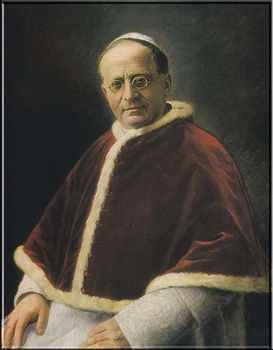
Words of Wisdom: Pope Pius XI

...of blessed memory.


"The enemies of the Church, who think that their time has come, will see that their joy was premature, and that they may close the grave they have dug" (Mit Brennender Sorge, 19 [1937]).

***

Like what Lingayen Dagupan Archbishop Oscar Cruz wrote.

Tuesday, January 11, 2011

Words of Wisdom: The Angelic Doctor and dissenters


The Church has ever proved indestructible. Her persecutors have failed to destroy her; in fact, it was during times of persecution that the Church grew more and more; while the persecutors themselves, and those whom the Church would destroy, are the very ones who came to nothing. Again, errors have assailed her; but in fact, the greater the number of errors that have arisen, the more has the truth been made manifest. Nor has the Church failed before the assaults of demons: for she is like a tower of refuge to all who fight against the Devil.

- St. Thomas Aquinas, OP

***

Kudos to 100% Katolikong Pinoy Facebook group for the photo and quote!

Sunday, November 21, 2010

Words of Wisdom: The Kingship of Christ

From the Papal Encyclical, Quas Primas, of His Holiness, Pope Pius XI, of blessed memory

***
16. Christ as our Redeemer purchased the Church at the price of his own blood; as priest he offered himself, and continues to offer himself as a victim for our sins. Is it not evident, then, that his kingly dignity partakes in a manner of both these offices?

17. It would be a grave error, on the other hand, to say that Christ has no authority whatever in civil affairs, since, by virtue of the absolute empire over all creatures committed to him by the Father, all things are in his power. Nevertheless, during his life on earth he refrained from the exercise of such authority, and although he himself disdained to possess or to care for earthly goods, he did not, nor does he today, interfere with those who possess them. Non eripit mortalia qui regna dat caelestia.[27]

18. Thus the empire of our Redeemer embraces all men. To use the words of Our immortal predecessor, Pope Leo XIII: "His empire includes not only Catholic nations, not only baptized persons who, though of right belonging to the Church, have been led astray by error, or have been cut off from her by schism, but also all those who are outside the Christian faith; so that truly the whole of mankind is subject to the power of Jesus Christ."[28] Nor is there any difference in this matter between the individual and the family or the State; for all men, whether collectively or individually, are under the dominion of Christ. In him is the salvation of the individual, in him is the salvation of society. "Neither is there salvation in any other, for there is no other name under heaven given to men whereby we must be saved."[29] He is the author of happiness and true prosperity for every man and for every nation. "For a nation is happy when its citizens are happy. What else is a nation but a number of men living in concord?"[30] If, therefore, the rulers of nations wish to preserve their authority, to promote and increase the prosperity of their countries, they will not neglect the public duty of reverence and obedience to the rule of Christ. What We said at the beginning of Our Pontificate concerning the decline of public authority, and the lack of respect for the same, is equally true at the present day. "With God and Jesus Christ," we said, "excluded from political life, with authority derived not from God but from man, the very basis of that authority has been taken away, because the chief reason of the distinction between ruler and subject has been eliminated. The result is that human society is tottering to its fall, because it has no longer a secure and solid foundation."[31]

19. When once men recognize, both in private and in public life, that Christ is King, society will at last receive the great blessings of real liberty, well-ordered discipline, peace and harmony. Our Lord's regal office invests the human authority of princes and rulers with a religious significance; it ennobles the citizen's duty of obedience. It is for this reason that St. Paul, while bidding wives revere Christ in their husbands, and slaves respect Christ in their masters, warns them to give obedience to them not as men, but as the vicegerents of Christ; for it is not meet that men redeemed by Christ should serve their fellow-men. "You are bought with a price; be not made the bond-slaves of men."[32] If princes and magistrates duly elected are filled with the persuasion that they rule, not by their own right, but by the mandate and in the place of the Divine King, they will exercise their authority piously and wisely, and they will make laws and administer them, having in view the common good and also the human dignity of their subjects. The result will be a stable peace and tranquillity, for there will be no longer any cause of discontent. Men will see in their king or in their rulers men like themselves, perhaps unworthy or open to criticism, but they will not on that account refuse obedience if they see reflected in them the authority of Christ God and Man. Peace and harmony, too, will result; for with the spread and the universal extent of the kingdom of Christ men will become more and more conscious of the link that binds them together, and thus many conflicts will be either prevented entirely or at least their bitterness will be diminished.

20. If the kingdom of Christ, then, receives, as it should, all nations under its way, there seems no reason why we should despair of seeing that peace which the King of Peace came to bring on earth - he who came to reconcile all things, who came not to be ministered unto but to minister, who, though Lord of all, gave himself to us as a model of humility, and with his principal law united the precept of charity; who said also: "My yoke is sweet and my burden light." Oh, what happiness would be Ours if all men, individuals, families, and nations, would but let themselves be governed by Christ! "Then at length," to use the words addressed by our predecessor, Pope Leo XIII, twenty-five years ago to the bishops of the Universal Church, "then at length will many evils be cured; then will the law regain its former authority; peace with all its blessings be restored. Men will sheathe their swords and lay down their arms when all freely acknowledge and obey the authority of Christ, and every tongue confesses that the Lord Jesus Christ is in the glory of God the Father."[33]

21. That these blessings may be abundant and lasting in Christian society, it is necessary that the kingship of our Savior should be as widely as possible recognized and understood, and to the end nothing would serve better than the institution of a special feast in honor of the Kingship of Christ. For people are instructed in the truths of faith, and brought to appreciate the inner joys of religion far more effectually by the annual celebration of our sacred mysteries than by any official pronouncement of the teaching of the Church. Such pronouncements usually reach only a few and the more learned among the faithful; feasts reach them all; the former speak but once, the latter speak every year - in fact, forever. The church's teaching affects the mind primarily; her feasts affect both mind and heart, and have a salutary effect upon the whole of man's nature. Man is composed of body and soul, and he needs these external festivities so that the sacred rites, in all their beauty and variety, may stimulate him to drink more deeply of the fountain of God's teaching, that he may make it a part of himself, and use it with profit for his spiritual life

Friday, November 6, 2009

Back to blogging

Just got back from our farm in Northern Luzon.

We saw along the way the devastation left by the recent typhoons.

THE TV FOOTAGE WAS NOTHING TO WHAT WE ACTUALLY SAW!

I just thought...

I was whining about my problems but seeing the state these people are after the floods, losing EVERYTHING THEY HAVE...

How can I whine?


"Look at the birds of the air; They do not sow or reap or store way in barns; And yet your heavenly Father feeds them. Are you not much more valuable than they?" Matthew 6:26


May nothing disturb you.

May nothing astonish you.

Everything passes.

God does not go away.

Patience can attain anything.

He who has God within,

does not lack anything.

God is everything!

-St. Teresa of Avila-


Wednesday, September 9, 2009

WORDS OF WISDOM: "Who can she possibly be?"

In answer to her prayers to remain hidden, poor and lowly, God was pleased to conceal her from nearly every other human creature in her conception, her birth, her life, her mysteries, her resurrection and assumption. Her own parents did not really know her; and the angels would often ask one another, "Who can she possibly be?", for God had hidden her from them, or if he did reveal anything to them, it was nothing compared with what he withheld.

God the Father willed that she should perform no miracle during her life, at least no public one, although he had given her the power to do so. God the Son willed that she should speak very little although he had imparted his wisdom to her. Even though Mary was his faithful spouse, God the Holy Spirit willed that his apostles and evangelists should say very little about her and then only as much as was necessary to make Jesus known.

St. Louis de Monfort (True Devotion to Mary)

Friday, September 4, 2009

Something to ponder...


“For not every sin, however grave it may be, is such as of its own nature to sever a man from the Body of the Church, as does schism or heresy or apostasy.”

Venerable Pope Pius XII (Mystici Corporis Christi)

Sunday, August 30, 2009

Words of Wisdom: Paul VI vs. Communion in the Hand

 
In some places the desire to return to the practice by which the Eucharistic bread is placed in the hand of the faithful who communicates himself by putting it in his mouth. In some communities and localities this rite has even been performed without obtaining the prior approval of the Apostolic See and occasionally without appropriate preparation for the people…..In the following period, after the true meaning of the Eucharistic mystery, its effect, and the presence of Christ in it had been profoundly investigated, from a pressing sense of reverence toward this holy Sacrament and of the humility which its reception demands, the custom was introduced by which the minister himself would place the piece of consecrated bread on the tongue of the communicants…
In view of the state of the Church as a whole today, this manner (on the tongue) of distributing Holy Communion must be observed , not only because it rests upon a tradition of many centuries but especially because it is a sign of the reverence of the faithful toward the Eucharist….
This manner of communicating, which is now to be considered as prescribed by custom, gives more effective assurance that Holy Communion will be distributed with the appropriate reverence, decorum, and dignity; that any danger of profaning the Eucharistic species, in which “the whole and entire Christ, God and man, is substantially contained and permanently present in a unique way,” will be avoided; and finally that the diligent care which the Church has always commended for the very fragments of the consecrated bread will be maintained: “If you have allowed anything to be lost, consider this a lessening of your own members.” 
 Pope Paul VI: Memoriale Domini

Tuesday, August 25, 2009

Words of Wisdom: Holy Communion

"If we could comprehend all the good things contained in Holy Communion, nothing more would be wanting to content the heart of man. The miser would run no more after his treasures, or the ambitious after glory; each would shake off the dust of the earth, leave the world, and fly away towards heaven." 

-  St. John Marie Vianney


***

That's St. (Padre) Pio of Pietrelcina receiving Holy Communion from the priest celebrant which is the right thing.  Before the changes after Vatican II, priests in attendance do not get the Hosts by themselves (or self-communicate).  They go down on their knees and receive the Lord from the priest who offered the Holy Sacrifice.

We fall on our knees not because we honor the one giving us Communion.  But we honor Him who we are about to receive. That's what Moses did in the sight of the burning bush.  That's what people did when they saw and recognized Christ (Luke 5:8).

Oh, if we could just comprehend what we are receiving...

Friday, August 14, 2009

Words of Wisdom from a future pope

" What happened after the Council (Vatican II) was altogether different: instead of a liturgy a fruit of continuous development, a fabricated liturgy was put in its place. A living growing process was abandoned and the fabrication started. There was no further wish to continue the organic evolution and maturation of the living being throughout the centuries and they were replaced -- as if in a technical production -- by a fabrication, a banal product of the moment. Gamber, with the vigilance of a true visionary and with the fearlessness of a true witness, opposed this falsification and tirelessly taught us the living fullness of a true liturgy, thanks to his incredibly rich knowledge of the sources. As a man who knew and who loved history, he showed us the multiple forms of the evolution and of the path of the liturgy; as a man who saw history from the inside, he saw in this development and in the fruit of this development the intangible reflection of the eternal liturgy, which is not the object of our action, but which may marvelously continue to blossom and to ripen, if we join its mystery intimately."

-  Joseph Cardinal Ratzinger

(Preface to The Reform of the Roman Rite by Monsignor Klaus Gamber)

Tuesday, August 4, 2009

Words of Wisdom from St. John Marie Vianney


"I throw myself at the foot of the Tabernacle like a dog at the foot of his Master." 

"When we go before the Blessed Sacrament, let us open our heart; our good God will open His. We shall go to Him; He will come to us; the one to ask, the other to receive. It will be like a breath from one to the other."
St. John Marie Vianney


Tuesday, June 16, 2009

Saturday, June 13, 2009

Words of Wisdom: Pope Benedict XVI

"Becoming the Eucharist: let this be our constant desire and commitment! So that the offer of the Body and Blood of the Lord we make upon the altar may be accompanied by the sacrifice of our own lives. Every day we draw from the Body and Blood of the Lord the free and pure love that makes us worthy ministers of Christ and witnesses to His joy. What the faithful expect from a priest is the example of authentic devotion to the Eucharist. They like to see him spend long periods of silence and adoration before Jesus, as did the saintly 'Cure of Ars' whom we will especially recall during the imminent Year for Priests".

"Aware that, because of sin, we are inadequate, yet needing to nourish ourselves from the love the Lord offers us in the Eucharistic Sacrament, this evening we renew our faith in the real presence of Christ in the Eucharist. Such faith must not be taken for granted!

"Today there is a risk of insidious secularisation, even inside the Church", "This could translate into a formal but empty Eucharistic worship, in celebrations lacking that involvement of the heart which finds expression in veneration and respect for the liturgy.

"There is always a strong temptation to reduce prayer to superficial and hurried moments, allowing ourselves to be overcome by earthly activities and concerns."

"With the Eucharist", the Pope explained, "heaven comes down to earth, God's tomorrow descends into the present moment and time is, as it were, embraced by divine eternity".

Monday, June 8, 2009

Words of Wisdom: John Paul the Great and Blessed Teresa of Culcutta on the sanctity of life


Pope John Paul the Great
"…There is no reason for the existence of a resigned mentality that leads to maintaining that laws that are contrary to the right to life -- laws that legalize abortion, euthanasia, sterilization, and the planning of births with methods contrary to life and the dignity of matrimony, present an inevitability and are, in addition, virtually a social necessity. On the contrary, they constitute a germ of corruption of society and its fundamentals. Civil and moral conscience cannot accept this false inevitability, just as it does not accept the idea of the inevitability of wars and of inter-ethnic exterminations." (Evangelium Vitae)


Blessed Teresa of Culcutta
“The greatest destroyer of peace today is abortion, because it is a war against the child, a direct killing of the innocent child, murder by the mother herself. And if we accept that a mother can kill even her own child, how can we tell other people not to kill one another?” (Speech at the National Prayer Breakfast, February 3, 1994).