Showing posts with label Saint of the Day. Show all posts
Wednesday, September 28, 2016
Hymn to St. Lorenzo Ruiz
Below are the lyrics to the beautiful hymn composed by the Filipino Jesuits to honor the first Filipino saint, St. Lorenzo Ruiz, whose feast day we celebrate today.
We love this hymn, but sadly there is a line here that is plainly wrong.
Can you identify which line it is and tell us why it is wrong?
****
Sanlibo man aking buhay
Bawat isa’y iaalay
Sa Diyos, sa bayan kong mahal
Sasanggalang iyong dangal.
Isugo mo kahit saan
Hamakin man ako’t saktan
dalangain ko’y maging tapat
Pag ibig mo’y sasapat
CHORUS
Sanlibo man aking buhay
Sanlibo ring iaalay
Sanlibo kong kamatayan
Sa palad Mo ilalaan
Sanlibo man aking buhay
Bawa’t isa’y iaalay
Sa Diyos at bayan kong mahal
Sasanggal inyong dangal
Isugo Mo kahit saan
Hamakin man ako’t saktan dalagin ko’y maging tapat
Pag ibig mo ay sasapat
Repeat CHORUS 2x
Thursday, August 6, 2015
St. Josemaria Escriva celebrated ONLY the Traditional Latin Mass
St. Josemaría was always first and foremost obedient, but he could not read the faded print in the new edition of the Roman Missal (see this photo). He had cataracts and found it difficult and painful to read the poor quality typeset. Also, the saint had experienced certain mystical moments associated with particular words, sentences, and structural parts of the Extraordinary Form of the Roman Rite. Such moments had been a part of his spiritual life since boyhood and through his priesthood. In having to celebrate the Mass of Paul VI, the saint would have been cut off from this.
Finally, it was the saint’s secretary, Don Alvaro del Portillo, who at the behest of the saint telephoned Msgr. Annibale Bugnini to ask permission to continue celebrating the Classical Rite. Monsignor Bugnini was quick in his response: “You don’t need permission from me. Just continue to celebrate the Mass of St. Pius V.”
This was taken from the blog of Rome tour guide, Mr. Orbis himself, John Sonnen.
Another account says that the Saint simply didn't like the New Mass and applied for an indult to say privately until his death, the Mass of his ordination.
The saint himself is nurtured by the Mass of All Ages.
And this is also the same reason why Pope Benedict XVI liberalized the celebration of the Traditional Latin Mass now officially known as the Extraordinary Form of the Roman Rite.
Which made me remember something.
There was once a raging lunatic cleric who said that those who attend and celebrate the Extraordinary Form of the Roman Rite are "sedevacantists, attackers of Vatican II and haters of Pope Francis".
The photo above shows the Saint celebrating the Extraordinary Form of the Roman Rite. Note the placement of the Missal is on the Gospel side (left side of the altar) and the Host is resting on the corporal. That is the reason why the corporal is called THE corporal. The Body of Christ rests on it.
There are those who say that this is NOT a Traditional Latin Mass but a Novus Ordo Mass and they use this photo below as "proof".
They claim that this is a concelebrated Mass which only happens in the Traditional Latin Mass during an Ordination.
If you see priests now concelebrating with a stole over a surplice, that is a ONE IN A LIFETIME thing! Bring out your phone cameras and click away! Most Filipino priests especially in their private Masses would celebrate Mass, offer the Holy Sacrifice in their jammies like these!


So seeing them in their cassock, surplice and stole concelebrating and NOT in the proper vestments (alb, stole, cassock) is such a PRIVILEGE to behold! You won't expect these priest to dress up this way when they get invited to a party in a posh hotel or in a VIP gathering in Malacanang or the US Embassy. Noooooooo! They dress properly for every event EXCEPT for Holy Mass.
Watch out! I got a lot of photos of that CREATIVE Mass in San Agustin.
Stay tuned.
Going back...
The photo of St. Josemaria with the priests behind him is NOT a concelebrated Novus Ordo Mass.
Those priests are properly vested to assist in distributing Holy Communion. Why? Even today, THAT is the proper vestment for a priest not concelebrating, not celebrating but distributing Holy Communion because a priest, bishop and deacon are the ORDINARY ministers of Holy Communion. Lay people, including nuns, are EXTRAORDINARY Ministers of Holy Communion.
That was a lot for a post.
Whew!
Time to go rest for the moment.
Wednesday, August 13, 2014
Martyr of the Brown Scapular
Meet Blessed Isidore Bakanja, a convert to Catholicism, back when missionaries work to preach the Gospel and bring people to the One True Faith.
He was baptized at the age of 18. He worked for the white colonizers as an assistant mason. He never forgot the lessons taught him by the Trappist missionaries; a Christian must be recognized by the rosary and scapular (Mary's habit, as it was rendered in Isidore's native tongue).
And this he kept all his life.
He found employment in a Belgian company that controlled the rubber plantations in the region as a house boy. Many of the agents were Christian-hating atheists. The missionaries' defense of the natives' rights and their denouncing of injustices perpetrated against them earned the ire of these atheists.
Isidore soon experienced this hatred. He was told to stop teaching his fellow workers how to pray: "You'll have the whole village praying and no one will want to work", one agent shouted at him.
Isidore was also ordered to take away his scapular. When he did not, he was twice flogged. The second time, the agent tore the scapular from around Isidore's neck and threw him to the ground. He had two servant boys hold Isidore by his hands and feet and a third one flogged him. The whip was made of elephant hide with nails protruding at the end.
Isidore asked for mercy. "My God, I'm dying". Isidore bore all the blows patiently.
After the beatings, the bones on Isidore's back were exposed. After the scourging, his legs were chained, and he was thrown into into a hut for processing rubber. He was severely beaten he could barely move.
When an inspector was about to visit the plant, Isidore was moved to another village. Unable to walk, he fell by the wayside and hid in the forest.
When he heard the inspector, he dragged himself before the inspector.
The inspector himself left a written account of his impression: "I saw a man come from the forest with his back torn apart by deep, festering, malodorous wounds, covered with filth, assaulted by flies. He leaned on two sticks in order to get near me -he wasn't walking; he was dragging himself".
The agent, responsible for the beating, appeared on the scene and tried to kill "that animal". He was restrained by the inspector.
He took Isidore to his own settlement, hoping to help him heal. But the beating was so severe, that the wounds have become infected. Isidore felt death nearing.
He told someone who had pity on him: "if you see my mother, or if you go to the judge, or if you meet the priest, tell them that I am dying because I am a Christian".
Two missionaries spent several days with him and gave him the last sacraments.
He told them the reason for his beating: "The white man did not like Christians.... He did not want me to wear the scapular.... He yelled at me when I said my prayers".
The missionaries urged Isidore to forgive the agent. Isidore assured the missionaries that he had already forgiven them, that he nursed no hatred for him. The missionaries urged Isidore to pray for the agent. "Certainly I shall pray for him. When I am in heaven, I shall pray for him very much". His agony - more painful than the actual flogging - lasted six months. He died on either 8 or 15 august 1909, rosary in hand and the scapular of Our Lady of Mt Carmel around his neck.
He was a convert for two and a half years but lived his life since his Baptism like he was a Christian all his life.
He was beatified by St. John Paul II in April 24, 1994 along with St. Gianna Beretta Molla and St. Elisabeth Canori Mora
His feastday is celebrated in his native country and in the Carmelite community every August 15.
***
May we follow his example of boldly proclaiming the Faith.
May the Christian martyrs of the Middle East bring about the fall of the Islamic State of Iraq and Syria and all jihadists and Muslim extremists.
May the blood of the martyrs bring these people towards conversion.
Amen.!
Thursday, June 26, 2014
Misunderstood Saint
Most Catholics, and most non-Catholics, misunderstand our saint for the day. They often times equate him with discipline and sternness.
Far from these limiting adjctives, Saint Josemaria Escriva is more than just that.
Like all other saints, he calls us all to holiness.
And with holiness comes discipline:
You say the Mass is long, he says, because your love is short.Strong words for some who rush to the parking lot before the final blessing just so they do not get stuck in the mad rush after Mass.
Strong words for those who say the Tridentine Mass is long and boring. This Mass, by the way, has always been the Mass St. Escriva prayed.
Holiness has a price. And it is cheaper than the a one-way ticket to hell.
Wednesday, June 18, 2014
BREAKING NEWS: Theologians approve miracle attributed to Venerable Fulton Sheen!
PEORIA, Ill. (CNS) — The possible miracle needed for the beatification of Archbishop Fulton J. Sheen took another step toward papal recognition June 17 when a panel of theologians met at the Vatican, the Archbishop Fulton Sheen Foundation announced.
As a normal part of the sainthood process, the theologians met to consider whether or not the promoters of Archbishop Sheen’s cause demonstrated that the proposed miracle — the survival of a child delivered stillborn — occurred after prayers for the intercession only of Archbishop Sheen.
In March, a seven-member board of physicians convoked by the Congregation for Saints’ Causes agreed there was no natural explanation for why the boy’s heart started beating 61 minutes after his birth.
The child, James Fulton Engstrom, is now 3 years old and developing normally. His mother, Bonnie Engstrom, had said she had no pre-composed prayer asking for help from Archbishop Sheen. “I just kept repeating his name over and over in my head: Fulton Sheen, Fulton Sheen, Fulton Sheen.”
Archbishop Sheen was a Peoria diocesan priest who gained fame for his 1950s television show “Life Is Worth Living” and for his 16 years at the helm of the Society for the Propagation of the Faith. The archbishop died Dec. 9, 1979, in New York.
In a statement June 17 from the Archbishop Fulton Sheen Foundation, Bishop Daniel R. Jenky of Peoria said, “With the recommendations of the medical experts and now the theologians, the case will next be reviewed by the cardinals and bishops” who are members of the Congregation for Saints’ Causes. [This is but ministerial. The crucial report is actually the certification of a miracle by the medical experts and the theologians.]
“Finally, the miracle would be presented to Pope Francis, who would then officially affirm that God performed a miracle through the intercession of Fulton Sheen. There is no timeline as to when these next steps might move forward,” Bishop Jenky said.
If Pope Francis formally issues the decree recognizing the miracle, the bishop said, “Sheen could then be declared ‘Blessed’ in a ceremony that could be celebrated in Peoria, Sheen’s hometown.”
Another miracle would be needed for Archbishop Sheen’s canonization.
Saturday, June 14, 2014
The true face of St. Anthony of Padua
And no he doesn't look very boyish like how most statues portray him.
This was done through 3D forensic facial reconstruction technology by a team of archeological facial reconstruction experts.
They relied heavily on a digital copy of the saint's skull.
By the way, the remains of the saint are preseved at the basilica built in his honor.
Read the details here.
Next time, let's have images of St. Anthony looking like this, ok? Instead of this.
Monday, May 26, 2014
St. Celestine's relics are revested
This is quite "old" as this was done last year, but better post it than never, no?
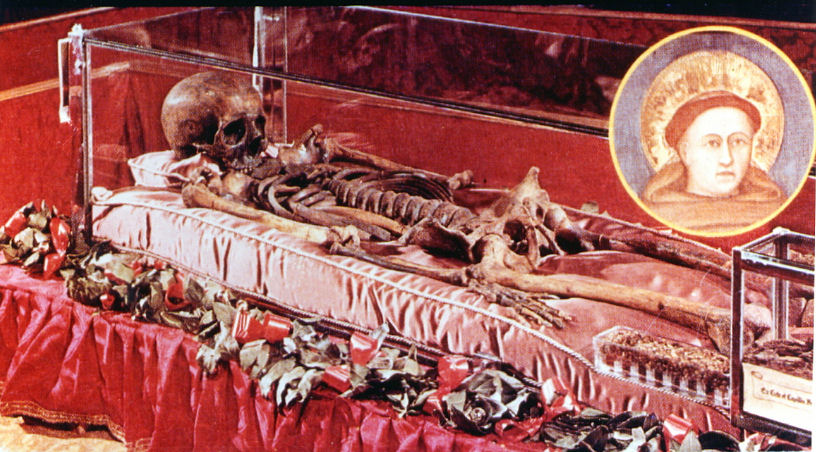
This is the relic of St. Celestine V, the humble monk elected pope who then resigned after a few months as pope to return to his old life as a hermit.
This is the skull of the saint.

This is the relic of St. Celestine V, the humble monk elected pope who then resigned after a few months as pope to return to his old life as a hermit.
This is the skull of the saint.
Note the arrow. It points to a hole on the skull fueling speculation that he died from it. Forensic experts studied the skull and noted that the hole was done post mortem, therefore it was not the cause of death.
Scientists scanned the skull using 3D imaging to create the likeness of the saint. They created a silver mask to cover the skull. They had to change the face mask because it was starting to melt and it was not the features of the saint.
The old mask was of wax, and had the appearance of Cardinal Carlo Confalonieri, from March 27, 1941 al 22 February 1950 Archbishop of L'Aquila
You can check the 3D computer images of the face of the saint here.
Here is the relic of the saint, fully vested in his pontifical. Note the pallium. Yes, that is the inaugural papal pallium of Benedict XVI which he left on the casket of St. Celestine when the pope emeritus visited La Aquila after the deadly 2009 earthquake
The hermitage of St. Celestine can be seen here.
L'Aquila, Italy, Jul 4, 2010 / 11:30 am (CNA/EWTN News).- Before leading the Angelus prayer from the Italian city of Sulmona he visited on Sunday, the Holy Father proposed Mary as "the perfect model of obedience to the divine will." He hoped also for increased appreciation of the simple life, as St. Celestine lived it, and the subsequent freedom of heart and mind that opens us up to sharing.
During the visit for the occasion of the 800th anniversary of the birth of St. Celestine, the Holy Father led thousands of faithful in the recitation of the Marian prayer after Mass in the town square.
He prayed that the people of God would be able to "walk joyously and united on the path of faith, hope and love" and that, "faithful to the inheritance of St. Celestine, we may always know how to put evangelical radicality and mercy together, so that all who seek God may find him."
St. Celestine was a 13th century hermit that became Pope Celestine V. His remains are now housed in the crypt of Sulmona's Cathedral of San Panfilo, where Benedict XVI will pay a visit Sunday afternoon to host an encounter with area youth.
Turning to Mary, "Virgin of silence and of listening," Benedict XVI said that, in her, St. Celestine "found the perfect model of obedience to the divine will," as he lived a simple and humble life, seeking the "truly essential" and thanking the Lord always as he recognized "in everything the gift of His goodness." [The pope emeritus must be thinking about his resignation here, no?]
Turning to the present, the Pope said "also we, who live in an age of greater comforts and possibilities, are called to appreciate a sober lifestyle, to keep our hearts and minds freer and to be able to share our possessions with our brothers."
He prayed that "Holy Mary, who encouraged the first community of disciples of Jesus with her maternal presence, help also the Church of today to give good witness to the Gospel."
Following the Angelus prayer the Pope met with the bishops of the local Abruzzo region for lunch at a newly restored house for elderly and sick priests inaugurated as the "Benedict XVI" house. After lunch he was scheduled to meet with a delegation from the local prison.
Here is one of the doors of the Cathedral of San Panfilo, where the relics of St. Celestine are now housed. The mosaic recalls the visit of Benedict XVI and the papal declaration of the Year of St. Celestine.
And here is Benedict XVI, back when he was still sitting on the Chair of Peter, praising the humility of St. Celestine.
Get that?
HUMILITY.
Not with simple vestments or smiling always on camera.
Thursday, April 3, 2014
April 2 is the feast of two saints!
Today is the feast of the boy martyr from the Visayas, the missionary catechist, St. Pedro Calungsod, my namesake.
I still prefer this image of the saint. It shows the instrument of his glorification / martyrdom, much like how our Lord chose to have the five wounds remain on His Body after the Resurrection. This was how martyrs are represented in Christian iconography.
Look near the feet of the image. See the blood?

And it was in 2005 that one of my fave pope's went to his eternal reward.
If you are not into superheroes, you wouldn't understand this meme.
But just the same, saints are superheroes, and St. John Paul is one!
ORA PRO NOBIS DEO!!!
Tuesday, February 18, 2014
Lorenzo Ruiz, back in 1981...
Pope John Paul II visited the Philippines for his first papal visit from February 17 to 21. The Holy Father visited several places then around the country, like Manila, Baguio, Cebu, Bacolod, Davao...(I might have missed another one).
But the highlight of this is the beatification of my dear lolo, Lorenzo Ruiz and his companion martyrs in Luneta Park on February 18, 1981!
This statue which still stands on Luneta Park is a gift of the Holy Father to the Filipino people on the occasion of the beatification of Lolo Lorenzo, the first beatification outside the Vatican.
And in case you didn't know, that tree behind the statue is the tree planted by Paul VI when he visited the country.
It has been 33 years since that day!
And according to tradition, Lolo Lorenzo might have been martyred at the age of 37.
The photo above is from this blog, where you can also read about the historic documentation of the martyrdom.
You can also grab a copy of “Lorenzo de Manila, the Protomartyr of the Philippines and His Companions,” by Fr. Fidel Villaroel, OP, the prolific historian-saint maker, credited for the beatification and canonization of Lorenzo and his 15 companion martyrs. The book is available via the UST Press.
Below is a photo essay of that historic visit to the country. I still have vivid memories of that trip. :)
But the highlight of this is the beatification of my dear lolo, Lorenzo Ruiz and his companion martyrs in Luneta Park on February 18, 1981!
This statue which still stands on Luneta Park is a gift of the Holy Father to the Filipino people on the occasion of the beatification of Lolo Lorenzo, the first beatification outside the Vatican.
And in case you didn't know, that tree behind the statue is the tree planted by Paul VI when he visited the country.

It has been 33 years since that day!
And according to tradition, Lolo Lorenzo might have been martyred at the age of 37.
The photo above is from this blog, where you can also read about the historic documentation of the martyrdom.
You can also grab a copy of “Lorenzo de Manila, the Protomartyr of the Philippines and His Companions,” by Fr. Fidel Villaroel, OP, the prolific historian-saint maker, credited for the beatification and canonization of Lorenzo and his 15 companion martyrs. The book is available via the UST Press.
Below is a photo essay of that historic visit to the country. I still have vivid memories of that trip. :)
Tuesday, December 3, 2013
If St. Francis Xavier were alive today...
What would most of his Jesuit brothers think of him?
More photos of Goa Basilica here.

"Hey Francis! You walk around dressed in a weird Batman cape trying to convert all non-Christians! What's important is we love one another and we save Mother Earth!"
***
For devotees of the saint, most especially graduates of Xavier School, the body of the saint will once again be displayed to the public as declared by Archbishop Filipe Neri Ferrao of Goa Daman and Diu. The exposition at Old Goa will be held next year from November 22, 2014, till January 4, 2015.
Are you buying tickets?
As you can see in the photo, the body of the saint is not incorrupt anymore as it was when it was discovered.
Here is the photo of the saint's face
The right arm of the saint is now at the Church of the Gesu in Rome.
More photos of Goa Basilica here.
Saturday, October 5, 2013
St. Francis was not a liturgist, but....
He knows his liturgy, and in obedience to Holy Mother Church, he followed them, faithfully, obediently.
He did not earn any degree from the great "masters" of liturgy like Bugnini and Chupungco....but he followed what was in the liturgical books.
If he were alive today, he would be accused by Dean Laum, as a "rigid:, "rubricist", "clinging to a lost past", "Ratzingerian", "rad trad".
But what did he instruct his little brothers?
Let us try to look at it, courtesy of the great Fr. Z.
And let us see what the great liturgist Fr. Genaro Diwa is doing.
Yup.
Non metal chalice.
Superb!
What do the liturgical books say?
Did the CBCP say anything about this? Nah.
Is ceramic an esteemed material? Nah.
"But TPC, it is what's in the heart that is important!"
Oh, right! I guess the Wise Men who visited the Baby Jesus told Him and His parents that it's the thought that counts...
And oh, Christ also did not mind that precious perfume was poured on Him by the repentant woman which Judas Iscariot rebuked and wondered why the money spent on that was instead given to the poor.
Yeah. They all do care for the poor that is why instead of spending money on precious vestments and vessels for the worship of God, we give it to the poor.
Yeah, as if I am not witness to the extravagance behind the...
Wonder why Pope Francis kept on insisting about the trappings of the "courtiers". Now, I understand. It was staring me right in my eyes...
And this is what you get from being a liturgical expert.
You get so numbed drowning in the trappings of your degree, you forget the most basic thing, OBEDIENCE.
And we all thought we had a liturgical expert in our midst.
No wonder you have such great differences between Manila and Cebu...
Even vocations wise.
It shows. It really shows.
He did not earn any degree from the great "masters" of liturgy like Bugnini and Chupungco....but he followed what was in the liturgical books.
If he were alive today, he would be accused by Dean Laum, as a "rigid:, "rubricist", "clinging to a lost past", "Ratzingerian", "rad trad".
But what did he instruct his little brothers?
Let us try to look at it, courtesy of the great Fr. Z.
Epistola ad custodes
To all the custodians of the Friars Minor to whom this letter shall come, Brother Francis, your servant and little one in the Lord God, greetings with new signs of heaven and earth which are great and most excellent before God and are considered least of all by many religious and by other men.
I beg you more than if it were a question of myself that, when it is becoming and you will deem it convenient, you humbly beseech the clerics to venerate above all the most holy Body and Blood of our Lord Jesus Christ and His Holy Name and written words which sanctify the body. They ought to hold the chalices, corporals, ornaments of the altar, and all that pertain to the Sacrifice as precious. And if the most holy Body of the Lord is left very poorly in any place, let It be moved by them to a precious place, according to the command of the Church and let It be carried with great veneration and administered to others with discretion. [Like Robby Okol and that EMHC who gave 5 hosts to a sick child in my upcoming blog post...] The Names also and written words of the Lord, In whatever unclean place they may be found, let them be collected, and then they must be put in a proper place. And in every time you preach,admonish the people about penance and that no one can be saved except he that receives the most holy Body and Blood of the Lord. [Do they still do that today? Rarely. Don't be surprised why we as a Catholic nation, have politicians who are so numbed they still think it is not a sin to lie, cheat and steal. Right Sen. Drilon???] And whenever It is being sacrificed by the priest on the altar and It is being carried to any place, let all the people give praise, honor, and glory to the Lord God Living and True on their bended knees. [Do you even see your priest genuflect when they enter the church? So why be surprised that people don't even do that today!] And let His praise be announced and preached to all peoples so that at every hour and when the bells are rung [You still have bells in your church or chapel?] praise and thanks shall always be given to the Almighty God by all the people through the whole earth.
And whoever of my brothers custodians shall receive this writing, let them copy it and keep it with them and cause it to be copied for the brothers who have the office of preaching [because not all priests then can preach, and they had to get permission to preach. And with the kind of homilies we get every Sunday Mass, ugh! You now know why there is a need for a preaching license. By the way, Vatican II did that. I mean the wrong interpretation of Vatican II.] and the care of brothers, and let them preach all those things that are contained in this writing to the end: let them know they have the blessing of the Lord God and mine. And let these be for them true and holy obedience. [Now it is dialogue first with the superior before obedience. And if you can't get your whims, leave! Yeah. I know one. BIG EGO. It shows, physically.]
And let us see what the great liturgist Fr. Genaro Diwa is doing.
Yup.
Non metal chalice.
Superb!
What do the liturgical books say?
GIRM No. 328 clearly states: "Sacred vessels are to be made from precious metal." Liturgical law, however, allows the bishops' conference to propose other esteemed materials for use in sacred vessels.
Redemptionis Sacramentum
Chapter V - CERTAIN OTHER MATTERS CONCERNING THE EUCHARIST
3. Sacred Vessels
117. Sacred vessels for containing the Body and Blood of the Lord must be made in strict conformity with the norms of tradition and of the liturgical books. [cf. GIRM 327-333] The Bishops’ Conferences have the faculty to decide whether it is appropriate, once their decisions have been given the recognitio by the Apostolic See, for sacred vessels to be made of other solid materials as well. It is strictly required, however, that such materials be truly noble in the common estimation within a given region, [cf. GIRM 329,332] so that honour will be given to the Lord by their use, and all risk of diminishing the doctrine of the Real Presence of Christ in the Eucharistic species in the eyes of the faithful will be avoided. Reprobated, therefore, is any practice of using for the celebration of Mass common vessels, or others lacking in quality, or devoid of all artistic merit or which are mere containers, as also other vessels made from glass, earthenware, clay, or other materials that break easily. This norm is to be applied even as regards metals and other materials that easily rust or deteriorate. [cf. GIRM 329,332; Inaestimabile donum, 16]
Did the CBCP say anything about this? Nah.
Is ceramic an esteemed material? Nah.
"But TPC, it is what's in the heart that is important!"
Oh, right! I guess the Wise Men who visited the Baby Jesus told Him and His parents that it's the thought that counts...
And oh, Christ also did not mind that precious perfume was poured on Him by the repentant woman which Judas Iscariot rebuked and wondered why the money spent on that was instead given to the poor.
Yeah. They all do care for the poor that is why instead of spending money on precious vestments and vessels for the worship of God, we give it to the poor.
Yeah, as if I am not witness to the extravagance behind the...
Wonder why Pope Francis kept on insisting about the trappings of the "courtiers". Now, I understand. It was staring me right in my eyes...
And this is what you get from being a liturgical expert.
You get so numbed drowning in the trappings of your degree, you forget the most basic thing, OBEDIENCE.
And we all thought we had a liturgical expert in our midst.
No wonder you have such great differences between Manila and Cebu...
Even vocations wise.
It shows. It really shows.
Saturday, August 24, 2013
How dumb can you be?
Why, you asked?
Because there are people who think that when a priest celebrates the Tridentine Mass, he is a sedevacantist, an SSPX...
If a lay person supports that priest, and attends the Tridentine Mass, he is a sedevacantist and an SSPX supporter.
And if a blogger does all of that, he is branded a secret SSPX!
Right, Padre?
Don't deny it.
I have the screenshot.
Time to APOLOGize.
That is why we have people like this.
When you mention St. Pius X, they think you are already of the group.
Some apologetics.
Thursday, August 22, 2013
JP2 and J23 Canonization date will be revealed on Sept. 30!
Vatican City, August 21, 2013 (Zenit.org) Junno Arocho Esteves | 593 hits
In a presentation on Saint Giovanni Battista Piamarta held in Rimini, Cardinal Angelo Amato, prefect for the Congregation for the Causes of Saints, confirmed that Consistory that will announce the date of Canonization for John XXIII and John Paul II will be held on September 30th.
In an interview with Vatican Radio, Cardinal Amato reiterated the Holy Father’s words during his press conference held on his return flight from World Youth Day in Rio.
“On the airplane, the Holy Father, who was returning from Brazil, already announced that their Canonizations will not be imminent - in these last months of 2013 - but in 2014,” the Cardinal said.
“A precise date will be announced by the Holy Father on September 30th, when the Consistory presided by him will be held. In that moment, the Holy Father will give the official date, that only he knows.”
The Prefect for the Congregation for the Causes of Saints went on to say that John XXII was “the great prophet and creator of the Council”, while John Paul II is regarded as “the one who put it into practice and developed it.”
Cardinal Amato regarded them as two pillars not only of Christian culture but of Christian holiness as well.
***
And Sept. 30 is the day of this other great guy!
And I think the date of the announcement has some significance with the feast of St. Jerome.
Not only was the saint known for his work on the Vulgate, but he is a Doctor of the Church.
So, I think the pope has something on his mind when he decided to hold the consistory announcing the canonizations on his memorial.
Mark you calendars folks!
Wednesday, July 31, 2013
Today is the Feast of St. Ignatius of Loyola
He famously said this to his Jesuits.
These two jokers had other things in mind.
Yup.
This pretty much sums it up!
You might want to read this.
Friday, May 3, 2013
Pope Francis' first canonization: 800 martyrs!
Yup!
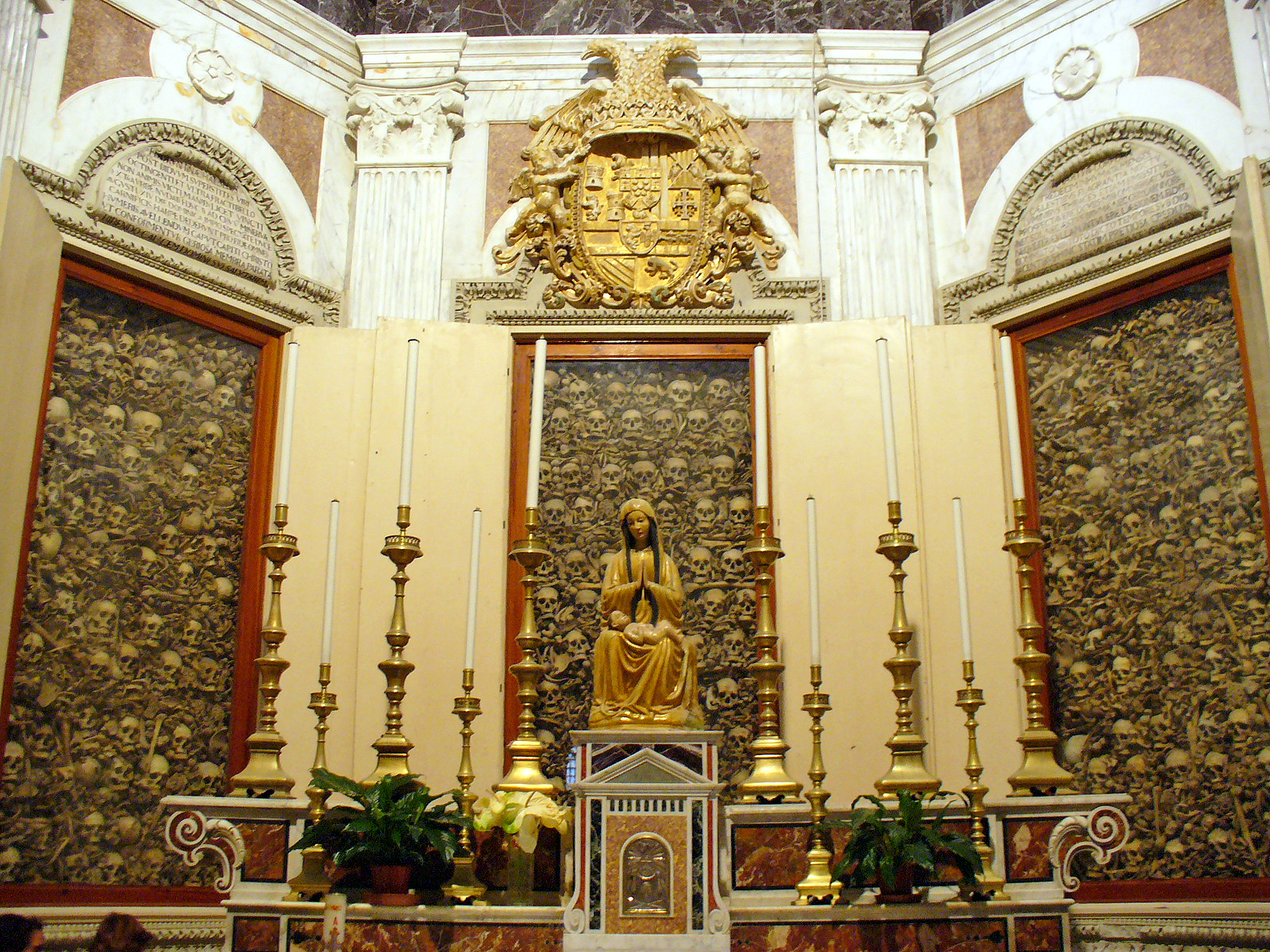
That is the altar with ALL of the relics of the martyrs.
Nope. Not Khmer Rouge.
It's Otranto!
***
Pope Francis is preparing to canonise an estimated 800 Italian laymen killed by Ottoman soldiers in the 15th century. The canonisation service will be on May 12 in St Peter’s Square and it will be the first carried out by the Pontiff since he was elected in early March. [The consistory announcing the canonization of these martyrs was announced by Benedict XVI along with his decision to step down as pope in February 11.]
The killing of the martyrs by Ottoman troops, who launched a weeks-long siege of Otranto, a small port town at the most eastern tip of southern Italy, took place in 1480.
When Otranto residents refused to surrender to the Ottoman army, the soldiers were ordered to massacre all males over the age of 15. Many were ordered to convert to Islam or die, but Blessed Antonio Primaldo, a tailor, spoke on the prisoners’ behalf. “We believe in Jesus Christ, Son of God, and for Jesus Christ we are ready to die,” he said, according to Blessed John Paul II, who visited Otranto in 1980 for the 500th anniversary of the martyrs’ deaths.
Primaldo inspired all the other townspeople to take courage, the late Pope said, and to say: “We will all die for Jesus Christ; we willingly die so as to not renounce his holy faith.” There were not “deluded” or “outdated,” Blessed John Paul continued, but “authentic, strong, decisive, consistent men” who loved their city, their families and their faith.
The skulls and other relics of the martyrs currently adorn the walls around the altar of Otranto Cathedral as a memorial to their sacrifice. [Imagine someone drooling at the sight of all those relics and would post a Facebook post of how lucky he was. OK. The relics are remains of the saints. OK, ok. Take a deep breath....and ask this question. Do you feel the same way in front of the exposed Blessed Sacrament? Simple question. Check your temper.] According to the archdiocese’s website, popular tradition holds that when the soldiers beheaded Primaldo, his body remained standing even as the combatants tried to push him over. Legend has it that the decapitated man stood until the very last prisoner was killed, at which point Primaldo’s body collapsed next to his dead comrades.
In 1771, the Church recognised the validity of the local veneration of Primaldo and his companions and allowed them to be called Blessed. In 2007, retired Pope Benedict XVI formally recognised [because they were not formally beatified] their martyrdom and, in 2012, he recognised a miracle attributed to their intercession. Martyrs do not need a miracle attributed to their intercession in order to be beatified. However, miracles must be recognised by the Vatican in order for them to become saints.
The miracle involved the late-Poor Clare Sister Francesca Levote. She was suffering from a serious form of cancer but was healed after a pilgrimage to pray before the martyrs’ relics in Otranto in 1980, a few months before Pope John Paul’s visit in October. She died in February 2012 at the age of 85.
In a letter published in December 2012, Archbishop Donato Negro of Otranto said that the martydom of the townnsfolk must represent a “purification of the memory of the Catholic Church and a rooting out of every possible lingering resentment, rancor, resentful policies, every eventual temptation toward hatred and violence, and every presumptuous attitude of religious superiority, religious arrogance, moral and cultural pride.” [Uh...what now? And I thought the glory of the martyrs show us their witness to the Gospel and their imitation to the ultimate act of giving up one's life for love....like Jesus Christ, the model of all Christian martyrs. Now the archbishop is saying that the martyrdom calls for the "purification of the memory of the Catholic Church...."??? Good golly! Their martyrdoms are the glory of the Church! Why rid our history of their glorious deaths?!]
Remembering Christian martyrs is an occasion to examine one’s own life and make sure it corresponds with the Gospel call to love and forgive, he added. [Uhm... archbishop. The occasion calls us to "if anyone wishes to follow me, let him take up his cross daily and follow me." I think that is the first thing that needs to come to mind. And of course forgiving those who planned your (martyr's) death like what Jesus did on the cross, and what most records of martyr's death says like of St. Thomas More, St. Maria Goretti and St. Maximilian Mary Kolbe.]
***
Tertullian once wrote that "the blood of martyrs is the seed of the Church" and it is through the witness of their death that they mirror the death of Jesus Christ, that they inspire other Christians to offer their lives for God and for His Holy Church.
By the way, the word martyr came from the Greek word μάρτυς, mártys, which means "witness."
That comment of Archbishop Negro about the martyrs really has me scratching my head. Really makes me wonder what all that hullabaloo was all about.
***
RANT TIME!
News came from the Catholic Herald. Unfortunately, while I scour the web for this kind of news, some smart-aleck Facebook historian just gets the link from the source and does not even acknowledge this lowly blog as the source of the news. How did I know?
Hello! I am the owner of the blog. I can see who visits.
And he says he doesn't visit my blog nor does he agree with my views...
| OMG!!! Pinoy Catholic knows I am reading his blog! Better change my drama.... |
Tuesday, April 2, 2013
Today is JP2's death anniversary
Memories of his death still vivid...
Click the image for a larger view.
Nice for a desktop wallpaper.
Click the image for a larger view.
Nice for a desktop wallpaper.
Another Great Image of St. Pedro Calungsod
I once made a post about how to best illustrate a martyr-saint. You can also read about my personal fave image of St. Pedro.
This is the image that was presented to Cardinal Vidal.
Now since today is the death anniversary of St. Pedro Calungsod, my namesake and patron, I present to you a new image I have found of St. Pedro. Note, it still doesn't look like what you see in religious store shelves today.
Glad to see the images of his martyrdom are seen in the image. :)
Today is April 2...
And yes enough of the April Fools jokes.
Some of us take life too seriously...
Well, this one is serious actually.
On April 2...these men died to receive their eternal reward in Heaven
Indeed! April 2 is a blessed day!
Ok, enough grumpiness out of that April 1 "Motu Propio".
Some of us take life too seriously...
Well, this one is serious actually.
On April 2...these men died to receive their eternal reward in Heaven
![]() |
| St. Pedro Calungsod. This is my personal favorite image of the boy martyr |
![]() |
| Blessed Diego Luis de San Vitores, the Jesuit who brought the young Pedro to Guam |
![]() |
| Blessed John Paul II, the pope who beatified the two martyrs. |
Indeed! April 2 is a blessed day!
Ok, enough grumpiness out of that April 1 "Motu Propio".
Tuesday, March 12, 2013
The remains of St. Vincent de Paul
When his remains were exhumed for the first time in 1712, his body was found intact.
This exhumation was done in 1960, only his skeleton was left, the decomposition blamed on an underground flooding. The 1737 exhumation for his canonization already found his body in this state.
The photo above was during the removal of the bones for "re-arranging" in time for the saint's 300th death anniversary.
His bones are now encased in a wax figure.
His heart, though, remains incorrupt...the heart of the Great Apostle of Charity, in a side altar in the Apparition Chapel in Rue du Bac, where the Virgin Mother revealed the Miraculous Medal to St. Vincent's daughter, St. Catherine Laboure.
PS: one of his sons was the architect of the liturgical revolution...
Subscribe to:
Posts (Atom)