Pages

Showing posts with label eucharistic miracle. Show all posts

Tuesday, October 8, 2013

Jubilee of Eucharistic Miracle of Orvieto


Did you know that this was declared by the former pope?


Rome, Italy, Oct 7, 2013 / 06:49 am (CNA/EWTN News).- In light of the jubilee instituted by Benedict XVI in honor of the Eucharistic miracle in Orvieto, Italy, the number of pilgrims coming to the area has increased, deepening the faith of those who come.  [ On that note, is your faith about the Real Presence deepened by your experience of Communion in the Hand?  Ask those who receive through this method.]

“It just makes you thankful that you can come somewhere where these things have happened that just reiterate the faith. It’s so real, it’s so tangible,” Jenna Schaffer of San Francisco, Calif., told CNA Oct. 6.

While he was Pope, Benedict XVI dedicated the years 2013 and 2014 as an Extraordinary Eucharistic Jubilee. The event celebrates the 750th Anniversary of the Bolsena Miracle of 1263, in which the Host began to bleed in the hands of the priest during the prayer of consecration.

Schaffer, who visited Orvieto with her mother and a close family friend, shared that she grew up Catholic, but has become especially close to God in recent years, and that being in the cathedral for her was “an honor.”

“It’s a great honor,” she emphasized, “to be able to hear and see what all of these people believe in and see it come true.”

The miracle occurred in 1263 when a German priest, Fr. Peter of Prague, stopped in Bolsena, Italy during a pilgrimage to Rome. The priest is described as having been pious, but found it difficult to believe in the real presence of Christ in the Eucharist.

During his stay, the priest was saying Mass in the Church of St. Christina in Bolsena, and had just finished the words of consecration when blood began to seep from the Host onto the altar and corporal, a special linen used during Mass in order to catch any fragments of the host which might fall.

Fr. Peter immediately journeyed to Orvieto where Pope Urban VI was residing at the time, and informed the pontiff of what had just occurred.

After hearing the priest’s account, the pontiff absolved the priest for his disbelief and had the host and blood-stained corporal brought to the Cathedral in Orvieto where they are still venerated today, and instituted the feast of “Corpus Christi” a year later.  [The events related here are depicted in paintings in the chapel of the Corporal in the Orvieto Cathedral.  I have seen it for myself.]

Upon seeing the corporal in the Cathedral, Schaffer said it was “almost like trying to grasp the concept of God himself.”

“It’s a lot to take in, and it gives you a lot to reflect on, and to sit there and see where it happened, see the dedication to it,” she said. “It’s just hard to grasp that concept that this happened here. It’s just an honor.”

“It really enriched my faith.”

Gianlucca Piazza, who works at the Orvieto cathedral as a part of their security personnel, told CNA in an Oct. 6 interview that although there are many people who visit the cathedral for “artistic purposes,” most of the pilgrims come “for religious purposes.”

In context of the Jubilee called by Benedict XVI, Piazza noted that the number of pilgrims coming to the area has increased, stating that the miracle is “especially important” for Catholics.

According to Piazza, the Orvieto Cathedral still functions as a Church, with daily Mass during the week and four Masses on Sunday for those who wish to attend.


***

A fitting post number 3,001 don't you think?  Especially after that post about Robby Okol taking home the Blessed Sacrament gathered some cobwebs from the priests who are supposed to protect the Blessed Sacrament.

Do you think they cared about Church regulations about bringing the Blessed Sacrament to a building not approved by the Church?  By a person not even a cleric?

I had a gut feeling about this and I was right.  They'd sweep it under the rug and act as it nothing bad happened.

Surprised?

Don't be.

This is the Archdiocese of Manila we are talking about.

We do not need to go to Orvieto to witness this miracle.  It happens at every single Mass.

Oh did I say that this Mass celebrated by the priest does not resemble the Mass we have right now, like in SM Megamall and ABS-CBN?


It looks like this.


Go and spend time before the Blessed Sacrament, either in the Adoration Chapel or in front of the Tabernacle.

Whichever you choose, He is there!

Just go!


***

One unknown fact about the cathedral is that it already was a popular site for pilgrimage due to the fact that the it houses the relics of St. Pietro Parenzo martyred by the Cathar heretics in 1199.  Many favors are granted through this saint's intercession.

On hindsight, I remember the late Ernie Baron of DZMM and ABS-CBN's Knowledge Power saying that the liturgical revolution after Vatican II took out "fictitious saints" from the Church's Liturgical Calendar.  If he were alive today, he would've probably said that there is no saint named Pietro Parenzo and that his name most likely was taken off the calendar by the Vatican.

Some knowledge no?

God have mercy on his soul.


Sunday, June 2, 2013

What is the Best Way to Receive Our Lord?

On this feast of Corpus Christi, literally meaning the body of Christ, it is imperative that we once again talk about the topic of receiving communion by hand, which has caused not-so-few heated discussions among Catholics.

Communion rails: it's time our churches put them back! 
Given that we have not committed any mortal sins prior to receiving the Lord, what is the best way to receive Holy Communion?

Is it by hand? Or straight to the tongue?

While we must emphasize that it is NOT a sin to receive communion by hand, when you talk about the best way to receive the body and blood of our Lord Jesus Christ, for obvious reasons, you do not want to desecrate the host. Just before receiving communion, we want you to be conscious: where have your hands been since you last washed them?

That's the thing with receiving communion by hand:  people have no idea how dirty their hands are at any given time. A while ago at mass I saw this girl playing with her hair constantly during the mass, and she received communion through the hand. Now that's just hair. From the moment you last washed your hands, going to the mass, what are the things you touched that could be dirtier than you thought?

Let's see. If you left home, you're sure to open the door or the gate. Everybody touches door knobs, and so it's a source of dirt. Then you commuted to the church and held on to the railings of the jeepney. Another dirty place. Riding the jeep, you had to bring out coins. Dirty. In the mass, you bring out money again, this time for the offertory.

And then you receive communion by hand. Is this really the best way to receive the Lord?

We're not even talking about small particles sticking to sweaty palms, or under the nails. Worse, the desecration of the host happens when people are allowed to receive communion by hand. We know of people who do not receive communion, instead feeding the consecrated host to their chickens. These folks believe that doing so strengthens their chickens for the inevitable cock fight.

So I urge all Catholics - let us do away with this practice of communion by hand. As I said, apart from a clean heart, communion by tongue is the best - and actually preferred form - of receiving communion.

More on this from Cardinal Arinze.


Wednesday, June 13, 2012

St. Anthony of Padua!

Ora pro nobis eo!

The Skeleton of St. Anthony

The incorrupt tongue of St. Anthony

***

And here is a very great article about the life and works of St. Anthony, including why he is the patron to ask for prayers in finding lost things, the miracle of the donkey and the Blessed Sacrament and why he is represented with the Baby Jesus in his arms.

***

Why is St. Anthony the patron saint of lost things?


Before actually addressing why St. Anthony is the patron saint of lost things, we ought to take some time to review his life.

St. Anthony was born in Lisbon in 1195 and was baptized "Ferdinand." His parents were of nobility. Some writers of the fifteenth century posited that his father was Martin Bouillon, a descendant of the famous Godfrey de Bouillon, commander of the First Crusade; and his mother, Theresa Tavejra, was a descendant of Froila I, fourth king of Asturia. However, this genealogy is unproven. Nevertheless, his parents were faithful and sought to hand their faith onto their son. He also was privileged to receive his early education at the cathedral school of Lisbon.

At the age of 15, Ferdinand joined the Canons Regular of St. Augustine in Lisbon. Two years later, he transferred to the monastery in Coimbra to avoid the distractions from frequent visits of relatives and friends. During this time, he studied diligently and, being gifted with an excellent memory, he attained an excellent knowledge of theology, sacred Scripture and the Church fathers.

In 1220, the five bodies of the first Franciscan Martyrs, who were martyred in Morocco at the hands of the Moslems, were returned to Portugal. They were brought to the Church of Santa Croce in Coimbra for burial where Ferdinand was stationed. Moved by their witness of faith in suffering martyrdom, Ferdinand also desired to preach the gospel to the Moslems and even give his own life for our Lord. To pursue this desire, he left the Augustinians and joined the Order of Friars Minor, the Franciscans, and took the name "Anthony."

St. Anthony set sail to go to Morocco in the spring of 1221. Almost as soon as he arrived, he was stricken with a severe illness, which, after several weeks, necessitated his to return to Portugal. On his return journey, a violent storm drove the ship off course, and eventually it docked in Messina, Sicily. He remained there until he regained his health. He learned that a general chapter of the Franciscans was to take place on May 30 in Assisi, so he traveled there to take part and to meet St. Francis.

During the chapter, St. Anthony asked to be assigned to live in a place in solitude and penance. His superior, Father Graziano, sent him to the hermitage of Monte Paolo near Forli and Bologna. One day, St. Anthony was attending an ordination of Franciscan and Dominican priests at Forli. (Possibly, at this time, St. Anthony himself was ordained as a priest.) When the time came for the sermon, they discovered that no one had been appointed to preach. The Dominicans declined because no one was prepared. The Franciscans then offered St. Anthony, who they thought could read only the Missal and the Breviary. They told him to preach whatever the Holy Spirit put into his mouth. This he did. He astonished everyone not only with his zeal and eloquence, but also with his profound theological knowledge. This event launched St. Anthony’s preaching and teaching career. The provincial assigned St. Anthony to preach through the Lombardy region, and he had great success in converting many heretics and renewing the faith of many people.

St. Francis himself soon heard of St. Anthony’s ability. In 1224, he wrote, "To Brother Anthony, Brother Francis sends his greetings. It is my pleasure that you teach theology to the brethren, provided, however, that as the Rule prescribes, the spirit of prayer and devotion may not be extinguished. Farewell." St. Anthony taught at Bologna, Montpellier and Toulouse.

In 1230, he moved to Padua, a monastery he helped establish and where he would spend his remaining life. Besides preaching, he organized relief for the poor, the abolition of debtors prisons, and the release of prisoners captured in the wars between city-states.

Nevertheless, St. Anthony was most known for his eloquent and compelling preaching. St. Anthony exhorted the faithful to conversion, laity and clergy alike. He preached against the vices of luxury, avarice and tyranny. At a time of fighting between the city-states of Italy, his sermons inspired peaceful reconciliations. He also converted many heretics to the faith with his solid, persuasive and compassionate arguments. He was especially noted for his defense of the Real Presence of Christ in the Holy Eucharist, the Immaculate Conception and Assumption of Mary, and the infallibility of the Pope. By the end of his life, 30,000 people would gather in Padua to listen to him; moreover, so many were moved to repentance that more priests had to be found to hear confessions. For these reasons, he was given the title "Hammer of Heretics" and "Ark of the Covenant." (Pope Gregory IX, who heard St. Anthony preach, in his canonization decree gave him the title "Ark of the Covenant," for just as the original Ark held the sacred Scriptures, so did St. Anthony in his person.) Pope Pius XII remarked, "If anyone attentively considers the sermons of the Paduan, Anthony will stand forth as a most skilled master of the Scriptures, an outstanding theologian in examining doctrine, an excellent doctor and master in treating of ascetical and mystical things."

Several miracles are attributed to St. Anthony during his lifetime. One miracle occurred when he was preaching on Holy Thursday evening in the Church of St. Pierre du Queriox in Limoges, France. He remembered that he had to sing a lesson in the Divine Office back at his monastery. He appeared simultaneously preaching in the church and singing the lesson at the monastery. Here is the miracle of bilocation.

Another famous miracle involved the defense of the Real Presence of the Holy Eucharist. (The same story is told with different antagonists — one a Jewish merchant, the other, a heretic named "Bonillo"; for this article, the former will be used.) The Jewish merchant challenged St. Anthony to prove the "fable" of the holy Eucharist and devised a contest. The merchant would starve a donkey for three days, denying it any kind of food. Meanwhile, St. Anthony retreated to the forest where he would fast and pray for three days. At the end of the three days, St. Anthony returned to town, and went to the church where he obtained the Blessed Sacrament. He then went to the town square where the donkey was. The merchant placed a bale of hay 20 feet from the hungry donkey. The donkey was untied and walked toward the hay. St. Anthony then exposed the Blessed Sacrament and called to the donkey, "Mule, in the name of the Lord our God, I command you to come here and adore your Creator!" The donkey stopped as though someone had pulled him by a bridle, turned and walked to St. Anthony. The donkey bent his forelegs, bowing to the Blessed Sacrament with his head toward the ground. The Jewish merchant was astonished, asked St. Anthony for forgiveness and converted. These and other miracles during and after St. Anthony’s death merited him the name, "Miracle Worker."

St. Anthony also received an apparition of the Infant Jesus. (French writers maintain that it happened at the Castle of Chateauneuf-la-Foret near Limoges, and Italian writers maintain that it happened at Camposanpiero near Padua.) St. Anthony, before going to bed for the night, was reading his Bible. Suddenly, the Infant Jesus appeared resting on the Bible and in the arms of St. Anthony. The Infant Jesus stroked St. Anthony’s face. Here the word of God appeared to the man who had so well preached His word. For this reason, most images of St. Anthony depict him holding a Bible with the Infant Jesus.

St. Anthony is invoked as the patron saint of lost things. A little jingle goes like this: "St. Anthony, please look around; something is lost and must be found." This attribution comes from an incident where a novice carried off a valuable psalter St. Anthony was using. St. Anthony prayed very hard that the psalter would be found. After seeing an alarming apparition of St. Anthony, the novice returned the psalter. However, many suggest he is more importantly the patron of lost souls — those who have fallen to mortal sin, have abandoned the Church and have grown apathetic to the practice of the faith.

This beloved saint died on June 13, 1231 at the age of 36. Right before his death, he went to confession, sang a hymn to the Blessed Mother, and was anointed; he was asked, "Do you see anything?" to which he replied, "I see my Lord." Upon his death, the children of Padua ran through the streets, crying, "The holy Father is dead. St. Anthony is dead." Thirty years after his burial, the vault was opened and his body had deteriorated to dust except for his tongue, which remained preserved and incorrupt: St. Bonaventure took the tongue in his hands and kissed it, exclaiming, "O Blessed tongue that always praised the Lord, and made others bless Him, now it is evident what great merit thou hast before God." Moreover, to this day, many faithful have received miracles at the tomb of St. Anthony in Padua.

Pope Pius XII declared St. Anthony a Doctor of the Church on January 16, 1946. His apostolic letter began as follows: "Exult, happy Portugal, rejoice, happy Padua; for you have given birth for earth and heaven to a shining star, a man who has illuminated and still dazzles with a radiant light the whole earth, not only by holiness of life and fame of miracles, but by the splendor of his celestial teaching."


A monument commemorating the miracle of the Eucharist and the Donkey

PS:  The Donkey falls on its knees while you opt to stand during the consecration and Communion and receive him using your hands.

If that donkey could ever speak...

Monday, October 25, 2010

Friday, August 20, 2010

The Holy Eucharist: Have you heard about the multiplication of loaves?

Its about the gospel narrative where Christ fed thousands of men, women and children by multiplying loaves and fishes.

But...

Have you ever heard priests saying that Christ did not multiply the loaves but that He taught the people who were attending how to share because, according to modern Biblical "exegetes", the people came with their own provision of bread and fish. And when they saw Christ, "bless, break and share" the bread and fish...hold on to your seats...a "greater miracle" happened! Yup. It was the sharing. Not that Christ can actually multiply bread and fishes to feed thousands but that He can move people to share.

Sounds good, right? WRONG!!!

That is the evil of MODERNISM, long ago condemned by St. Pius X in his encyclical "LAMENTABILI SANE".

Listen to these YouTube uploads how Steve Ray, who was recently here in Manila, trounces the Modernist interpretation of that Gospel passage and how he brilliantly defends the Holy Eucharist. The series is composed of 7 videos entitled "Defending the Eucharist with Steve Ray". I embedded only two of these. You may head to YouTube to watch the other videos.

If ever you hear your priest or deacon or nun say these things again, you know how to answer back...in a more respectful way of course.


Sunday, June 6, 2010

Rants and Trivia: Solemnity of Corpus Christi


(Thanks to A Catholic Life Blog for the photo above)

I was watching TV this morning flipping through the channels when I chanced upon Studio 23.  The Family Rosary Crusade of the Servant of God, Father Patrick Peyton, CSC was on.  The last part of the 1 hour program is a reflection of the Sunday Gospel.  This is probably my favorite part of the program.  I listened to the reflection of the Sunday Gospel given by Fr. Arlo Sison, SVD of the Christ the King Mission Seminary.  I was wondering why he was wearing a red stole over the common plain white chasuble.  Well, of course, most Filipino priests think that an overlay stole is the standard liturgical norm.  If they only read the General Instructions of the Roman Missal…  Well, do priests read them?  Maybe a few.

Going back… He developed his reflection upon the readings.  The first reading was about the high priest Melchizedek giving offering bread and wine and giving thanks.  The second reading was a letter from Paul reminding Christians that Christ took bread, said the blessing, gave thanks, broke it and shared it.  The Gospel is about the multiplication of the loaves and fishes where Christ said the blessing over the bread and gave thanks.  According to Fr. Sison, the message of Corpus Christi is…hold on to your seats…giving thanks.  Because for him, the readings remind us that the Eucharist, by the etymology of the word, is in itself an act of thanksgiving.  We are reminded of the fact that Christ gave thanks whenever he offers bread and wine.  So we must never forget to give thanks.

I believe this.  Most often, people forget to give thanks for whatever they have.  In fact it is this ingratitude to the Creator that led our first parents to even look for more than what they already had, and so was easily tempted by the Serpent.

BUT…

Is this all there is to it?  Is this the real treasure behind the feast of Corpus Christi?  Why does Holy Mother Church require that a solemn Eucharistic Procession be held every Feast of Corpus Christi?

Now here’s the trivia.

The Feast of Corpus Christi started in 1263 when Pope Urban IV (after confirming the  Eucharistic miracle at Bolsena, in which a consecrated host began to bleed.   This happened after the a priest doubted the Real Presence.  He had not yet said the words of consecration when the host began to bleed.  The host left blood spots on the altar and on the corporal.  Today, the corporal is preserved in the city of Bolsena (pictured below).  For more about this Eucharistic miracle, click here.

In 1264 he issued the papal bull Transiturus de hoc mundo in which Corpus Christi was made a feast throughout the entire Latin Rite. This was the very first papally sanctioned universal feast in the history of the Latin Rite.

A new liturgy for the feast was composed by St. Thomas Aquinas, upon orders of the pope, along with it the beautiful hymn, Pange Lingua.  The last two verse of the hymn itself became a famous hymn; Tantum Ergo.  O Salutaris Hostia, another hymn sung at Benediction of the Blessed Sacrament, comprises the last two verses of Verbum Supernum Prodiens, Aquinas' hymn for Lauds of Corpus Christi. Aquinas also composed the propers for the Mass of Corpus Christi, including the sequence Lauda Sion Salvatorem" Did your priest talk about this “little” trivia?

Or just like Fr. Sison, most priests would like to talk about the Woodstock era values of Love, Peace, Brotherhood and Friendship.  Not bad, though...BUT we are still missing the real point of the celebration. Back to Basics! We keep on ignoring the real reason for this season! Holy Mother Church reminds us all of the Real Presence, Body and Blood, Soul and Divinity of our Lord and Savior, Jesus Christ in the Blessed Sacrament.

THAT IS WHY WE HAVE THE FEAST OF CORPUS CHRISTI!!!

On another note, let us compare and contrast the translations of Tantum Ergo.
Here is the original in Latin as written by the Angelic Doctor.
Tantum ergo Sacramentum
Veneremur cernui:
Et antiquum documentum
Novo cedat ritui:
Praestet fides supplementum
Sensuum defectui.

Genitori, Genitoque
Laus et jubilatio,
Salus, honor, virtus quoque
Sit et benedictio:
Procedenti ab utroque
Compar sit laudatio.
Amen.


Now here is the literal translation in English

Therefore so great a Sacrament
Let us venerate with bowed heads
And as the ancient dispensation
gives way to the newer rites:
Let Faith supply a help
to the defect of the senses.

To the One Who Begets and the One who is begotten
Be praise and jubilation,
Salvation, honor, strength also
And may there be blessing
(and) to the One proceeding from them both
may there be equal praise. Amen.


***
If that is not deliberate disregard for the beautiful theology behind the lyrics, tell me what it is and make me believe that it is so!

Did the Redemptorist translation say anything about the Real Presence?  Do you smell Modernism around the corner

Plain hatred of Latin? Or silent apostasy? Or simple case of misinformation?

Saturday, January 23, 2010

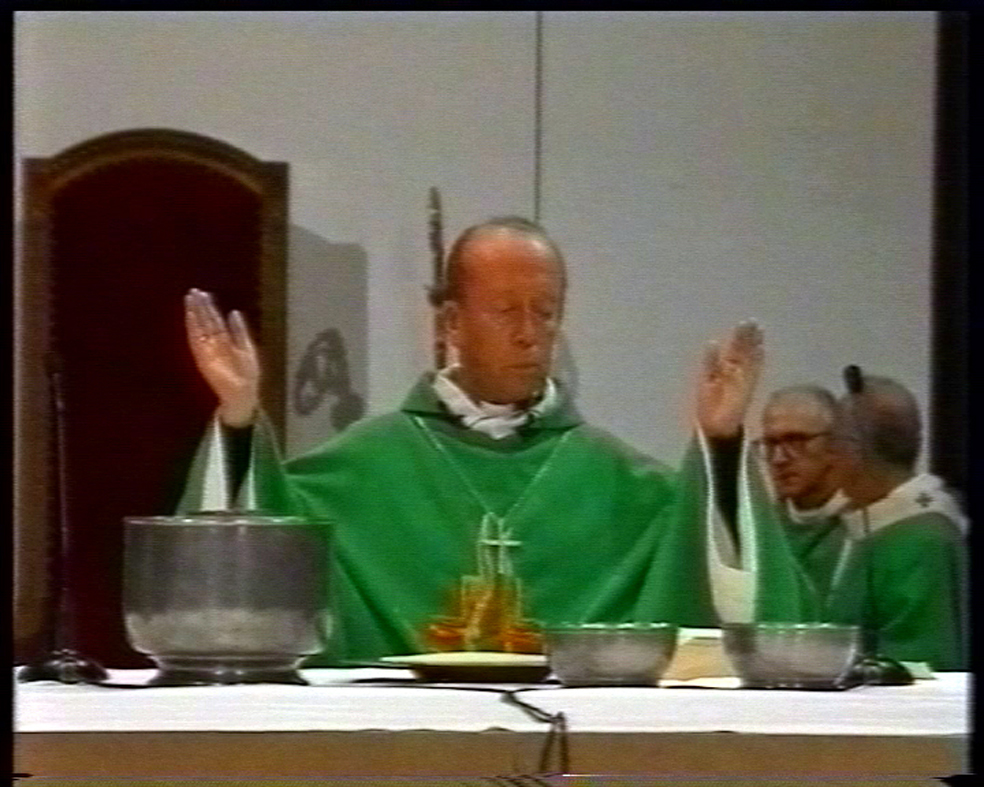
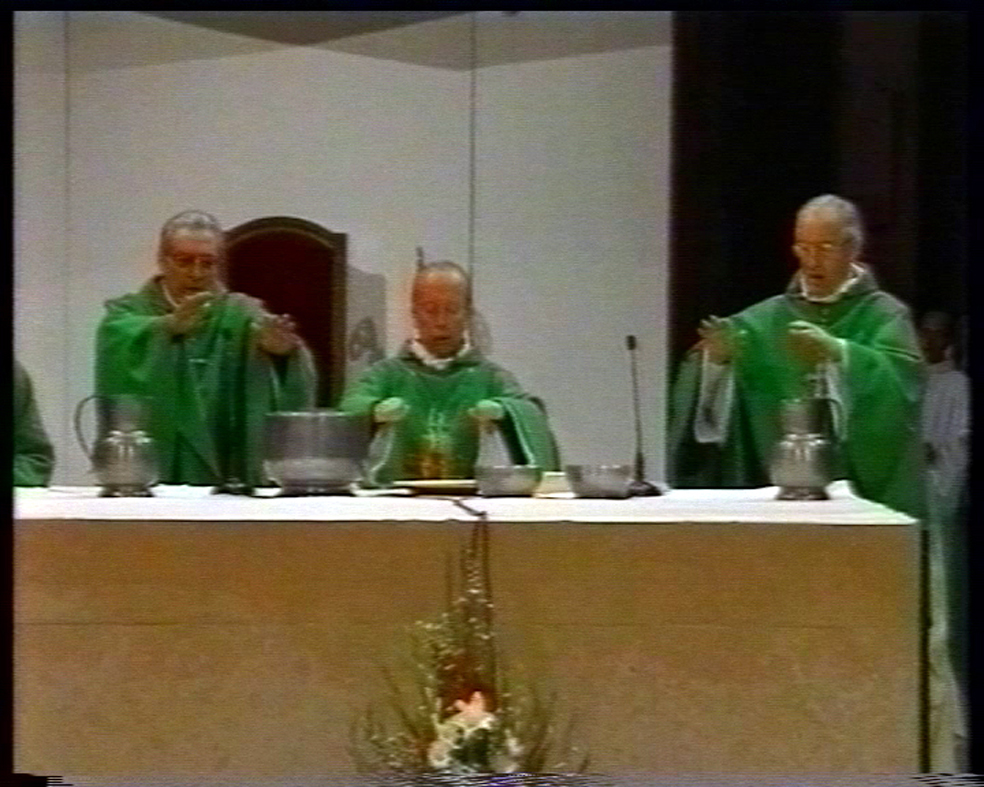
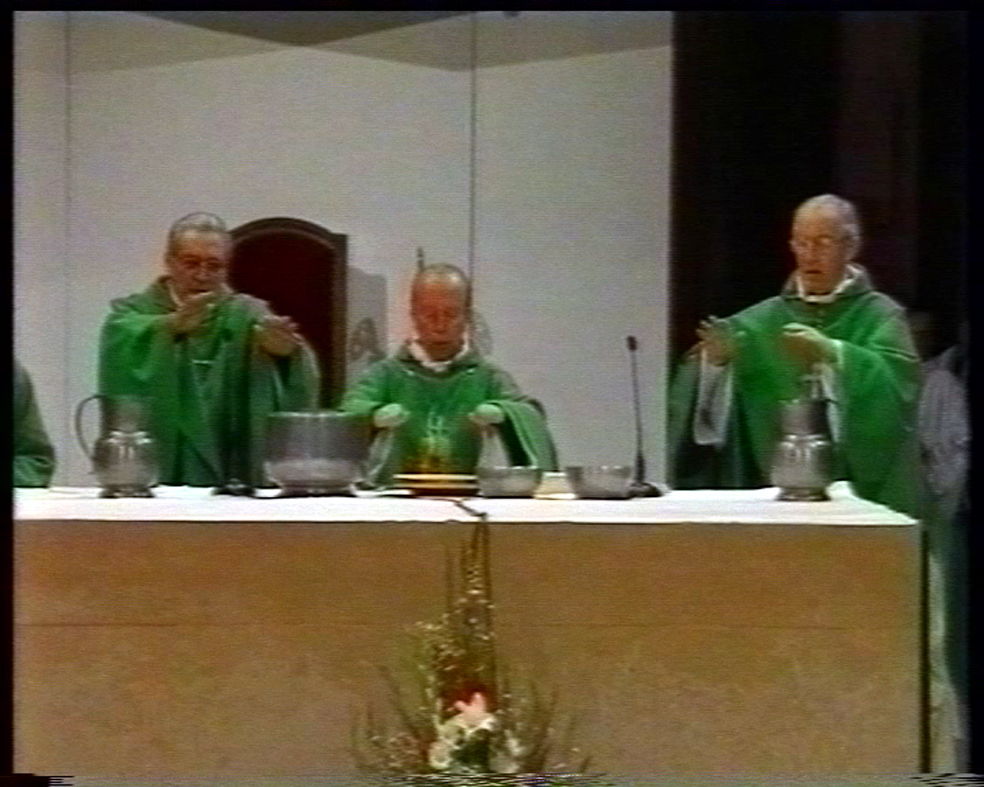
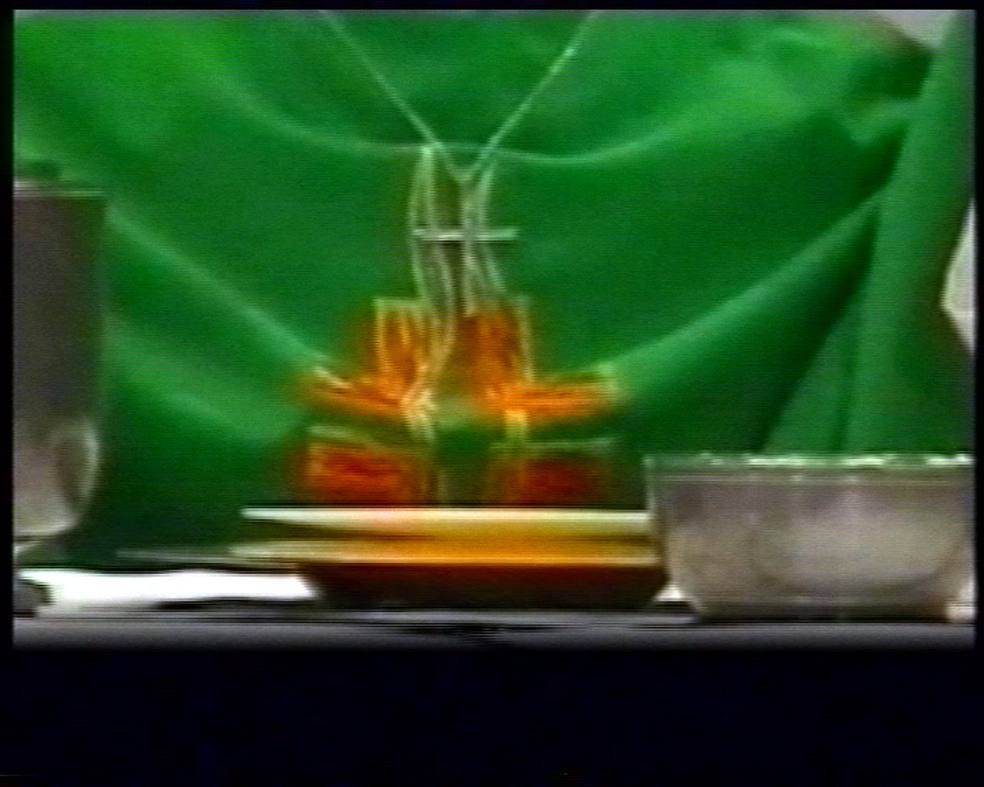
Eucharistic Miracle in Lourdes?

Watch the video and judge for yourselves.

Watch the host during the epiclesis (the moment the Holy Spirit is invoked upon the the host and wine.)


And here are video screen caps.

Before


 During the epiclesis


Look at the Host!


***

This proves that the Novus Ordo Mass is a valid Mass as declared by our Holy Mother Church through the Holy Father.

***
Domenico Bettinelli on his blog says that "At the time, the French bishops decided to keep it quiet. Recently, it was brought to the attention of a cardinal in the Curia, who took it upon himself to verify the origin of the clip and ask the current archbishop of Lyon for the position of the French bishops on the matter. This cardinal in turn passed it on to the Holy Father. He is concerned that certain bishops were too quick to put the lid on what seems to be an authentic sign."