Showing posts with label sede vacante. Show all posts
Thursday, March 14, 2013
Reporting the Sede Vacante and the Conclave
and we have Korina Sanchez reporting live from Rome.
And as usual, she is pathetic and did an awful job.
Any of my Facebook friends can substitute for her and still they'll do a wonderful job compared to this loud mouth!
She is pathetic. Period.
Why you might ask.
Because she said the resignation of Benedict XVI is the "first in history".
Yup! She said it. And twice!
Read about it here.
Really pathetic!
Tuesday, March 12, 2013
The myth of the papabili list
The Western media is always ready to put their dirty fingers into the affairs of the Church when it suits them right.
From issues against clerical sex abuse, to calls for equality in the role of women in the Church most specifically in issues of women ordination and altar girls...
The Western media will talk about the Catholic Church when it suits their taste. You'll never see them whip up an article praising the encyclicals or apostolic constitutions. They'll be quick to attach the Church and even quicker to say who is likely to be pope.
And some lay Catholics are not far from this attitude of the MSM.
Notice how a so-called list of papabile, cardinals who are likely to be elected pope always comes out before a conclave. With only a matter of hours before the famous "extra omnes" is said by the papal Master of Ceremonies, Msgr. Guido Marini, most look at the list written by men who couldn't care less at the Church but cares that a cardinal which the MSM thinks thinks like them...
And so let us go back in 2005 when we had the conclave that elected Benedict XVI...
In this post at Rorate Coeli, we notice how a list that Vaticanista John Allen who writes for the National Schismatic Reporter missed out the cardinal who became pope.
Ennio Antonelli, 68, Italy; Francis Arinze, 72, Nigeria; Jorge Mario Bergoglio, 68, Argentina; Dario Castrillón Hoyos, 75, Colombia; Godfried Danneels, 71, Belgium; Julius Darmaatmadja, 70, Indonesia; Ivan Dias, 69, India; Claudio Hummes, 70, Brazil; Lubomyr Husar, 72, Ukraine; Walter Kasper, 72, Germany; Nicolás de Jesús López Rodríguez, 68, Dominican Republic; Wilfrid Fox Napier, 64, South Africa; Jaime Lucas Ortega y Alamino, 68, Cuba; Marc Ouellet, 60, Canada; Giovanni Battista Re, 71, Italy; Norberto Rivera Carrera, 62, Mexico; Oscar Andrés Rodríguez Maradiaga, 62, Honduras; Christoph Schönborn, 60, Austria; Angelo Scola, 63, Italy; Dionigi Tettamanzi, 71, Italy.
No Ratzinger, eh? Honestly, I don't like Allen at all.
Now even famed Vaticanista Sandro Magister who always had a scoop about the Vatican, gave a list that included Joseph Ratzinger as a papabile, albeit with hesitation because as he wrote, "the indication of Ratzinger as the next pope is perhaps more symbolic than real." Whatever that meant!
The Pope Blog, who monitored the 2005 Conclave and is monitoring this year's conclave, posted this list of papabili often mentioned by the MSM:
Cláudio Hummes, Archbishop of São Paulo (Age 70)
Miloslav Vlk, Archbishop of Prague (Age 72)
Ivan Dias, Archbishop of Mumbai (Age 69)
Francis Arinze, Prefect of the Congregation for Divine Worship and the Discipline of the Sacrament (Age 72)
Geraldo Majella Agnelo, Archbishop of Salvador, Brazil (Age 71)
Godfried Danneels, Archbishop of Mechelen-Brussels (Age 72)
Giovanni Battista Re, Cardinal Bishop, Prefect of the Congregation for Bishops (Age 71) -
Dionigi Tettamanzi, Archbishop of Milan (Age 71)
Oscar Andrés Rodríguez, Archbishop of Tegucigalpa, Honduras (Age 62)
Christoph Schönborn, Archbishop of Vienna (Age 60)
Angelo Scola, Patriarch of Venice (Age 63)
Peter Kodwo Appiah Turkson, Archbishop of Cape Coast (Age 56)
Angelo Sodano, Cardinal Bishop, Vice-Dean of the College of Cardinals (Age 77)
Alfonso López Trujillo, Cardinal Bishop, President of the Pontifical Council for the Family (Age 69)
Norberto Rivera Carrera, Archbishop of Mexico City (Age 62)
Cormac Murphy-O'Connor, Archbishop of Westminster (Age 72)
Lubomyr Husar, Ukrainian Rite Major-Archbishop of Lviv (Age 72)
Tarcisio Bertone, Archbishop of Genoa (Age 70)
Dario Castrillón Hoyos, Prefect of the Congregation for the Clergy (Age 75)
Crescenzio Sepe, Prefect of the Congregation for the Evangelization of Peoples (Age 61)
Walter Kasper, President of the Pontifical Council for the Promotion of Christian Unity (Age 72)
Juan Luis Cipriani Thorne, Archbishop of Lima (Age 61)
José da Cruz Policarpo, Patriarch of Lisbon (Age 69)
Jorge Mario Bergoglio, Archbishop of Buenos Aires (Age 68)
Still, no mention of Ratzinger.
Catholic News Service also ran an article about the papabili in the 2005 Conclave. He was described as "the dominant personality among the electors" but the article also adds that Ratzinger "may be perceived as too old for the rigors of the papacy. He has a history of heart problems which, while mild in themselves, are enough to heighten that concern.
More important, Cardinal Ratzinger has been a lightning-rod for controversy both within the Church (because of his disciplinary action against wayward theologians) and outside (because of his insistence that Christ is the sole means to salvation). His public image as the authoritarian Panzerkardinal, although it is completely at odds with his mild personality, would make him the target of vitriolic attacks by secular liberals.
Until recent weeks, those obvious drawbacks seemed to be enough to eliminate Cardinal Ratzinger from serious consideration as a candidate for the papacy. Yet as the cardinals gathered in Rome, their thoughts turned toward him. As they begin their deliberations, the cardinals will all face the same initial question: whether to vote for, or against, Cardinal Ratzinger. No other prelate commands nearly the same consideration. Even if he is not the 265th Pontiff, his support could be crucial to the conclave's eventual choice."
I wouldn't call that piece betting on the next pope, but look what happened in 2005!
Moral of the story? A man who comes into conclave a Pope, comes out....
No, not that one.
"For my thoughts are not your thoughts, neither are your ways my ways, says the LORD.. (Is. 55:8) For what person knows a man's thoughts except the spirit of the man which is in him? So also no one comprehends the thoughts of God except the Spirit of God. (1Cor 2:11)Whoever thinks they know what the cardinals are thinking right now, are definitely out of their minds and think they are more cardinatial than those in the red robes themselves!
The list is nothing but pure conjecture.
So for the LOVE OF GOD!!!
JUST PRAY, WILL YOU?
And just like what Pope Benedict XVI said in his last Audience in Paul VI hall in February 14...
WE ARE NOT A CHURCH OF THE MEDIA! WE ARE THE CHURCH OF GOD!
Monday, March 11, 2013
Fisherman's Ring was not completely destroyed!
Don't tell me I didn't tell you so!
From the Catholic News Service
***
VATICAN CITY (CNS) -- When Pope Benedict XVI officially stepped down from office Feb. 28, his wardrobe changed -- right down to the ring on his finger.
He simply stopped wearing the familiar red shoes and the traditional white cassock with a white cape on his shoulder. He also stopped wearing the fisherman's ring, one of the main symbols of the papal office, and went back to wearing an episcopal ring he wore as a cardinal.
But it was not enough to simply leave the papal ring behind.
According to the rules governing the interregnum and election of a pope, the College of Cardinals must "arrange for the destruction of the fisherman's ring and of the lead seal with which apostolic letters are dispatched." [From the Apostolic Constitution Universi Dominis Gregis]
On March 6, Jesuit Father Federico Lombardi, Vatican spokesman, told reporters that this "destruction" had been completed, although he explained that the ring is not smashed or destroyed completely; rather, two deep cuts are made in its face so that it can no longer be used as a seal. [I told you so.]
Retired Pope Benedict received the ring at his inauguration Mass along with his pallium, the woolen stole symbolizing a bishop's authority. Both were based on ancient designs.
The gold ring, similar to the old rings that popes used also as seals, was designed by the Rome Association of Goldsmiths. [Uhmmm...The ring was designed and made by Roman master goldsmith Claudio Franchi and not that group. Dieter Phillipi who also gave the pope meritus his tiara as a gift, wrote an article about the Piscatorial Ring.] It had Pope Benedict's name etched on it and a scene of St. Peter casting out his net, symbolizing how popes are successors of the apostle Peter.
Many Catholics pay their respects to the pope by kneeling and kissing his ring. [Imagine an item revered by all Catholics other than the pope, gets smashed for no apparent practical reason other than tradition?]
The Catholic Encyclopedia notes that the earliest mention of the fisherman's ring worn by popes is in a letter to Pope Clement IV wrote in 1265 to his nephew, stating that popes were to seal their private letters with "the seal of the fisherman."
During the 15th century, the papal ring also was used to seal official papal documents known as briefs. [As was the case in feudal system of communication.]
***
In a briefing of the Vatican Press Office...
The only practical reason for making deep cuts on the face of the ring that Benedict XVI wore was to prevent any forgeries made by impressions on it. But, on the other hand, who'll make the forgeries? I discussed this in detail in a related post.
And like what I mentioned in the earlier post, the ring maker himself, insists that the ring is a decorative ring and not a signet ring.
BUT!
If you want to feel your own pope, and want to make you "own" piscatorial ring, we'll here are some choices for you.
Note: They did not pay any advertising fee to The Pinoy Catholic, ha!
https://www.familysealrings.com/Religious_Rings2.html
http://www.suarezandsons.com/
That is...if you want to feel popish....ha!
From the Catholic News Service
***
| It should be a museum item! |
VATICAN CITY (CNS) -- When Pope Benedict XVI officially stepped down from office Feb. 28, his wardrobe changed -- right down to the ring on his finger.
He simply stopped wearing the familiar red shoes and the traditional white cassock with a white cape on his shoulder. He also stopped wearing the fisherman's ring, one of the main symbols of the papal office, and went back to wearing an episcopal ring he wore as a cardinal.
But it was not enough to simply leave the papal ring behind.
According to the rules governing the interregnum and election of a pope, the College of Cardinals must "arrange for the destruction of the fisherman's ring and of the lead seal with which apostolic letters are dispatched." [From the Apostolic Constitution Universi Dominis Gregis]
On March 6, Jesuit Father Federico Lombardi, Vatican spokesman, told reporters that this "destruction" had been completed, although he explained that the ring is not smashed or destroyed completely; rather, two deep cuts are made in its face so that it can no longer be used as a seal. [I told you so.]
Retired Pope Benedict received the ring at his inauguration Mass along with his pallium, the woolen stole symbolizing a bishop's authority. Both were based on ancient designs.
The gold ring, similar to the old rings that popes used also as seals, was designed by the Rome Association of Goldsmiths. [Uhmmm...The ring was designed and made by Roman master goldsmith Claudio Franchi and not that group. Dieter Phillipi who also gave the pope meritus his tiara as a gift, wrote an article about the Piscatorial Ring.] It had Pope Benedict's name etched on it and a scene of St. Peter casting out his net, symbolizing how popes are successors of the apostle Peter.
Many Catholics pay their respects to the pope by kneeling and kissing his ring. [Imagine an item revered by all Catholics other than the pope, gets smashed for no apparent practical reason other than tradition?]
The Catholic Encyclopedia notes that the earliest mention of the fisherman's ring worn by popes is in a letter to Pope Clement IV wrote in 1265 to his nephew, stating that popes were to seal their private letters with "the seal of the fisherman."
During the 15th century, the papal ring also was used to seal official papal documents known as briefs. [As was the case in feudal system of communication.]
***
In a briefing of the Vatican Press Office...
Fr. Lombardi, SJ’s English-language consultant, Fr. Thomas Rosica, CSB, elaborated. “Fr. [Lombardi, SJ] saw with his very own eyes this (Saturday) morning, five objects that were ruined – scratched [and] rendered useless, because the image was destroyed,” he said.
Fr. Rosica went on to say, “First of all, there’s the ring – the Fisherman’s Ring that was destroyed – the image was scratched – secondly, there was [also destroyed] a stamp of the Fisherman’s Ring, a seal, which was used to seal official documents.” There were, in addition, “[T]wo stamps that were used for official Papal documents with the image on it, were scratched, so they cannot be used, and finally, the master lead seal, which was used for major documents, and [for] creating other seals: that was scratched, as well.”
The only practical reason for making deep cuts on the face of the ring that Benedict XVI wore was to prevent any forgeries made by impressions on it. But, on the other hand, who'll make the forgeries? I discussed this in detail in a related post.
And like what I mentioned in the earlier post, the ring maker himself, insists that the ring is a decorative ring and not a signet ring.
BUT!
If you want to feel your own pope, and want to make you "own" piscatorial ring, we'll here are some choices for you.
Note: They did not pay any advertising fee to The Pinoy Catholic, ha!
https://www.familysealrings.com/Religious_Rings2.html
http://www.suarezandsons.com/
That is...if you want to feel popish....ha!
Learn from the little ones...
Unlike most adults who have Facebook and Twitter accounts, and most especially the Main Stream Media...
They....all of them...who kept on campaigning for a cardinal...
watch and learn!
They....all of them...who kept on campaigning for a cardinal...
watch and learn!
Saturday, March 9, 2013
Former Papal MC talking to Cardinal Tagle
Marini: If you get elected, will you bring me back as Papal MC? I promise you. There'll be lots of liturgical dance!
Tagle: If???
BREAKING: Conclave date set!
from the Catholic Herald
***
The Vatican press office has said the conclave to elect the successor of Pope Benedict XVI will begin on Tuesday.
Vatican spokesman Fr Federico Lombardi announced the date in a message to reporters today.
The first session of voting inside the Sistine Chapel will begin in the afternoon, following a morning Mass “Pro eligendo Summo Pontifice” (“For The Election of the Supreme Pontiff”) in St Peter’s Basilica. [the Mass will be led by the Dean of the College of Cardinals]
The 115 cardinal electors will assemble in the Hall of Blessings in St Peter’s Basilica after lunch and go in solemn procession to the Sistine Chapel where, after the singing of the hymn Veni Creator Spiritus, each cardinal will take an oath. [As stipulated by the Ritus Conclavis]
Msgr Guido Marini, papal master of ceremonies, will give the command extra omnes (everybody out), the doors will be locked, and the conclave will begin. One round of balloting will be held in the evening.
The College of Cardinals decided the conclave date on March 8, the fifth day of its meetings, after waiting for all cardinals eligible and expected to vote to arrive in Rome. The last to arrive was Cardinal Jean-Baptiste Pham Minh Man of Ho Chi Minh City, Vietnam.
At the morning session, before announcing the scheduled vote, Cardinal Angelo Sodano, dean of the College of Cardinals, told the assembly that with the changes made by Pope Benedict, the cardinals would not have to debate on whether they were authorised to begin the conclave before March 15, Fr Lombardi said.
During the same session, the cardinals chose 87-year-old Cardinal Prosper Grech, a Maltese expert in the early Church fathers, to give the meditation at the beginning of the conclave.
The Vatican spokesman said that 18 cardinals spoke during the morning session. As people around the world observed International Women’s Day, one of the cardinals spoke about the role of women in the church.
Other topics included interreligious dialogue, bioethics, the Church’s role in promoting justice, collegiality in the church and the need for the Church’s evangelisers to proclaim God’s love and mercy. [No mention about the handling of sex abuse offenders and theological and liturgical dissenters?]
***
Time to intensify our prayers!
Tuesday, March 5, 2013
What to say at Mass during a Sede Vacante
Rome, February 19, 2013 (Zenit.org) Father Edward McNamara, LC
***
Answered by Legionary of Christ Father Edward McNamara, professor of liturgy and dean of theology at the Regina Apostolorum university.
Q: After Feb. 28, and before the election of a new pope, do we continue to name Benedict in the Eucharistic Prayer of the Mass? My opinion is that we do what we do when the pope dies: Say no name but continue on to the bishop. -- E.R., Keimoes, South Africa
A: Our reader's opinion is correct. Even though Pope Benedict XVI will be thankfully still alive, the Holy See will be vacant as of 8 p.m. Rome time (2 p.m. New York time; 4 a.m. March 1, Sydney time).
With respect to naming the pope most of the recent liturgical manuals don't go into such detail, but manuals from before the Second Vatican Council can still be found that touch on the more arcane aspects of liturgy. [Arcane but useful! Most of the liturgical books pre-Vatican II are down pat to the last detail of what to do. That is the reason for the rubrics and the liturgical laws. For order! Remember that does who love to use the term "rubricism" and being too "tied down with liturgical laws" are most likely to commit liturgical abuse. Mark my words.]
In this case the pope's name, and the entire phrase referring to the pope, is omitted from the Eucharistic Prayer during the period of the sede vacante. Mention is made only of the local bishop and the clergy according to the literary form of each prayer.
For example, in Eucharistic Prayer II it would be: "Together with … N. our bishop, and all the clergy." [This goes out to all Catholic churches, chapels and oratories.]
In the Diocese of Rome: "Together with …. all the clergy." Even though the cardinal vicar of Rome and the auxiliary bishops remain in their functions, their collective mention is optional.
An analogous procedure is followed in each diocese following the death or retirement of the local ordinary. During a time of vacancy of the episcopal see, the clause "N., our Bishop" is also simply omitted. The name of an apostolic administrator is mentioned but not that of a temporary diocesan administrator. [It should go like "For N., our apostolic administrator. There are dioceses in the Philippines that are still sede vacante or have only an apostolic administrator like Bontoc - Lagawe, Infanta, Imus, Gumaca, Dumaguete, Romblon, Kalookan, San Carlos and the Archdiocese of Zamboanga. Liturgists and those in the...uhm..."Worship Ministry" would have to take note of this.]
In the case where both diocese and the Holy See are currently vacant, the priests would follow the same practice as in Rome, omitting both names.
***
Praying for the cardinal electors...
...that is what we need to do also!
Monday, March 4, 2013
The meaning of the Arms of the Sede Vacante
I will not be writing who loses his job or who gets to keep his during a Sede Vacante. Wikipedia has written about that quite extensively.
What I'll be posting today is the explanation of the arms of the Holy See Sede Vacante.
Since most people have been using this emblem as their own profile photo in Facebook during this Sede Vacante, I thought of making a post to explain each of the ecclesiastical devices used in the Arms of the Holy See Sede Vacante.
But before continuing on look at the difference at the Arms of the Holy See and the Arms of Vatican City.
| Arms of the Holy See |
| Arms of Vatican City |
Notice the difference?
It is the placement of the keys.
The meaning of the keys also accounts for the meaning of the arms.
The Gold Key represents the Key presented by Christ to Peter with the power lose and bound those in Heaven and on Earth. While the Silver Key represents his earthly powers of governance in the Vatican City State.
So as you can see, the gold key's end points to the left for the arms of the Holy See, with the left or dexter side traditionally representative of Heaven. That of the right side or sinister side to that of the earth, thus the end of the silver key pointing to the right side. The ends of the keys are in the lower part of the arms indicating the power to turn the keys rests in the hands of the the bearer of the keys, the Pope. As in traditional chivalric charges, the headdresses of the owner of the arms rests above the keys. For knights it is their helmets, kings have their crowns, dukes and princes their coronets, and for the pope, the triple crown symbolical of the Pope's power as Supreme Pastor, Supreme Teacher and Supreme Priest.
So you can see how the keys are differently placed in the arms of the Holy See and the arms of Vatican City State.
(The meaning of the red and gold cords on both the Arms of Vatican City and the Holy See were not properly defined.)
Now during a sede vacante, the tiara is taken out to symbolize the absence of a reigning Pope. But what we have "crowning" the keys is an umbrella known as umbraculum (in Latin) or ombrellino in Italian and in English uhm...it's called an umbrella.
It can trace its origin with the Borgia Pope Alexander VI who used during processions. Royalty used these ornate umbrellas when they go out for processions and Alexander VI who had a very nasty reputation for flare and pageantry used it to emphasize his temporal powers.
The canopies also denote the power of the cardinals as a collegial bodies. This is evident in conclaves before the 1978 Conclave when the number of cardinals were so few that there were canopies above the heads of each sitting cardinal in the Sistine Chapel sitting in conclave.
Once the cardinal elected responds "Accepto" to the question of the cardinal dean whether he accepts his canonical election to the papacy, the other cardinals stand and pull the strings holding their canopies. This will cause the canopies to fold up thus acknowledging that there, among them, is someone of higher authority than them. The only canopy left unfolded is that of the cardinal elected into the papacy.
I highly suggest you watch "The Shoes of the Fisherman" for a more accurate portrayal of the papal conclave.
The ombrellino then became the symbol of the Pope's temporal powers and it is actually given as one of the privileges of minor basilicas along with the use of the Tiara and Crossed Keys.
Ombrellinos are now used as the power of the Holy See over papal basilicas. It is commonly seen in minor basilicas with the bell on a rod known as a tintinnabulum.
| Tintinnabulum of Mission Dolores Basilica, San Francisco, USA |
| St. Louis Cathedral - Basilica, St. Louis, MO |
Don't strain yourself. You won't find this in any minor basilica in the Philippines. Filipino rectors of these basilicas either don't know about this or simply don't care about these "popishry".
| Basilica of St. John the Evangelist Stamford, CT |
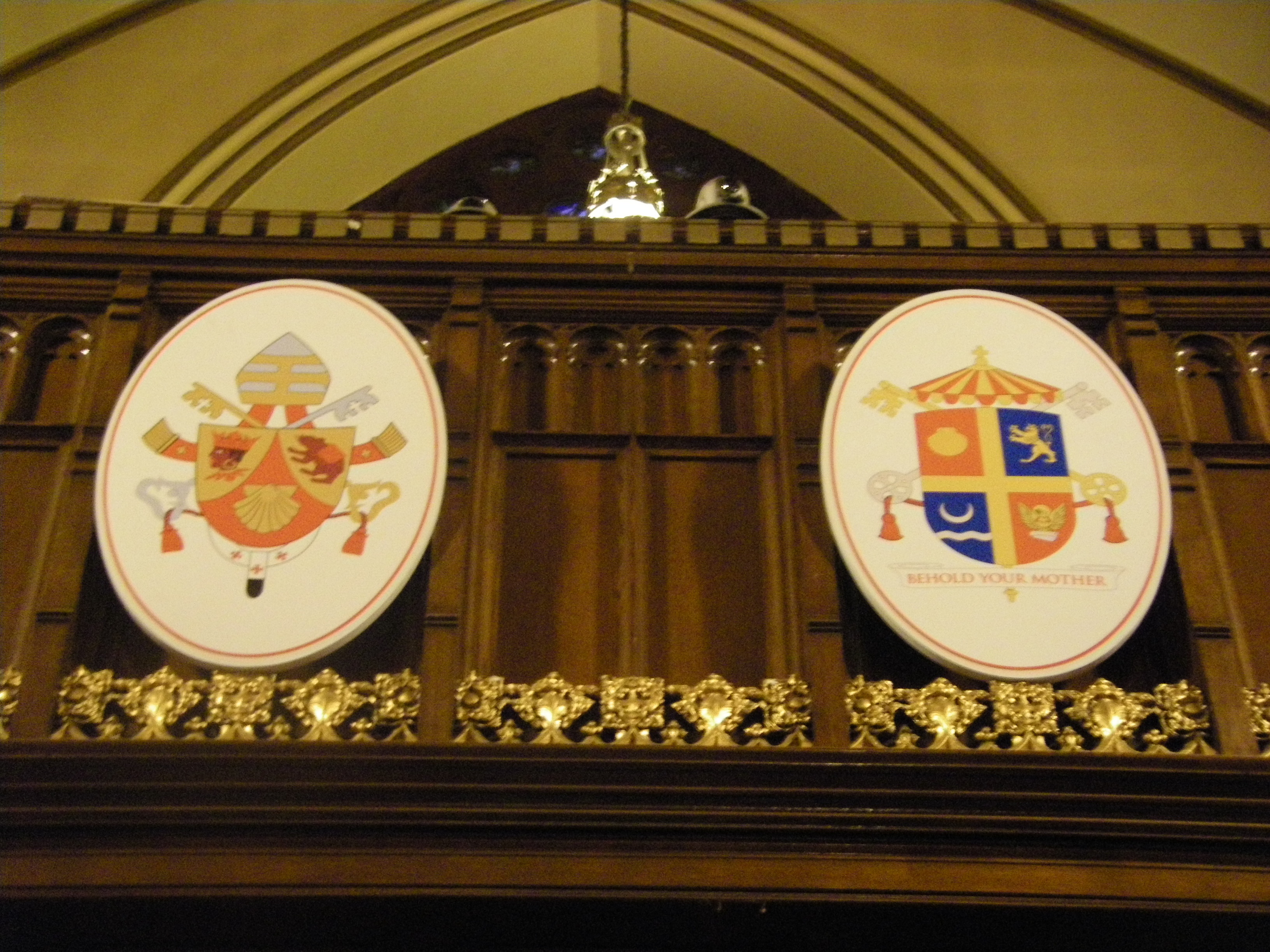
And here is the arms of the reigning pope, which at that time the photo was taken was Benedict XVI and the arms of the basilica which....is ALSO not done here in the Philippines.
And here is the arms of the Cardinal Camerlengo. He possesses these arms even though not is sede vacante to mark him as not just your "usual cardinal".
So what does the arms of the Holy See Sede Vacante denote?
Just like the functions of the Camerlengo...Temporal Governance of the Holy See. Just as the ombrellino denotes temporal powers, so does the Holy See Sede Vacante is being governed on purely temporal matters, until the successor of St. Peter sits upon his chair.
Saturday, March 2, 2013
The Sede Vacante begins...
...along with the sealing of the papal apartments.
Honestly, my first time to see this actually being done.
Friday, March 1, 2013
The Vatican website Sede Vacante
This is the arms of the Holy See sede vacante. Keys in saltire with the ombrellino in the center...NO arms of the former pope, who ever made that one does not know heraldry.
Sede Vacante: Now we must pray harder
It is the first Friday of the month, Sacred Heart Day!
Pray! Pray! Pray!
The Chair of Peter awaits...
Pray! Pray! Pray!
The Chair of Peter awaits...
Subscribe to:
Posts (Atom)