Pages

Sunday, February 7, 2010

Personal Parish for Traditional Catholics


From The Traditional Roman Catholic Philippines

***

The Bishop of the Diocese of Cubao, his excellency Bishop Honesto F.Ongtioco, D.D., has permitted the erection of a personal parish for those who are attached to the Extra Ordinary Form of the Latin Rite. [A first in the Philippines!] The church building will be dedicated to the Immaculate Heart of Mary and will under the auspices of Fr. Michell Joe Zerrudo [God bless Fr. Jojo.  It has been a long while since I've seen him and attended his EF Mass.] and the Ecclesia Dei Society of St. Joseph to consolidate efforts aong various groups advocating the return of the form of Mass popularly known as the Tridentine Mass. The parish will also be available for other Sacraments to be administered according to the liturgical books of 1962 or prior to 1970. It will also be a venue of training for priests who would like to learn the ancient usage of the Roman Rite and others who would like to learn the rubrics of serving at the traditional rites, including schola and choir training. The Diocese is now looking for a venue for the said personal parish and funds are solicited in order to commence such as august aposolate. Funds may be channeled through Fr. Michell Joe B. Zerrudo, Parish of Our Lord of Divine Mercy, Diocese of Cubao, Maamo cor. Madasalins Sts., Sikatuna, Quezon City, Philippines or may call his parish at 029213337. We therefore appeal to traditonal Catholic communities to help us in such endeavor.

Dennis Raymond P. Maturan
Founding Chairman
Ecclesia Dei Society of St. Joseph

***
PLEASE SUPPORT OUR COMMUNITY!

SEND YOUR DONATIONS, DIRECTLY TO FR. ZERRUDO.

I WILL NOT ACCEPT ANY DONATIONS.

***

I want to digress here a bit.

The one serving as MC with the bishop at the side, wearing a purple cassock in a beautiful laced surplice is a student of liturgy of Anscar Chupungco.

He even posted photos of Cardinal Canizares, the Prefect of the Congregation of Divine Worship, celebrating the EF Mass, with this headline.  "Through these pictures, you will know him more..."

With him being a student of Chupungco, you know that there is more to that line.

Question:  Why is he wearing a purple cassock?  Is he a monsignori?  Lay people only wear black cassocks when they serve for Mass.

Italy appeals Crucifix ban

ROME, FEB. 5, 2010 (Zenit.org).- The Italian government is appealing a November ruling by the European Court of Human Rights that crucifixes in public school classrooms are a violation of freedom.

The Italian appeal defends the crucifix as "one of the symbols of our history and our identity."

"Christianity represents the roots of our culture, what we are today," the text of the appeal states. "The display of the crucifix in schools should not be seen so much for its religious meaning but as reference to the history and tradition of Italy. [Europe wants to forget that its Christian roots.  All I hear is this "We must tolerate each others beliefs since we are all one and the same under one God."  Hmmm... I just saw  video studying Freemasonry s related by a former 32nd degree Worshipful Master Mason.  And yes, that line I just said is one of the things Masonry wants its members to live by.]

"The presence of the crucifix in class remits also to a moral message that transcends secular values and does not infringe the right to adhere or not adhere to a religion." [So is you are in a Catholic school, this Court tells you you cannot practice your belief because it is against human rights?  I can't see the logic there.]

The European Convention on Human Rights foresees that the Grand Chamber can consider an appeal if a case raises "a serious question" on the interpretation of the convention. [Did it study the human rights abuses of Muslims?  I seriously doubt they have the b@#%$ to do it.]

***
Here is a suggestion.

When you walk around, be it in the office or in the mall or in the streets, wear a crucifix, a Miraculous Medal, St. Benedict's medal or Scapular.
IT IS YOUR HUMAN RIGHT TO PUBLICLY PROFESS YOUR FAITH!!!

Help!

Someone posted a comment on one of my posts but I cannot moderate it since it is in Chinese characters.

Can the poster send in English?

Or can someone help me translate it?

Back to blogging!

At LAST!!!

I have my fingers on my keyboard typing for my blog and not for somebody else!

Not that I hate my job its just it took my entire weekend, or even the whole two months of my life.

Now I am back to what I love doing, that is blogging about my Faith, my Church, my Lord!

Thank for your patience for going back to The Pinoy Catholic, for looking for updates.  I promise to keep you updated on the latest.  I hope my sources don't get impatient...

God bless you all.  As I always keep you in my prayers, my only request is that you always keep me and my family in yours.

Vivat Jesus!

Wednesday, February 3, 2010

Incorrect date spurs more anti-Pius XII rhetoric

ROME, FEB. 2, 2010 (Zenit.org).- Pope Pius XII was again in the news this week, as researchers presented two documents that were interpreted as putting the Pope in a negative light regarding his response to the Holocaust.

As ZENIT reported Monday, a brief document was presented as a new find dated Oct. 19, 1943. The document is a telegram from American diplomat Harold Tittmann on his meeting with the Pope. [He wrote a book about his time spent in the Vatican as a diplomat.]

The document does not mention the Oct. 16 raid on the Jews of Rome, wherein more than 1,000 of the city's Jews were rounded up and deported to Auschwitz. [There is a reason for this and it will be explained later.]

Given that Tittmann's report does not mention the raid (though theoretically it had happened just three days before), and instead reports Pius XII's concern about Communists in Rome and his desire to keep the Eternal City in peace, headlines reported the Pope's "indifference" to the Holocaust. [Here is the stupid Western media ganging up on a dead guy and twisting historical facts just to advance their anti-Catholic rhetoric.]

However, there is a basic problem.

In a statement sent to ZENIT, Professor Ronald Rychlak of the University of Mississippi explains that Pius XII could not have expressed concern about the roundup of Roman Jews because it hadn't happened yet.

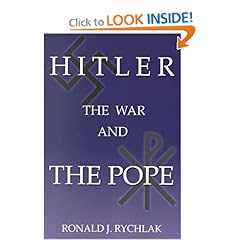
Rychlak is the author of "Hitler, the War, and the Pope." [You can buy it here.]

He explained: "The transcribed message to Washington from Harold Tittmann is dated Oct. 19, but this is a mistake. Vatican records show that the meeting between Pius and Tittmann took place on Oct. 14."

"In fact, L'Osservatore Romano of Oct. 15, 1943, reported on page one -- top of the first column -- that Tittmann was received by the Pope in a private audience on Oct. 14, 1943.

"Apparently a handwritten '14' was misread as a '19' when the documents were typed. The Pope did not mention the roundup of Jews because it had not yet happened
!" [See how a misinterpretation of a handwritten number sends the anti-Pius zealots into a frenzy?  See what difference that makes?]

Rychlak noted that what the Pope did express to Tittmann was his concern "that a group of Communists would commit a violent act and this would lead to serious repercussions. Of course, he proved to be exactly correct the following spring."

Moreover, though the Oct. 14 document was presented as a new find, historians were already aware of it because it was published in 1964, with the incorrect date.

It is in the Foreign Relations of the United States (FRUS) collection, in Volume II of 1943, on page 950.

In his blog, Andrea Tornielli, Vatican expert of the Italian daily "Il Giornale," points out that the researchers who presented this "new document," Giuseppe Casarrubea and Mario Cereghino, have already made such "revelations" in the past.

"In October of 2008," he reported, "they presented as unpublished a document to use it against Pius XII (it was also referred to by ANSA [news] agency) and later they had to apologize."

***

I was thinking of writing something as a reaction to this but I came upon this online review of the book Inside the Vatican and I would like to share this with everybody.


"After reading this book one clearly sees the absurdity of the "Hitler's pope" myth - for the Allies there was no question whether the pope was pro-Hitler or not. [True.  If indeed the Pope were sympathetic to the Nazis, why, after the war, was he not tried or even questioned.  He could have answered all of these attacks against him, from anti-Catholic media, to anti-Catholic Jews.  Why on earth would Golda Meir even pay homage to him when the pope died?  For Pete's sake.]  There was no argument (as there is today) on where the sympathies of the pope lay. The idea of the pope being on friendly terms with Hitler would have seemed sheer nonsense to anyone at the time, to such a degree that anyone who would have suggested thus during his pontificate would have probably been suspected of being either vehemently anti-Catholic or even communist (communists certainly had good reason to smear the reputation of the pope). If it were true that he was on friendly terms with Hitler, it would have seemed utterly strange for him to shelter POW's who managed to sneak into the Vatican (as it is reported in the book). But it did not seem strange to anyone at the time, rather it seemed logical, given that everyone knew Pius to be strongly anti-Nazi. This book raises the question: who should be trusted as a source for judging Pius XII, those who lived with him at the time of his pontificate who are all in universal agreement on the goodwill of the pope and on his anti-Nazi stance, or those who came later who have judged the pope through calumnies and twisted facts. [Just as I have been raising against the anti-Pius zealots.  They have no historical proof!  Nothing but Dan Brown evidence!] The answer is clearly evident to those who wish to know the truth of the matter. In conclusion, this book is an invaluable source for any serious historian who is interested in learning more about the Vatican during WWII and the whole "did Pius do enough to help the Jews" question.


Need I say more?


But these books.  Don't waste your money on John Cornwell's or Dan Brown's.

Tuesday, February 2, 2010

Pius XII defended in Israeli paper

JERUSALEM, FEB. 1, 2010 (Zenit.org).- Similar to a defense of Pope Pius XII by French scholar Bernard-Henri Levy, American writer Dimitri Cavalli has published an article in the Israeli newspaper Haaretz in the same vein.

Cavalli hails from New York where he is writing a book on Pius XII. His articles have been published in the Wall Street Journal and the New York Times; L'Osservatore Romano reported on the Haaretz report today.

In that piece, Cavalli asserted that the "campaign against Pope Pius XII is doomed to failure." [I am praying.]

"[H]is detractors cannot sustain their main charges against him -- that he was silent, pro-Nazi, and did little or nothing to help the Jews -- with evidence," Cavalli contended. [As I have mentioned before, the burden of proof shifts to Pius XII'2 detractors.  They can't show evidence other than demanding the opening of the Vatican Archives pertaining to Pius XII.]

The author said the proof that exists shows the contrary.

He noted that in 1933, when Cardinal Pacelli [the future Pius XII] was still secretary of state, he "instructed the papal nuncio in Germany to see what he could do to oppose the Nazis' anti-Semitic policies."

The author also points out that Pope Pius XI's 1937 encyclical "Mit brennender Sorge," which was drafted by Cardinal Pacelli, was considered by the Germans as a "security threat."

Then, Cavalli continued, when Cardinal Pacelli was elected Pope on March 2, 1939, "[o]n March 4, Joseph Goebbels, the German propaganda minister, wrote in his diary: 'Midday with the Fuehrer. He is considering whether we should abrogate the concordat with Rome in light of Pacelli's election as Pope.'" [Is this Hitler's pope when in fact Hitler was one of those who was not happy of Pacelli's election?]

Moreover, Cavalli continued, "During the war, the Pope was far from silent."

And, he asserted: "Unlike many of the Pope's latter-day detractors, the Nazis understood him very well.

"After studying Pius XII's 1942 Christmas message, the Reich Central Security Office concluded: 'In a manner never known before the Pope has repudiated the National Socialist New European Order. ... Here he is virtually accusing the German people of injustice toward the Jews and makes himself the mouthpiece of the Jewish war criminals.'"

"Pick up any book that criticizes Pius XII, and you won't find any mention of this important report," Cavalli reflected.

The author reiterated that during the War, representatives of the Pope "frequently ordered the Vatican's diplomatic representatives in many Nazi-occupied and Axis countries to intervene on behalf of endangered Jews."

And he observed that until the Holy Father's death in 1958 "many Jewish organizations, newspapers and leaders lauded his efforts." He cited in this regard a 1944 letter to the papal nuncio in Romania, from Alexander Shafran, chief rabbi of Bucharest. [As I also said before, anti-Catholic rhetoric is always done when the guy is already dead and unable to defend the one being attacked.]

Cavalli concludes, saying, "Perhaps only in a backward world such as ours would the one man who did more than any other wartime leader to help Jews and other Nazi victims, receive the greatest condemnation."

***

I can't find this in any other media organization except Zenit.  Probably because it is pro Pius.

It is probably against their editorial policy to print news that is against Catholicism.

Monday, February 1, 2010

Incoming!


Papa Benny and the children making sure "nothing" falls on them.

About Communion in the Hand

A very interesting video at Glori TV about Communion in the Hand.


Odd music choice, though.

I love the comment of Raymond Arroyo.

Saturday, January 30, 2010

Scenes from the 2nd National Congress of the Clergy


Priests praying the rosary on their knees. Models of piety!


"Mass" consecration

Knights Donate 1/2M Soldiers' Prayer Books

WASHINGTON, D.C., JAN. 29, 2010 (Zenit.org).- The Knights of Columbus are delivering 100,000 more prayer books for U.S. armed services personnel, bringing their donation of the books to more than a half million copies since 2003.

The latest delivery of "Armed With The Faith: A Catholic Handbook for Military Personnel" will be taken Saturday to the Washington, D.C. headquarters for the Archdiocese for the Military Services.

The version provided to members of the armed forces are spiral bound, printed on special coated stock, and are sized to fit in the pockets of uniforms worn in the field.

The Knights offer a version on regular paper to family members of service members. These prayer books can be obtained through the Knights of Columbus Catholic Information Service. [Where I got other booklets for free!]

Last year, the Knights of Columbus also produced "Armour of Faith: A Catholic Handbook for Canadian Military Personnel," and 30,000 of that version have been printed and distributed for Canadian soldiers.

***
What started me out with the Knights of Columbus was the free booklets I received via mail courtesy of Catholic Information Service which is funded by the Knights.

So I donate my money and hours to the Order...because I believe in our brotherhood's cause.

Be a Knights of Columbus!

Wednesday, January 27, 2010

Nuns say witnessing more important than conversion


LOIKAW, Myanmar (UCAN) — For the Sisters of Missionaries of Faith living among animists and Buddhists, evangelization is about setting a good example for others to follow.

“We show the Good News to the people with good examples. That’s how we carry out evangelization, said Sister Flora Aye, superior of the nuns in Dousanbu village near Loikaw. Evangelization, said the nun, was not proselytizing. “We are not trying to convert them to becoming Catholics,” she said. [So the eternal salvation of their souls is not important?  And you call yourselves Catholic missionaries?]

Her community of four nuns [wow!  Lots of vocation!  Great example.] work among the Padaung, whose women are characterized by their distinctive brass neck coils. The nuns work primarily for the development of villagers and have even opened a nursery school.

There are 30 houses in the village, with only 10 of them Catholic. [Great missionary work!] The villagers are poor, illiterate and daily wage earners. The village has no electricity and living conditions are very poor.

The nuns visit villagers regularly, help with children’s education and reach out to the disabled. They also invite villagers to church during special occasions such as Christmas. [No conversions right?]

“We invite the villagers to our house too. That is how we share our lives with them,” Sister Flora said. “In the past, they didn’t know us well but now they even volunteer to help out with some of our work.”

During Lent, the nuns set aside a handful of rice before they cook their meals, and distribute it to the poor.
Villagers overcame initial suspicions

Sister Monica Jalin, in charge of a nursery school, recalled that when the nuns first started the school in 2005, villagers were wondering if it was a ruse to convert them. “But later on they understood that we were there to help with their kids’ education and develop the village.”

The nuns were not from the locality and had to struggle to learn the local language. “No matter what difficulties we faced, we proceeded with our mission of showing our faith through our example of love and helping the villagers,” Sister Flora said. [And still no conversion?  Nothing wrong with being good but the ultimate goal of every missionary is to lead people to Christ!  Baptisms, conversion...that's the goal!]

The nuns also carry out “re-evangelization” in Dousanbu and its surrounding four villages. “Re-evangelization” means strengthening the faith of Catholics by teaching them catechism as well as regularizing the marriages of couples from different faiths, the nuns said. [NOW WE'RE TALKING!]

Thein Mo Law Mu, a Buddhist man from the Padaung tribe, said, “I’m very glad that I have seen the improvement of my children with regard to education. I am thankful to the nuns. I want to help them as much I can in supporting their running of the nursery school.”

Nan Mya Mya Oo, a Buddhist, said she is closer to the nuns now after her Catholic husband passed away than when he was alive.

The Sisters of Missionaries of Faith is a congregation based in Italy with a local presence in Loikaw diocese. Its mission is service to all people. Presently, seven nuns work at two different locations in Loikaw diocese.

***

The issue of witnessing sometimes waters down the real purpose of a missionary's 'being'.

Salvation of souls is the great commission given by Christ to all the baptized, lay or ordained!

Chupungco vs. Guido Marini

I have received a copy of Fr. Anscar Chupungco's talk wherein he openly criticizes our dear Pope's Reform of the Reform. He even mentions the Papal Masters of Ceremonies, Msgr. Guido Marini by name.

Here's an excerpt.
Springtime fittingly describes the liturgical renewal before, during, and the twenty or so years after Vatican II. [More like a never ending autumn!] Firmly grounded on historical research, theological investigation, and pastoral consciousness, [*%$@#&!] the framers of the postconciliar liturgy [aka Bugnini and the Gang] set out to implement the decisions of the Council. Across the globe local churches experienced the flowering of liturgical worship. [and the flowers stink!] The noble simplicity of the revised rites and the use of the vernacular helped immensely to promote full, intelligent, active participation, which the Council had declared as the primary aim of the liturgical reform. [And we saw the emptying of churches and watering of our Catholic identity]
But even before we could, with satisfaction, gather the flowers and harvest the fruits of summer, a cold wind has begun to blow on the face of the postconciliar reform. [And how we loved that gentle breeze!] The autumn leaves are starting to fall. [wrong.  more like a new springtime!]  No less than the papal master of ceremonies, Msgr. Guido Marini, announced on January 6, 2010 that there is need for a new reform of the liturgy. He intimated that the postconciliar experts did not grasp fully the meaning and intention of the liturgy constitution, which they had drafted and presented to the council fathers. He claimed that as a result, the postconciliar reform has “not always in its practical implementation found a timely and happy fulfilment.” [He is sounding as if he all got it right and that the Pope and Msgr. Marini don't.]
What are the possible implications of a reform of the postconciliar reform? What remedy does it offer for a reform that according to some Catholics has gone bad? [That some is Pope Benedict, Father!] What agenda does it put forward so that liturgical worship could be more reverent and prayerful? [Hmm... Maybe less sales of his books?]
The agenda is, to all appearance, an attempt to put the clock back half a century. [More like righting the wrong.] It seems to conveniently forget that since Vatican II, the Church has been marching with the times, [towards perdition?] acknowledging the changes in social and religious culture, and adopting new pastoral strategies. [like empty seminaries, convents and churches.] Will Latinised English make the liturgy more awesome? [Bp. Trautman 2!] It will certainly sound mysterious, but will it be more prayerful? [Yeah!  You should try it.  Simply ineffable!] Will the silent recitation of the Eucharistic Prayer, preferably in Latin, evoke more vividly the Last Supper of Jesus? [So making it in the vernacular makes it all the more vivid?  The Last Supper was in Aramaic.  Can't wait to see him do it.] Is receiving Holy Communion on one’s knees and on the tongue more reverent than receiving it standing and in the hand? [Will saluting the President standing up be more respectful than doing it sitting down?  Duh!  See how this priest hates reverence?] Will the priestly role of mediation be reinforced by praying at the altar with the back to the assembly? [Oh yeah!  No reverend showman!]

***

You can feel the angst of the liturgist known to many as the master inculturator.   Dying breeds of modernists are feeling the clock ticking and that their own interpretation of Vatican 2 will soon be part of the Church's dark history.

Probably feeling that the liturgical reform train of Papa Benny is catching up, eh?

I heard a story that Fr. Anscar once taught at Rome.  He got the boot after a cardinal hated his style of liturgical inculturation.  Everybody knows who that cardinal is or was.  So my source tells me that his crusade against Papa Benny's liturgical reform is quite personal.

***

I love this exchange from the pro- and anti-Chupungco from the modernist blog that praised the paper.  I am not going to lead you that site.


I have some serious doubts about the rhetoric of “reform-of-the-reform,” since I think it often masks a nostalgic restorationism. But I become a bit more sympathetic when I read someone saying (approvingly) that “since Vatican II, the Church has been marching with the times.” Of course I know that Fr. Chupungco is a more sophisticated thinker than this single quotation would indicate, but it is these sorts of statements that give the reform-of-the-reform rhetoric its traction.   -  by F C Bauerschmidt on January 25, 2010 - 11:17 am
 Are we going to let the liturgical experts, i.e. elitists, tell us that our nearly 1500 years of Latin Rite heritage are nothing compared to what “they” say is the “spirit of Vatican II” which in only 45 years supposedly trumped as “new and improved” everything that preceded it? ? I prefer what Msgr. Marini speaks of, as it is in continuity with the Holy Father’s writings and example. The Holy Father is calling for “organic” development of the Liturgy, which an “elitist” committee in Rome foisted upon the universal Church after Vatican II. Vatican II was much more measured and nuanced about any future revisions compared to what a small body of so-called liturgists eventually imposed upon us with the help of Pope Paul VI. These revisions, while authoritative and yes valid, are in no way comparable to the liturgical document of Vatican II–therefore Vatican II actually must be the hermeneutic we must follow in the “reform of the reform.” We must go back to what Vatican II actually requested! The Holy Father is on to something. Liturgists still living in the pseudeo-euphoria of 1965 need to sober up–it’s 2010! We’re not trying to turn the clock back on Vatican II, only on the ill-advised post Vatican II revision of the Mass and lack of oversight on vernacular translations and just what inculturation means. Not everything in any one’s culture is good or should be dragged into the Latin Rite liturgy. Some things are good. The question is, who decides? I think our Roman Catholic Tradition and ecclessiology makes that quite clear. -  by Fr. Allan McDonald on January 26, 2010 - 8:38 am 
Fr. Allan, I live right in the thick of liturgical reform in Collegeville, and I honestly don’t know anyone who is “still living in the pseudo-euphoria of 1965.” I do know lots of sincere people of differing opinions who are doing their best to serve the Church. I’m finding some of your stereotyping and word choice to be divisive. Pax in Christo  - by Anthony Ruff, OSB on January 26, 2010 - 8:46 am 
“I’m finding some of your stereotyping and word choice to be divisive.”It may be divisive to conclude that many liturgists are “still living in the pseudo-euphoria of 1965”, but I think it’s largely true. To “march with the times”, was the governing principle then and is still as the preceding quote from Fr. Chupungco proves. That desire to bend the essentials of the Faith to suit modern sensibilities, which had been gaining strength since the beginning of the 20th century, was held back from spewing its poison largely by The Anti-Modernist Oath required of all clergy and professors in philosophical and theological seminaries. If some Catholics feel a little outrage at the junking of that oath and the seemingly consequent dismantling of the sensus Catholicus, perhaps a little understanding is in order.
Fr. McDonald’s disgust with modernists and “elitists” hijacking Vatican II in the name of the so-called “Spirit of Vatican II” is justified and Fr. Chupungco’s insistance that any Reform of the Reform requires “serious academic work” smacks of that modernist elitism. Just what does he think has been going on in Pope Benedict’s head? Oh, that’s right – he told us – “mere romantic attachments to the past that close the eyes to the reality of the present time”. His claim of finding “sound tradition” “precious” rings hollow. - by Robert Burns on January 26, 2010 - 7:31 pm